
Selecting Solar Panels for Water Pump Systems: Watts, Volts, and Configuration Guide
Introduction
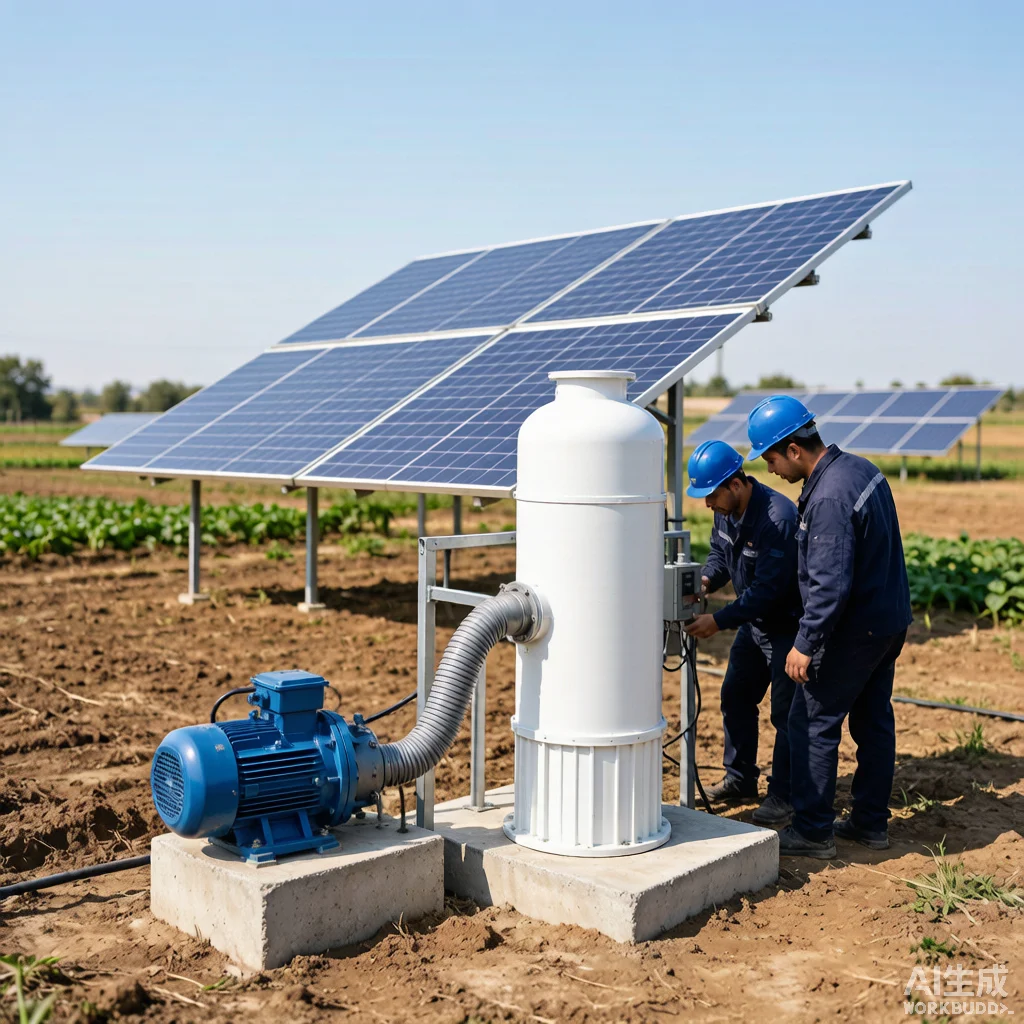
Solar panels are the fuel tank of a solar water pump system—get the sizing wrong, and you either overspend on unnecessary capacity or starve your pump of the power it needs. Unlike grid-connected solar installations where panel quantity is primarily an economic optimization, solar pump panel sizing directly determines daily water output. Too few panels, and your pump fails to meet water demand during critical irrigation windows. Too many, and you waste capital that could have funded additional water infrastructure. For procurement managers and project engineers, understanding the relationship between panel wattage, voltage configuration, and pump performance is essential to delivering systems that meet specification at minimum cost. Manufacturers such as KINBO provide detailed panel sizing recommendations matched to each pump model.
Table of Contents
Calculating Required Panel Wattage
The fundamental formula is: Panel Wattage = (Pump Power in Watts × 1.3) ÷ System Efficiency. The 1.3 multiplier accounts for real-world conditions: panel temperature derating (panels lose 0.3-0.5% efficiency per degree above 25°C), dust accumulation, wiring losses, and controller conversion losses. For a 3 kW pump with 90% system efficiency: (3,000 × 1.3) ÷ 0.90 = 4,333 watts of panel capacity required. This translates to approximately 8-9 panels at 550W each—the current industry standard for large-format modules used in solar pumping applications.
Voltage Configuration: Series vs Parallel
The panel array must deliver voltage within the pump controller’s MPPT input window. A controller with a 90-380V DC input range accepts various series-parallel configurations. Series connections add voltage, parallel connections add current. For a 3 kW pump with a 200-380V MPPT range and 550W panels (Voc=50V, Vmp=42V), 8 panels in series produce 336Vmp—comfortably within range. For sites with partial shading from trees or buildings, split the array into two parallel strings of 4 panels each to prevent one shaded panel from reducing the entire array’s output.
Panel Sizing Reference by Pump Power
| Pump Power | Min Panel Wattage | Recommended Panels (550W) | Typical Configuration | Array Area (m²) |
|---|---|---|---|---|
| 0.75 kW | 1,100 W | 2-3 | 3S (126V) | ~8 |
| 1.5 kW | 2,200 W | 4-5 | 5S (210V) | ~13 |
| 3.0 kW | 4,300 W | 8-9 | 8S (336V) | ~22 |
| 5.5 kW | 7,900 W | 15-16 | 2P8S (336V) | ~39 |
| 7.5 kW | 10,800 W | 20-22 | 2P10S (420V) | ~52 |
Note: All configurations assume 550W mono PERC panels, Voc=50V, Vmp=42V. Adjust for different panel specifications.
Mounting and Orientation Best Practices
Panel tilt angle should equal the site latitude for year-round pumping. For seasonal irrigation (dry season only), tilt at latitude minus 10° to optimize for the higher sun angle during summer months. In the Southern Hemisphere, panels face true north; in the Northern Hemisphere, true south—not magnetic. A fixed ground-mount structure with concrete footings is standard for agricultural installations. Allow 1.5-meter clearance between panel rows to prevent self-shading during winter when the sun is low. See our complete panel configuration guide for detailed mounting specifications.
Frequently Asked Questions
Q: Can I add panels later if water demand increases?
A: Yes, if your pump controller’s MPPT input range has headroom. Check the maximum DC input voltage specification. If the existing string voltage is near the upper limit, add panels in a parallel string rather than extending the series string. This increases current without exceeding voltage limits.
Q: Should I use mono or polycrystalline panels for solar pumping?
A: Mono PERC panels are preferred for solar pumping due to their higher efficiency (21-23% vs 18-20% for poly), better low-light performance, and lower temperature coefficient. In space-constrained installations, the 15-20% efficiency advantage of mono panels translates directly to more water per square meter of array area.
Q: How much does panel soiling reduce output, and how often should I clean?
A: Dust accumulation reduces output by 3-5% per month in agricultural environments, potentially reaching 15-20% during dry seasons without rainfall. Clean panels every 4-6 weeks during dry periods using water and a soft brush. Automated cleaning systems are cost-effective for arrays above 5 kW in dusty regions.
For B2B buyers specifying solar panel arrays for water pumping projects, contact KINBO for matched panel-pump packages with optimized voltage configuration and competitive FOB pricing.
Related Articles
- Configure Solar Panels for Water Pump Systems
- How to Choose the Right Solar Water Pump Model
- Explore KINBO Solar Submersible Pumps