Solar Pump Thrust Bearing Design: Load Calculation and Material Selection
Introduction
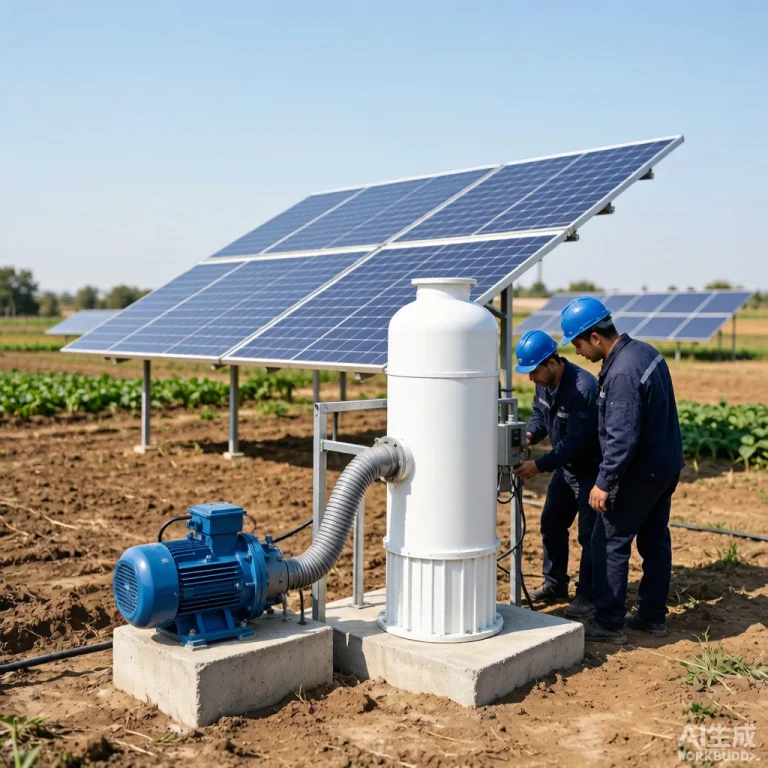
KINBO solar pumps use water-lubricated thrust bearings engineered for the high axial loads typical of deep-well submersible applications.
Table of Contents
Axial Load Calculation
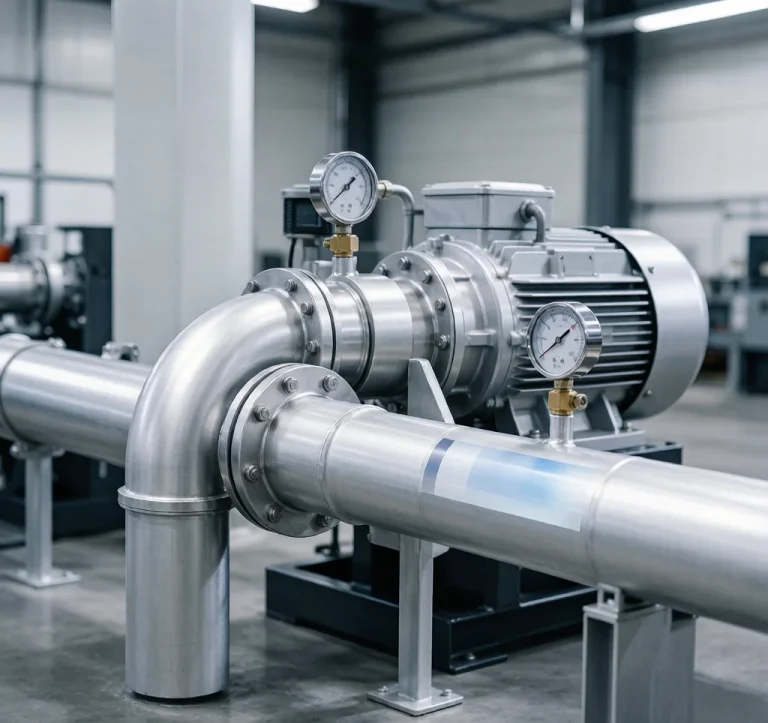
The thrust bearing in a submersible pump carries the total axial load from the pump’s hydraulic thrust plus the weight of the rotating assembly. Hydraulic thrust is calculated as: F = P × A, where P is the pressure differential across the impeller stages and A is the effective impeller area. For a 10-stage pump delivering 80 meters of head with 100mm impellers, axial hydraulic thrust is approximately 6,200 N. Adding the rotor weight of 800 N gives a total bearing load of 7,000 N—equivalent to supporting 700 kg on a bearing surface smaller than a coin.
The bearing’s specific load (load per unit area) must not exceed the material’s PV limit (pressure × velocity product). For water-lubricated carbon-graphite bearings, the PV limit is approximately 1.75 MPa·m/s. Exceeding this limit causes rapid wear, bearing seizure, and catastrophic pump failure within hours.
Bearing Material Selection
Water-lubricated bearings use the pumped water as both lubricant and coolant, eliminating oil lubrication systems that can leak and contaminate the water source. Carbon-graphite is the standard material for clean water applications. For sandy water, silicon carbide-faced bearings provide 3-5x longer life at 2-3x the cost. For high-temperature geothermal applications above 60°C, PTFE-based composite bearings maintain dimensional stability where carbon-graphite would degrade.
| t | a | b | l | e | |||||||||||
|---|---|---|---|---|---|---|---|---|---|---|---|---|---|---|---|
| B | e | a | r | i | n | g | M | a | t | e | r | i | a | l | |
| P | V | L | i | m | i | t | |||||||||
| M | a | x | T | e | m | p | e | r | a | t | u | r | e | ||
| S | a | n | d | T | o | l | e | r | a | n | c | e | |||
| R | e | l | a | t | i | v | e | C | o | s | t |
[[‘Carbon-Graphite’, ‘1.75 MPa·m/s’, ’90°C’, ‘Low (<50 ppm)', '1.0x'], ['Silicon Carbide', '3.5 MPa·m/s', '200°C', 'High (<200 ppm)', '2.5x'], ['PTFE Composite', '1.2 MPa·m/s', '120°C', 'Low-Moderate', '1.5x'], ['Tungsten Carbide', '4.0 MPa·m/s', '300°C', 'Very High', '4.0x']]
Frequently Asked Questions
Q: How often do thrust bearings need replacement?
A: In clean water (sand below 50 ppm), carbon-graphite bearings typically last 20,000-30,000 operating hours (5-8 years at 8 hrs/day). In sandy water, silicon carbide bearings can extend this to 40,000+ hours.
Q: What are the signs of thrust bearing wear?
A: Gradual increase in motor current at the same flow rate (typically 5-15% increase), increased vibration, and audible bearing noise transmitted through the drop pipe. These symptoms develop over weeks, providing time for scheduled maintenance before catastrophic failure.
Q: Does bearing material choice affect pump efficiency?
A: Slightly. Lower-friction bearing materials (silicon carbide, PTFE) reduce mechanical losses by 1-3% compared to carbon-graphite. For a 5 kW pump, this translates to 50-150W savings—approximately 1-3 additional solar panels’ worth of power over the pump’s lifetime.
For B2B engineers specifying pumps for challenging operating conditions, contact KINBO for bearing specification options.
Related Articles