Solar Water Pumps for Community and Village Water Supply: Design and Case Study
Introduction
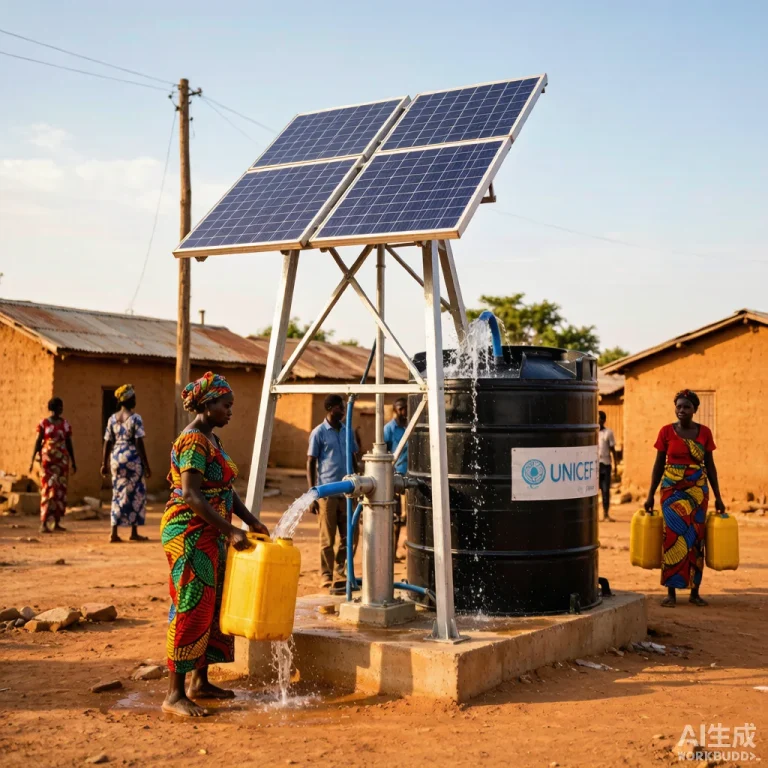
Reliable drinking water is the first test of any rural development project, and diesel carting or hand-pumps fail it on cost, labour, or uptime. A solar water pump turns idle sunshine into a permanent village supply with no fuel bill and almost no moving parts to break. KINBO has equipped villages from sub-Saharan Africa to Southeast Asia, and the design rules are surprisingly repeatable: size the daily demand, lift it once to an elevated tank, and let gravity do the rest. This article walks through demand calculation, system architecture, a real 500-person case, and the O&M habits that keep a community system running for 15 years.
Step 1: Calculate Daily Demand
Start from people, not from pump curves. A practical planning figure is 20–40 L per person per day for drinking and cooking, plus livestock and small gardens if the system serves them. For a village of 500:
- Human demand: 500 × 30 L = 15,000 L/day (15 m³).
- Livestock: 50 cattle × 40 L = 2,000 L/day (2 m³).
- Peak buffer: size the tank for 1.5× daily demand to ride cloudy days.
Total design flow ≈ 17 m³/day. At 6 h of strong sun, the pump must deliver about 2.8 m³/h — a modest duty a small submersible handles easily.
Step 2: System Architecture
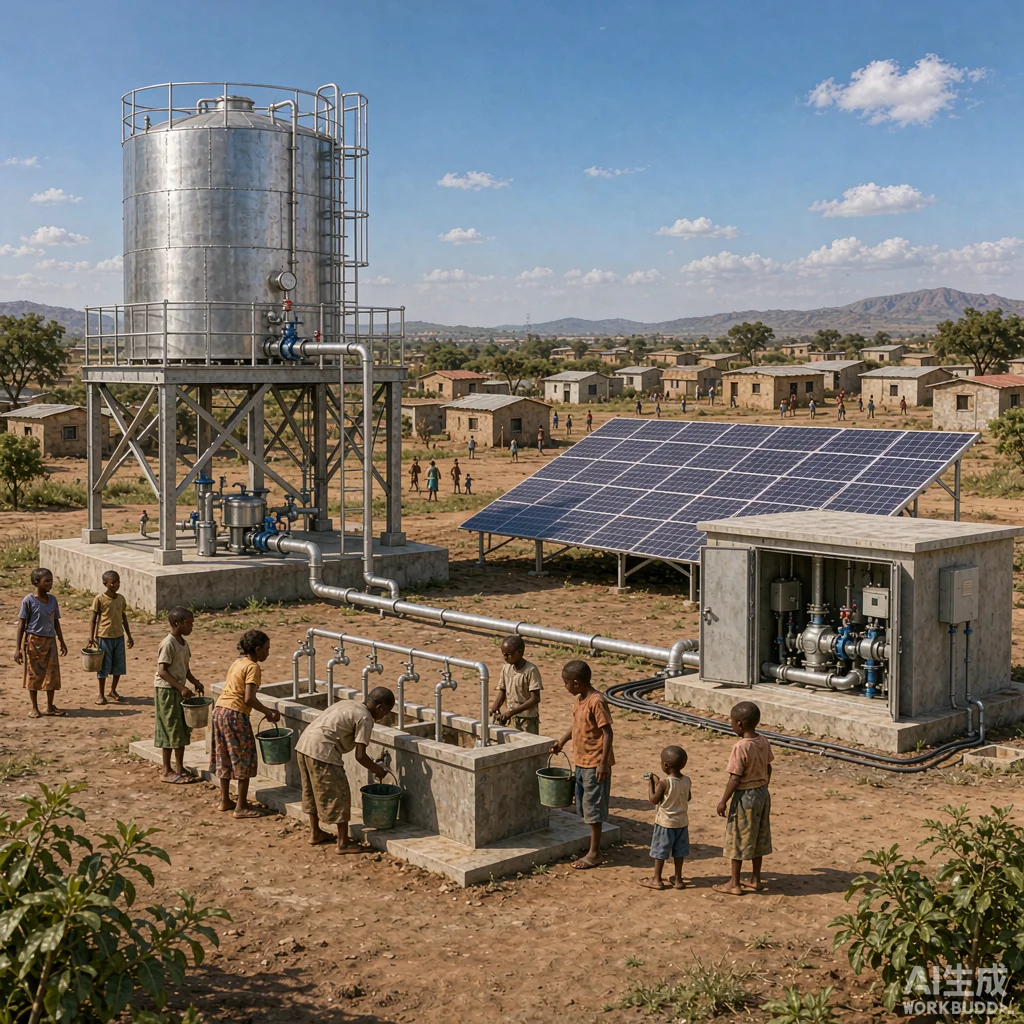
The robust village layout is a one-stage lift to an elevated tank, then gravity distribution:
| Component | Role | Typical spec |
|---|---|---|
| Solar submersible pump | Lift water from well to tank | 1.5–3 kW |
| PV array | Power the pump by day | 3–5 kWp |
| Elevated tank | Storage + pressure | 10–30 m³ |
| Distribution network | Gravity to tap stands | HDPE, 30–60 m head |
| Controller + protecs | Dry-run, surge, lightning | MPPT, IP65 |
No battery is needed: the tank is the storage. This is the single biggest cost saver versus a battery-backed design.
Submersible vs Surface Pump
Village wells are usually deep (30–100 m), which points to a submersible. A surface (centrifugal or helical) pump suits shallow wells, rivers, or ponds under 15 m. For most community supplies the choice is:
- Submersible – deep boreholes, higher head, concealed and safe from tampering.
- Surface – shallow sources, easier service, cheaper but exposed.
Match the pump to the static water level plus drawdown, not to the ground surface, or it runs dry and burns out. Our system design guide covers head measurement in detail.
Case Study: A 500-Person Village
A Sahel village of 500 drew water by diesel carting at $0.06/L delivered — about $1,100/yr — and still ran short in dry season. KINBO installed:
- Well depth 60 m, static level 45 m, total dynamic head ~65 m.
- Solar submersible pump, 2.2 kW, 3 m³/h at 65 m.
- PV array 3.6 kWp on a ground frame.
- 20 m³ elevated steel tank (1.3-day buffer).
- HDPE network to 4 tap stands.
| Item | Cost (USD) |
|---|---|
| Pump + controller + array | $3,400 |
| Tank + tower | $1,600 |
| Network + taps + labour | $1,800 |
| Turnkey | $6,800 |
| Annual diesel carting avoided | −$1,100/yr |
| Annual service | $80/yr |
| Simple payback | ~6.5 yr |
Community supply pays back slower than irrigation because the duty is smaller, but a local subsidy or carbon credit typically cuts payback to 3–4 years; the uptime and health gain are the real return.
Operation and Maintenance
- Monthly – visual check of array, tank level, tap flow.
- Quarterly – clean panels, inspect controller indicator, test dry-run cutout.
- Annual – desludge well, verify pressure, tighten mounts.
- Community rule – a trained local operator owns the key; a small tariff covers spares.
A village that funds one operator and a tiny water tariff keeps the system alive for its full 15-year design life. Theft and neglect, not equipment failure, are the top causes of abandoned systems.
FAQ
How big a tank does a village need?
Size for 1–1.5 days of demand. A 500-person village at 30 L/day needs roughly 15–22 m³. The tank also smooths cloudy-day gaps without any battery.
Can the system run at night?
Only from the tank. Pump by day, draw by gravity at night. If 24/7 pressure is required, add a small DC booster or a battery — but most villages do not need it.
What if the well is shallow?
Use a surface pump and save on submersible cost. Confirm the static level stays above the pump intake during the dry season to avoid dry running.
Who maintains it after instalment?
A trained local operator plus a micro-tariff. KINBO supplies a spare-parts kit and a one-page checklist in the local language at handover.