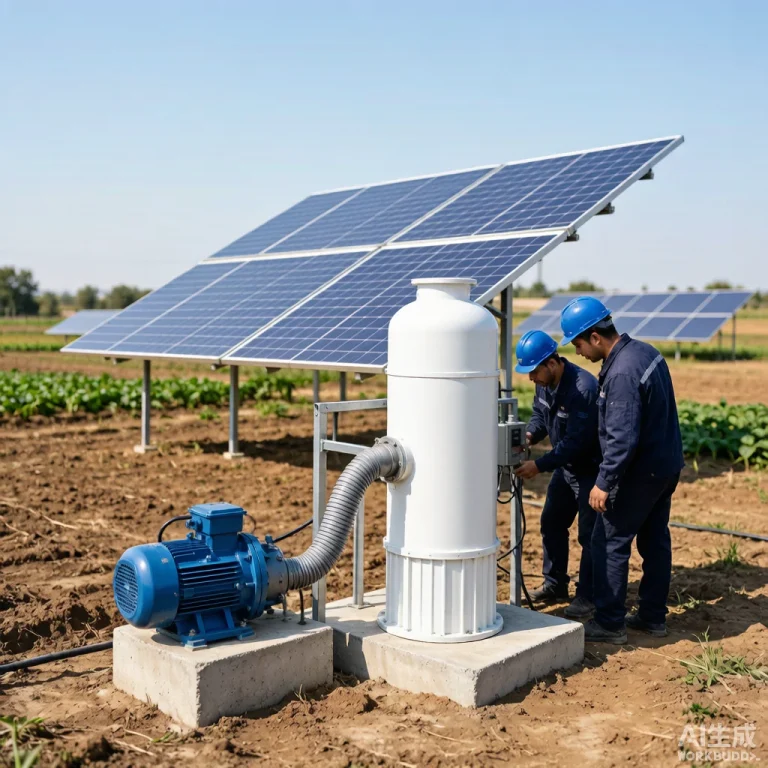
Dust & Heat Protection for Gold-Mine Solar Pumps in Niger: Survive the Sahel
Introduction
In the Sahel, heat and dust kill electronics faster than anything else. This article covers dust and heat protection for gold-mine solar pumps, using Niger’s Sahara-edge mines around Agadez and Tillabéri as the worked example, written by the solar-pumping specialists at KINBO. At 45–50°C with blowing sand, a controller in an open box is a countdown timer; proper enclosures and cooling are what let a system run for years. This is the environmental companion to our installation guide.
Table of Contents
Why Protection Matters
- Heat shortens electronics—every 10°C over rating roughly halves component life; a hot controller fails early.
- Dust conducts and clogs—fine sand bridges terminals and chokes passive heatsinks, driving temperatures higher still.
- UV and thermal cycling—cable and gasket degrade under relentless sun and day-night swings.
- Derating protects output—a correctly cooled system holds rated flow; an overheating one trips and loses the day’s water.
Niger Site Conditions
Niger’s gold—concentrated around Agadez and Tillabéri in the Sahel at the edge of the Sahara—is mined off-grid under some of the harshest conditions in Africa. Our dewatering guide, process-water guide and remote-monitoring guide frame the duties; here the environment itself is the design constraint, so enclosures and cooling come first.
Dust & Heat Protection, Step-by-Step
- Seal the controller—use at least an IP65 enclosure with proper cable glands so sand cannot reach the electronics.
- Cool passively first—mount on a shaded, ventilated wall or frame; use a heatsink or thermally conductive base rather than a sealed oven.
- Ventilate with filtered air—where active cooling is needed, draw air through a dust filter and maintain positive pressure to keep grit out.
- Choose UV-stable cable—use UV-rated, high-temperature insulation and bury or shield runs exposed to the sun.
- Mount the array for airflow—tilt and stand the panels off the ground so heat sheds and sand does not accumulate underneath.
- Derating and shade—size the system with a heat margin and provide controller shade so it never cooks at peak sun.
Good vs Poor Protection
| Aspect | Good protection | Poor protection |
|---|---|---|
| Enclosure | IP65, glanded | Open box |
| Cooling | Ventilated, shaded | Sealed in sun |
| Cable | UV-rated, buried | Exposed, brittle |
| Result | Years in the Sahel | Fails in a season |
For keeping an eye on a hot, remote site, our remote-monitoring guide shows how to catch overheating before it trips the pump.
Frequently Asked Questions
Is a sealed box enough to protect the controller?
A sealed box keeps dust out but traps heat; pair IP65 sealing with shading and ventilation so the electronics stay cool, not cooked.
How hot is too hot for a solar pump controller?
Most rated electronics are comfortable to about 40–45°C ambient; above that, derating and active cooling protect both life and output.
Does dust really get inside a closed enclosure?
Fine Sahel sand does, through unfiltered vents and loose glands; proper IP65 glands and filtered airflow are what stop it.
How do I start a heat-and-dust-protected solar pump project in Niger?
Describe your Agadez or Tillabéri site’s sun and sand exposure, and we size the system and the enclosures together—our installation guide covers commissioning the cooling.
Related Articles
- Solar Pump Installation & Commissioning for Gold Mines
- Remote Monitoring for Gold-Mine Solar Pumps
- Gold Mine Solar Pump Sizing Methodology
- Explore KINBO Solar Pump Products
Get a Heat- and Dust-Protected Solar Pump System for Your Niger Gold Mine
Tell KINBO your Agadez or Tillabéri site’s exposure—relentless sun, blowing sand, no grid—and we will specify a solar pump system built to survive the Sahel. Contact our team for a tailored quote.
Published by KINBO · September 30, 2026 · Category: Application Cases