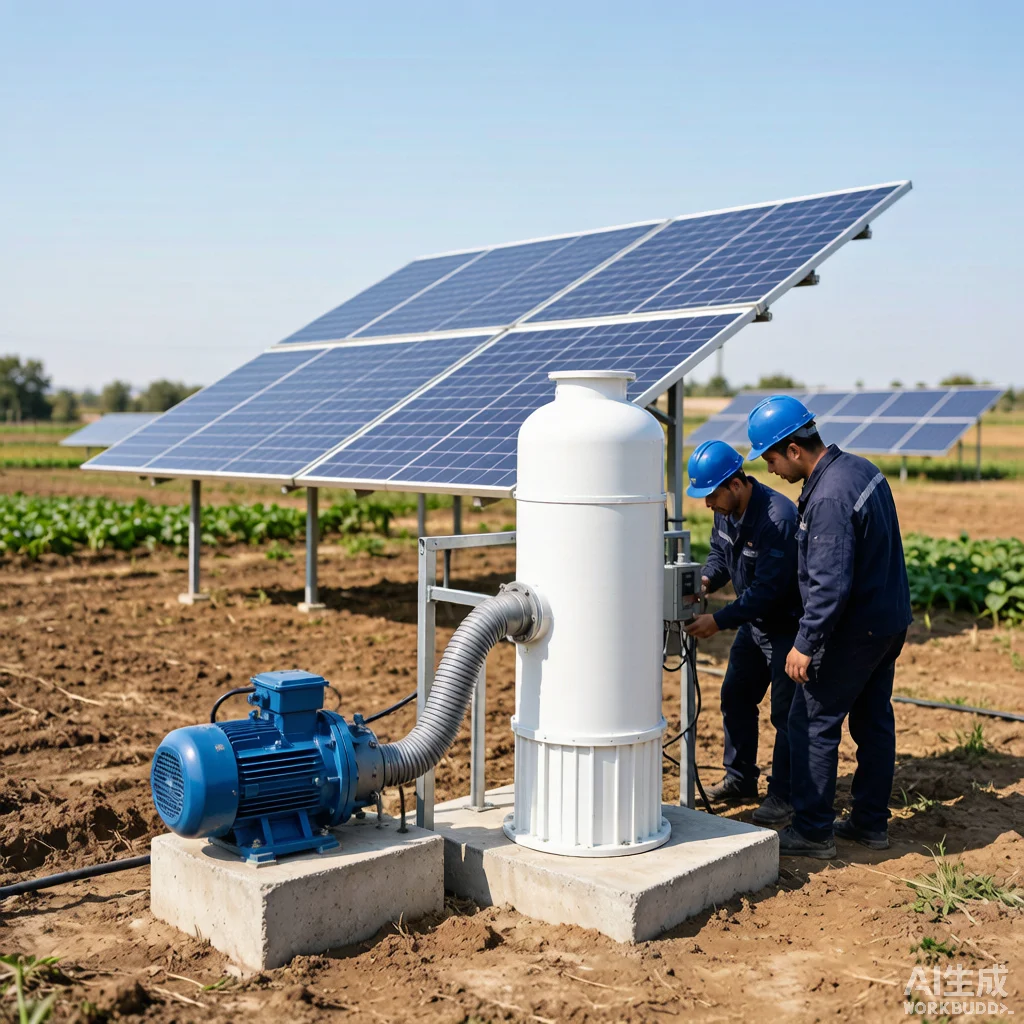
Solar Pumps for Golf Course and Sports Turf Irrigation
Introduction
Golf courses and sports turf facilities represent one of the most demanding applications for irrigation pumping — combining high instantaneous flow rates, multi-zone distribution complexity, and often unfavorable electricity tariff structures. An 18-hole championship course in a temperate climate typically consumes 1,500–3,000 m³ of irrigation water per day during peak summer months, with flow requirements of 80–150 m³/h to cycle through irrigation zones within the available watering window. The energy cost of running 30–75 kW grid-connected pump stations for 12–18 hours daily represents a significant and rising operational expense. KINBO has been at the forefront of adapting solar photovoltaic pumping technology to meet the specific demands of turf irrigation — an application that, a decade ago, was widely considered beyond the practical reach of solar-powered systems. This article examines the technical and economic parameters that now make solar pumping viable for golf courses, covering water requirement modeling across irrigation zones, multi-pump sizing with comparative performance data, integration pathways with existing central control systems, and a detailed return-on-investment case study for an 18-hole course retrofit.
Table of Contents
Golf Course Water Requirements and Irrigation Zones
A golf course is not a single irrigation zone — it is a mosaic of distinct turf areas with dramatically different water demands, soil profiles, and irrigation infrastructure. Understanding this heterogeneity is prerequisite to sizing a solar pump system that can efficiently serve the entire facility without costly oversizing.
Greens (typically 1–1.5 hectares per 18-hole course) demand the highest irrigation precision and frequency. Constructed on sand-based root zones with 85–95% sand content for drainage, greens have low water-holding capacity (8–12% volumetric water content at field capacity) and require light, frequent applications — often 3–6 mm per day in 2–3 cycles during summer. This translates to 30–90 m³/day for all greens combined, delivered at 15–30 m³/h through dedicated pump stations or zone valves.
Tees and fairways (8–16 hectares combined) represent the largest irrigated area. Fairways are typically irrigated every 2–4 days with 15–25 mm per application, translating to a daily equivalent of 5–8 mm. For a 12-hectare fairway complex, this means 600–960 m³/day at peak demand. Flow requirements depend on the number of sprinkler heads operating simultaneously — a typical fairway irrigation block of 1.5–2 hectares with rotor sprinklers delivering 8–12 mm/hour requires 30–50 m³/h per block.
Roughs and native areas (15–30 hectares) may receive minimal or no supplemental irrigation, depending on climate and course philosophy. Where irrigated, applications are infrequent (weekly or bi-weekly deep watering) and can be scheduled during off-peak hours.
The aggregate peak-day water demand for a well-maintained 18-hole course in a Mediterranean or continental climate (annual rainfall 400–800 mm) falls in the range of 1,800–3,200 m³/day. Annual irrigation volumes range from 120,000–350,000 m³ depending on climate, turfgrass species (cool-season vs warm-season), and irrigation efficiency. Cool-season grasses (bentgrass, ryegrass, Kentucky bluegrass) typically require 20–40% more water than warm-season species (Bermudagrass, zoysia, seashore paspalum) due to higher evapotranspiration rates and shallower root systems.
Solar Pump Sizing for Multi-Zone Turf Systems
Golf course irrigation differs from agricultural pumping in one critical respect: the system must deliver high flow rates (60–150 m³/h) against moderate to high head (40–80 meters) for relatively short daily durations (8–14 hours during summer), while operating across widely varying zone hydraulic characteristics. A single oversized pump would operate at poor efficiency across most zones; multiple smaller pumps provide better part-load performance but higher capital cost. The sizing methodology must balance these trade-offs against the available solar window.
| Configuration | Pump Capacity | Solar Array (kWp) | Daily Flow at 6 PSH | Part-Load Efficiency | Installed Cost (USD) |
|---|---|---|---|---|---|
| Single large pump | 30 kW (40 HP) | 45–52 | 1,800–2,400 m³ | 55–88% | $38,000–$48,000 |
| Dual parallel (2 × 15 kW) | 2 × 22 kWp each | 44–50 | 1,800–2,300 m³ | 68–91% | $42,000–$52,000 |
| Triple cascade (7.5+15+22 kW) | 20+20+26 kWp | 48–55 | 1,900–2,500 m³ | 74–92% | $48,000–$58,000 |
| Four-pump VFD array (4 × 7.5 kW) | 4 × 11 kWp each | 44–50 | 1,700–2,200 m³ | 76–93% | $52,000–$62,000 |
Notes: Pricing based on 2026 equipment costs for three-phase 380-480V AC solar pump systems with MPPT controllers, excluding civil works and distribution piping. PSH = peak sun hours (equivalent full-sun hours per day). Part-load efficiency range represents 20-100% of rated flow.
The dual parallel configuration (2 × 15 kW) typically represents the optimal balance for mid-size courses (70–120 m³/h peak demand). It provides acceptable part-load efficiency when a single pump operates at 50–70% speed during night irrigation or shoulder-season watering, while delivering full design flow with both pumps during peak summer daytime irrigation blocks. The 6–10% capital cost premium over a single large pump is recovered within 18–24 months through improved wire-to-water efficiency — each percentage point of system efficiency improvement on a 30 kW system running 2,000 hours annually saves approximately 600 kWh/year, worth $60–$90/year at commercial electricity rates.
For championship courses with peak demand above 120 m³/h, the triple cascade configuration becomes preferable, offering the widest efficiency plateau across the full operating envelope. KINBO’s approach to course-specific sizing begins with a detailed hydraulic model of all irrigation zones — including static head, friction losses through laterals and mainlines, and sprinkler operating pressure requirements — then optimizes the pump count and rating to maximize annual weighted efficiency.
Integration with Existing Irrigation Control Systems
Most golf courses already operate sophisticated central control systems — Toro SitePro, Rain Bird Cirrus/Nimbus II, or Hunter IMMS — that manage irrigation scheduling, zone sequencing, and flow monitoring. A solar pump retrofit must integrate seamlessly with these existing control architectures, not replace them. The integration point is typically at the pump start relay or variable frequency drive (VFD) interface, where the irrigation controller’s demand signal triggers pump operation.
Interface architectures fall into three tiers of integration depth:
Tier 1 — Basic relay interface: The simplest and most common approach. The irrigation controller’s pump start relay (typically a dry contact closure) signals the solar pump controller to begin operation. The solar VFD ramps the pump to a pre-set speed or pressure setpoint. Flow variation across zones is accommodated by the VFD’s PID pressure control loop, which adjusts pump speed to maintain constant discharge pressure as zone valves open and close. This approach works well for courses with relatively uniform zone hydraulics (zone-to-zone pressure drop variation within 15–20%). Installation requires minimal control system modification — essentially connecting two wires from the existing pump start circuit to the solar VFD’s remote start terminals.
Tier 2 — Modbus/BACnet integration: For courses with highly variable zone characteristics, the solar pump controller communicates bidirectionally with the central irrigation system via Modbus RTU (RS-485) or BACnet IP. The central controller transmits the active zone configuration (which valves are open, target flow rate) to the solar pump controller, which pre-positions pump speed and, in multi-pump systems, selects the optimal pump combination before flow begins. During operation, the pump controller reports real-time power draw, estimated flow, and DC bus voltage to the central system for logging and alarm management. This integration level reduces pressure transients during zone changes by 70–85% compared to simple PID response, minimizing stress on piping and sprinkler heads.
Tier 3 — Full SCADA integration: At the highest tier, the solar pump system becomes a node on the course’s overall energy management SCADA. This enables predictive pump scheduling based on next-day solar irradiance forecasts: if tomorrow is forecast at 7.2 PSH versus today’s 4.8 PSH, the system can defer non-critical irrigation (roughs, practice areas) to the high-irradiance day and prioritize greens and tees today. A 2025 pilot installation at a resort course in Southern Spain using this approach reduced grid electricity consumption by an additional 18% over Tier 2 integration, beyond the primary solar displacement.
Regardless of integration depth, all KINBO solar pump controllers include a dry-contact “grid fallback” relay output. If solar irradiance drops below the threshold required to maintain minimum system pressure (typically set at 80% of design operating pressure for 10+ continuous minutes), the controller automatically switches the pump supply to grid power and sends an alert to the course superintendent’s mobile device. This ensures uninterrupted irrigation even during unexpected cloud events.
ROI Case Study: 18-Hole Course Solar Retrofit
The following case study models a representative solar pump retrofit for an 18-hole championship course in a continental climate zone (annual rainfall 550 mm, 5.2 PSH annual average, 6.8 PSH summer peak). All financial figures are in 2026 U.S. dollars.
Baseline System:
- Existing pump station: 2 × 22 kW (30 HP) end-suction centrifugal pumps, grid-powered, manual changeover
- Annual irrigation volume: 210,000 m³
- Average total dynamic head: 62 meters
- Annual electricity consumption: 78,400 kWh
- Electricity tariff: $0.14/kWh (commercial rate, including demand charges)
- Annual energy cost: $10,976
Solar Retrofit Design:
- Configuration: Dual parallel 15 kW solar pumps with shared DC bus and MPPT controllers
- Solar array: 42 kWp (105 × 400 W monocrystalline panels, ground-mount fixed-tilt at 28°)
- Grid interconnection: Hybrid configuration — solar-primary with automatic grid fallback
- Storage: None (direct solar-to-pump with grid supplement for night irrigation)
- Annual solar energy contribution (modeled): 58,600 kWh (75% of total pumping energy)
- Remaining grid consumption: 19,800 kWh/year
Investment and Returns:
| Cost Item | Amount (USD) |
|---|---|
| Solar PV array (42 kWp, including mounting structure) | $16,800 |
| Dual 15 kW solar pump sets with MPPT/VFD controllers | $18,500 |
| DC cabling, combiner boxes, disconnects, surge protection | $4,200 |
| Installation labor, commissioning, controls integration | $8,500 |
| Grid fallback ATS and electrical interconnection | $3,800 |
| Total Installed Cost | $51,800 |
Annual Savings:
- Grid electricity displaced: 58,600 kWh × $0.14/kWh = $8,204/year
- Reduced demand charges (lower peak grid draw): ±$1,200/year
- Reduced pump maintenance (lower runtime hours on grid pump): ±$600/year
- Total annual savings: ±$10,004/year
Financial Metrics:
- Simple payback: 5.2 years
- 20-year net present value (5% discount rate): $72,400
- Internal rate of return (IRR): 18.7%
- Levelized cost of water delivered: $0.041/m³ (solar) vs $0.052/m³ (grid)
- CO₂ emissions reduction: 41.6 metric tons/year (based on grid emission factor 0.71 kg CO₂/kWh)
This payback period is conservative — it assumes no increase in grid electricity tariffs over 20 years. At a 4% annual tariff escalation rate (consistent with 20-year historical averages in most markets), the simple payback drops to 4.1 years and the 20-year NPV exceeds $110,000. Courses in regions with higher electricity rates ($0.20–$0.30/kWh, common in Southern Europe, Australia, and parts of the Middle East) can achieve payback in 2.5–3.5 years. Additionally, many jurisdictions offer renewable energy incentives, accelerated depreciation for solar assets, or feed-in tariff programs that further improve project economics. KINBO provides detailed site-specific ROI modeling as part of the project quotation process, incorporating local tariff structures, solar resource data (from NASA POWER or Solargis databases), and course-specific hydraulic parameters.
Frequently Asked Questions
Q: Can solar pumps meet the high flow demand of golf course irrigation?
A: Yes — modern solar pump systems using parallel multi-pump configurations and VFD control can reliably deliver the 80–150 m³/h flow rates required by 18-hole courses. The key enabling technologies are: (1) high-voltage DC bus architectures (600–800 VDC) that reduce cable losses from the solar array to the pump station, enabling array placement up to 300–500 meters from the pump location with less than 2% voltage drop; (2) modular VFD controllers rated to 45–75 kW that accept direct DC input from the solar array without an intermediate battery or AC inversion stage, achieving 96–98% DC-to-AC conversion efficiency; and (3) intelligent pump staging algorithms that activate additional pumps as solar irradiance rises and deactivate them as it falls, matching pump capacity to available solar power in real time. A typical 42 kWp array can deliver 120–160 m³/h at 60 meters TDH during the 4–5 hour peak solar window (10:00–15:00), sufficient for the primary daily irrigation cycle. The remaining water volume — typically 20–35% of daily requirement for early-morning or evening irrigation blocks — is handled by grid fallback or, where site conditions permit, by pumping into elevated storage during peak solar hours and gravity-distributing during off-solar periods. Course superintendents who have adopted solar pumping consistently report that the technology meets or exceeds their irrigation performance requirements, with the primary adjustment being a shift in scheduling philosophy toward solar-hour prioritization for the highest-volume irrigation blocks.
Q: How do you handle night irrigation with solar?
A: Night irrigation — preferred by many superintendents to minimize evaporation losses, reduce wind drift, and avoid player disruption — presents an obvious challenge for direct solar pumping since no power is generated after sunset. Three strategies address this, often in combination: (1) Pumped storage: During daylight hours, the solar array drives pumps that fill an elevated storage pond or tank (typically 500–2,000 m³ for an 18-hole course). At night, gravity or a smaller grid-powered booster pump distributes the stored water through the irrigation system. This decouples pumping from irrigation timing entirely and is the preferred approach for new-build courses or courses with existing water storage features. Capital cost for a 1,500 m³ lined reservoir with floating cover is $25,000–$45,000 in most markets. (2) Hybrid grid-solar operation: The solar system handles daytime irrigation blocks (typically 08:00–16:00, covering 65–75% of daily volume), while night irrigation blocks draw grid power through an automatic transfer switch. This is the lowest-capital approach and the most common retrofit pathway, as it requires no storage infrastructure. (3) Battery-buffered solar: A lithium battery bank (30–60 kWh for a mid-size course) charges during the day and discharges at night to power the pump. While technically feasible, this approach is rarely cost-effective for golf courses — battery storage sufficient to power a 30 kW pump for 4 hours costs $35,000–$60,000, more than double the cost of pumped storage for equivalent energy throughput and with a 10–12 year replacement cycle versus 25+ years for a reservoir. KINBO recommends pumped storage for courses with available land and hybrid operation for courses with space constraints or existing effective grid supply.
Q: What is the typical payback for a golf course solar pump conversion?
A: Payback periods for golf course solar pump retrofits fall into three tiers depending on local electricity costs and available solar resource: (1) Fast payback (2.5–4 years): Courses in high-electricity-cost regions ($0.20–$0.35/kWh — common in Southern Europe, Australia, Japan, and island nations) with good solar resource (5.0+ PSH). These projects typically achieve IRR above 25% and generate positive cash flow from year three or four onward. (2) Moderate payback (4–7 years): Courses with mid-range electricity rates ($0.10–$0.20/kWh) and adequate solar resource (4.0–5.0 PSH). This represents the majority of economically viable projects and aligns with the 5.2-year payback in our 18-hole case study above. IRR typically falls in the 14–20% range. (3) Extended payback (7–12 years): Courses with low electricity rates (below $0.10/kWh) or marginal solar resource (below 4.0 PSH). These projects may still be viable when considering non-energy benefits: insulation from future tariff increases, sustainability certification requirements (Audubon Cooperative Sanctuary, GEO Certified), marketing value for eco-conscious members and tournament hosts, and reduced maintenance on primary grid-powered pump sets that see dramatically lower annual runtime hours. The most important variable driving payback is not equipment cost — solar pump system pricing has been relatively stable — but electricity tariff trajectory. Courses that locked in solar pump retrofits in 2022–2023 at $0.12/kWh rates have seen their effective payback period shorten by 25–35% as commercial electricity rates have risen 30–60% in many markets over the same period. KINBO’s project engineering team can prepare a site-specific financial model including local tariff structures, solar irradiance data, and available incentive programs — contact us at the link below to initiate a feasibility assessment.
Ready to evaluate solar pumping for your golf course or sports turf facility? Contact the KINBO engineering team for a detailed site-specific feasibility analysis and ROI projection — no obligation, no upfront cost.