Solar Water Pumps for Palm Oil Plantation: Sustainable Water Management in Tropical Estates
Introduction
A commercial oil palm estate balances three very different water needs: nursery irrigation for seedlings, processing water for the mill, and dust and road control across vast planted areas. Diesel pumping across thousands of hectares is expensive and logistically fragile, especially in remote tropical regions. Forward-looking estates are turning to solar water pumps to stabilize supply and cut operating cost. KINBO has deployed solar pumping packages on tropical plantations where reliable off-grid water movement is the difference between a productive cycle and a stalled one, and the economics are compelling when spread across a full growing season.
Table of Contents
Three Water Demands on a Palm Oil Estate
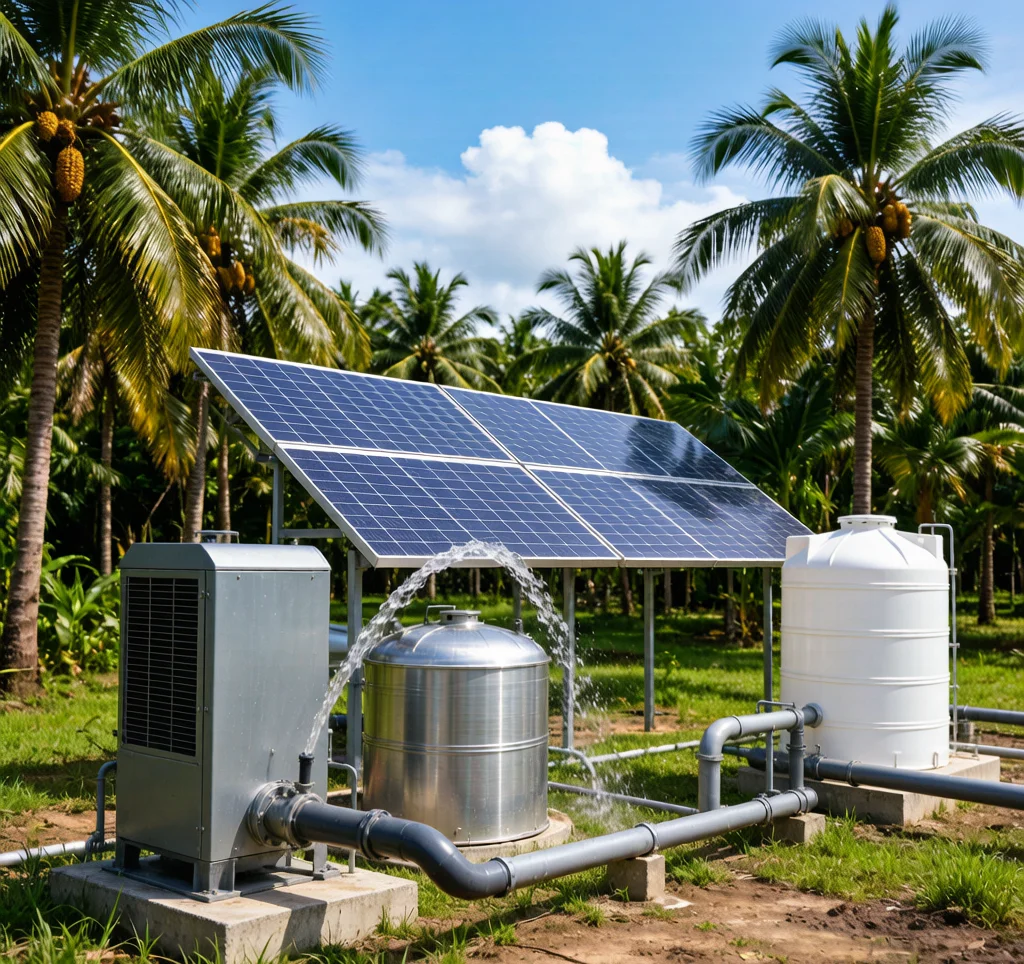
Palm oil water requirements are often underestimated. The nursery alone needs frequent light irrigation for thousands of polybags; the mill consumes process water for clarification and cooling; and estate roads require periodic watering for dust suppression. Each demand has a different flow and pressure profile, so a single oversized pump rarely serves them all efficiently. The practical solution is to zone the estate and match each zone to the right solar pump configuration.
| Demand | Flow Need | Head Need | Recommended Setup |
|---|---|---|---|
| Nursery irrigation | Low–medium, frequent | 10–25 m | Submersible + drip zone |
| Mill process water | Medium, steady | 15–30 m | Surface pump + tank |
| Dust & road control | High, intermittent | 20–40 m | High-head surface pump |
Designing the Solar Pump System
Good design starts with a daily water budget per zone and the local peak sun hours, which in equatorial plantations often exceed five hours. From there, hydraulic power converts to PV capacity, and a matched MPPT controller keeps the pump on its best efficiency curve as irradiance swings through the day. For estates drawing from a river or canal, a surface pump with a robust strainer avoids the retrieval cost of a buried submersible. KINBO field teams typically reference our advantages of solar irrigation pumps when benchmarking against diesel for the client’s finance team.
Case Study: 800-Hectare Estate in Southeast Asia
An 800-hectare estate replaced three diesel sets with four solar pumping stations: two for nursery and field irrigation, one for mill process water, and one for road dust control. Combined PV capacity was 18 kWdc feeding submersible and surface pumps through a shared controller topology. Over a 12-month observation the estate recorded the following operating shift:
| Metric | Diesel Baseline | Solar Hybrid |
|---|---|---|
| Annual fuel cost | USD 24,000 | USD 3,200 |
| Labor for refueling | 320 hours/yr | 40 hours/yr |
| Downtime events | 11 / year | 2 / year |
| CO2 emissions | ~58 t / yr | ~6 t / yr |
Figures are from a single 12-month estate deployment and illustrate typical outcomes; actual savings depend on diesel price, solar resource and maintenance discipline.
Economic and Sustainability Impact
The capital cost of a solar pumping retrofit is recovered in roughly two to three years on a diesel-dependent estate, after which the marginal cost of water approaches zero. Beyond the balance sheet, the emission reduction supports carbon accounting and increasingly matters for buyers demanding traceable, lower-footprint palm oil. For KINBO clients, the combination of predictable supply and verifiable sustainability has become a selling point in export markets.
Operations and Maintenance in the Tropics
Tropical heat, high humidity and organic debris shape the maintenance plan. Panel surfaces should be rinsed monthly to counter dust and pollen film; pump intakes need strainers cleared of leaf matter weekly during rainy season; and controller enclosures must be inspected for termite and moisture ingress. A simple logbook of daily run hours and flow lets estate staff catch the slow performance decline that precedes a failure.
Frequently Asked Questions
Can solar pumps handle the full water demand of a large estate?
Yes, by zoning the estate and deploying several matched stations rather than one oversized unit; each zone runs on its own solar array sized to local demand.
What happens during the rainy season with lower sun?
Equatorial sites still receive strong diffuse light, and a small buffer tank carries the system through short heavy-rain periods without batteries.
Are solar pumps reliable enough for mill process water?
With a surface pump and storage tank, process water is available on schedule; most mills keep a small diesel backup only for critical continuity.
How long until the investment pays back?
Most diesel-dependent estates recover the retrofit cost in two to three years through fuel and labor savings alone.
For B2B buyers planning solar water pumping for plantations or tropical estates, contact KINBO for competitive FOB pricing and technical specifications.