Solar Water Pumps for Tea Plantation Irrigation: System Design and ROI Guide
Solar Water Pumps for Tea Plantation Irrigation: System Design and ROI Guide
Introduction
Tea is one of the world’s most water-sensitive commercial crops, and its cultivation is concentrated in hilly, often remote regions where grid electricity is unreliable and diesel is expensive. A dependable irrigation supply directly determines both the quantity and the quality of the harvest. For tea estates and smallholder growers alike, solar water pumping offers a way to secure that supply at near-zero operating cost.
KINBO supplies solar pumping systems to tea plantations across Asia and East Africa, where steep terrain and seasonal dry spells present distinctive engineering challenges. This guide explains how to size water demand, design a system for hilly terrain, and evaluate the return on investment. For related agricultural applications, see our livestock water solution and irrigation guides.
Table of Contents
Calculating Tea Water Demand
Tea thrives in regions receiving 1,500 to 2,000 millimeters of annual rainfall, but rainfall is rarely distributed evenly through the year. During dry seasons and drought years, irrigation must make up the deficit to protect yield and leaf quality.
Water demand is driven by several factors:
- Evapotranspiration: Mature tea bushes typically require about 4 to 6 millimeters of water per day during dry periods, depending on temperature, humidity, and wind.
- Planting density and age: Dense, mature stands transpire more than young or widely spaced bushes.
- Soil type: Sandy soils hold less water and require more frequent irrigation than clay soils.
As a practical reference, a mature tea plantation typically needs 40 to 60 cubic meters per hectare per day during dry-season irrigation. An estate irrigating 10 hectares would therefore require 400 to 600 cubic meters per day, which must be pumped and delivered across the terrain within the available sunshine hours.
Designing for Hilly Terrain
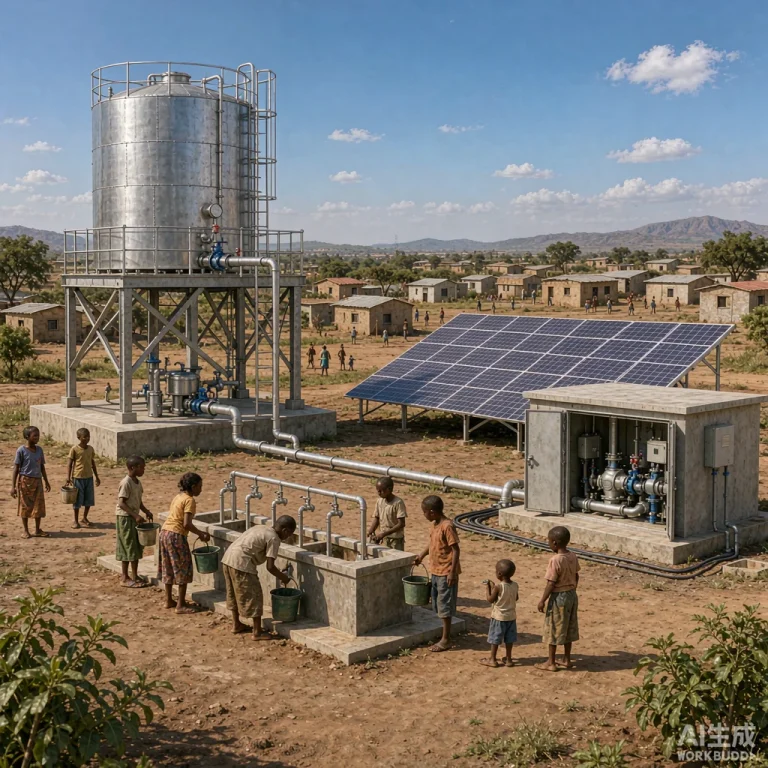
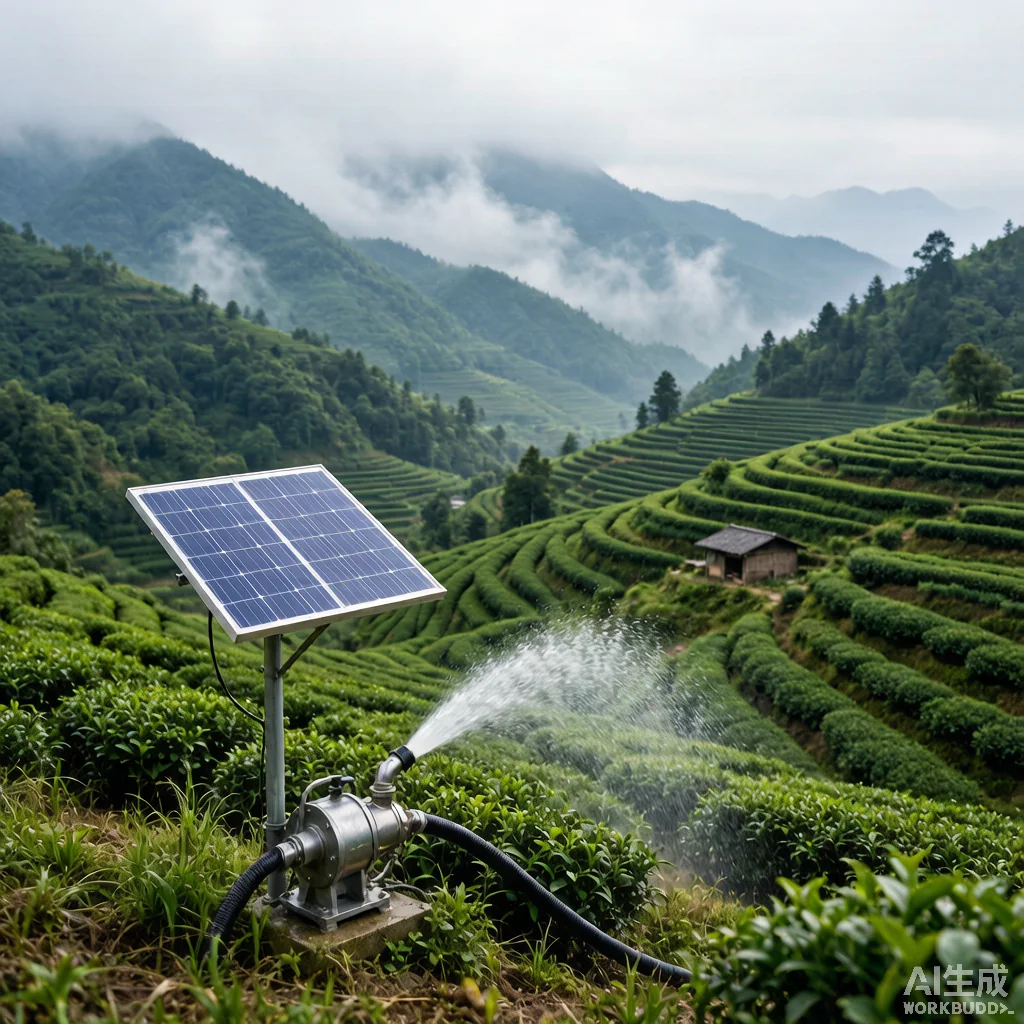
The defining challenge of tea plantation irrigation is elevation. Water sources are usually valley streams, springs, or wells at the bottom of the slope, while the tea bushes grow on the hillsides above. This means high total dynamic head and careful attention to pressure management.
The most effective approach is a two-stage strategy:
- Lift stage: A solar pump lifts water from the valley source to one or more elevated storage tanks positioned above the highest terraces. The tank holds 1.5 to 2 times daily demand as a buffer.
- Distribution stage: Water flows from the elevated tanks by gravity through the irrigation network, reaching each terrace at controlled pressure.
This design decouples the pumping schedule from the irrigation schedule. The pump can run whenever the sun shines, filling the tanks, while irrigation proceeds on its own timing by gravity — even at dawn, dusk, or during cloudy periods. On steep slopes, pressure-reducing valves and pressure-compensating emitters ensure uniform application between the highest and lowest terraces. For the pump side of the equation, see our guide on calculating required head.
System Configuration by Estate Size
The table below provides starting-point configurations for three common tea estate scales, assuming a water source 40 meters below the storage tank and temperate-to-warm conditions.
| Estate Size | Daily Demand | Pump Power | Solar Array | Storage Tank |
|---|---|---|---|---|
| Smallholder (2 ha) | 100 m³ | 1.5 kW (2 HP) | 2.2 kW | 20,000 L |
| Medium estate (10 ha) | 500 m³ | 5.5 kW (7.5 HP) | 7.5 kW | 100,000 L |
| Large estate (25 ha) | 1,250 m³ | 11 kW (15 HP) | 15 kW | 250,000 L |
Note: Reference points only. Actual sizing depends on exact lift, pipe length and diameter, terrain profile, and local sunshine hours, and must be verified against manufacturer curves.
Investment and ROI Analysis
The economic case for solar on a tea plantation rests on eliminating diesel fuel costs and reducing maintenance, while also protecting yield during dry seasons. The table below shows a representative 5-year comparison for a 10-hectare estate replacing a diesel pump.
| Cost Item | Diesel | Solar |
|---|---|---|
| Upfront equipment | $1,200 | $9,500 |
| Annual fuel / energy | $3,800 | $0 |
| Annual maintenance | $600 | $180 |
| 5-year total | $23,200 | $10,400 |
| Payback period | — | ~2.4 years |
Note: Illustrative estimates for a 5.5 kW system in 2026, assuming 6 hours of daily operation during the dry season and typical rural fuel and maintenance costs. Actual figures vary by region and duty cycle.
The payback of under three years is compelling on its own, and it does not account for the value of protecting the harvest during drought — which can be the largest hidden benefit of a reliable water supply. For a broader view of solar pumping economics, see our solar water pump ROI analysis.
Frequently Asked Questions
How much water does a tea plantation need?
Tea requires 1,500 to 2,000 millimeters of annual rainfall equivalent, but in dry seasons irrigation must supplement rainfall. Mature tea bushes typically need about 4 to 6 millimeters of water per day during dry periods, which translates to 40 to 60 cubic meters per hectare per day depending on planting density and evaporation.
Can solar pumps handle the hilly terrain of tea plantations?
Yes, but head requirements are often high because water must be lifted from valley streams or wells up steep slopes. Submersible solar pumps and multi-stage surface pumps can deliver water to elevated storage tanks that then gravity-feed the irrigation network across terraced plots.
What is the payback period for a solar pump on a tea plantation?
Payback is typically 2 to 3 years when replacing a diesel pump, driven by eliminated fuel costs and lower maintenance. Tea plantations that irrigate during long dry seasons see faster payback because the solar pump runs more hours and offsets more diesel.
Does solar irrigation affect tea quality?
Yes, positively. Consistent soil moisture during dry periods reduces plant stress, which supports steady shoot growth and better leaf quality. The reliable water supply that a storage-based solar system provides helps prevent the flush disruption that drought stress causes.
Planning Tea Plantation Irrigation?
For B2B buyers and estate managers securing a reliable water supply, contact KINBO for competitive FOB pricing and technical specifications.
August 19, 2026 | Author: KINBO Editorial Team
Related Articles