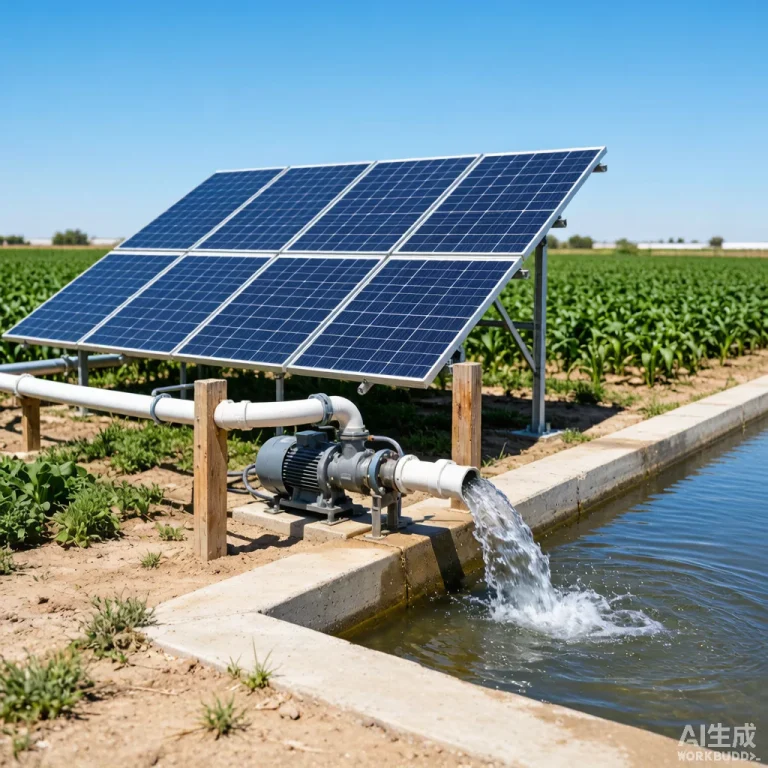
Solar Drip Irrigation System Design: Water Demand, Pressure and Pump Sizing Guide
Solar Drip Irrigation System Design: Water Demand, Pressure and Pump Sizing Guide
Introduction
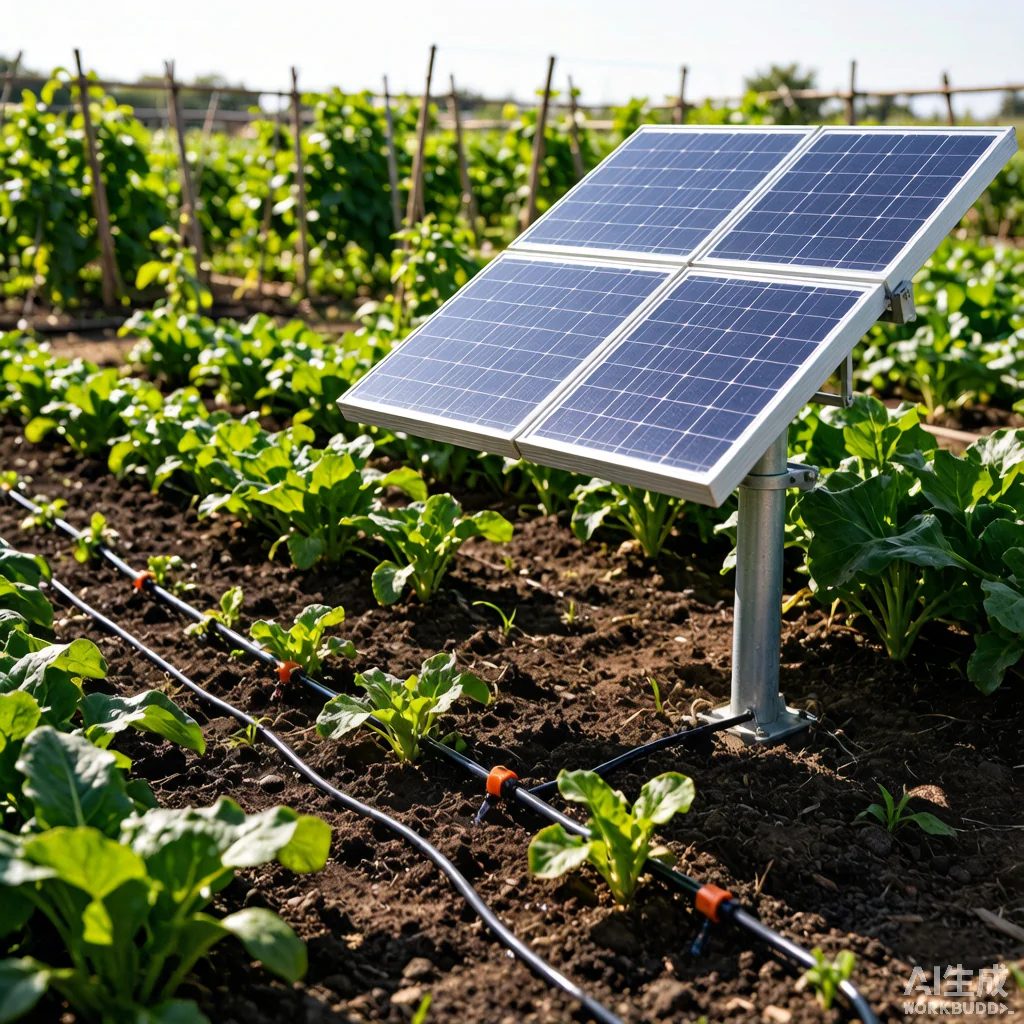
Drip irrigation is the most water-efficient method of crop irrigation available, delivering water directly to the plant root zone and cutting water use by 30 to 70 percent compared with flood or sprinkler methods. When powered by solar, it becomes an entirely off-grid, low-operating-cost solution ideally suited to regions where both water and grid electricity are scarce. The result is a system that maximizes crop yield per unit of water and per unit of energy.
KINBO supplies solar pumping systems for drip irrigation projects across arid and semi-arid regions worldwide. This guide walks through the complete design process — from calculating water demand to sizing the pump and solar array — so you can build a system that performs reliably. For the broader system design context, see our guide to solar pump system design for irrigation.
Table of Contents
Calculating Water Demand
Accurate water demand is the foundation of drip system design. Underestimate it and crops suffer during peak heat; overestimate it and the system is oversized and wasteful.
The demand is driven by three factors:
- Crop type and growth stage: Different crops have very different water requirements, and demand rises from planting through fruit development.
- Climate: Evapotranspiration, the combined loss from soil evaporation and plant transpiration, is much higher in hot, dry, windy conditions.
- Plant spacing and density: The number of plants — and therefore emitters — per unit area determines total flow.
A practical sizing method works from the emitters upward. Multiply the number of emitters by their individual flow rate and the expected daily operating hours. For example, a plot with 1,000 emitters, each delivering 4 liters per hour, operating 4 hours per day, requires 16,000 liters per day. This bottom-up calculation is usually more reliable than area-based estimates because it directly reflects the actual irrigation hardware.
Pressure and Emitter Requirements
Drip systems are low-pressure by design, but they are not zero-pressure. Emitters require a specific operating pressure to deliver a consistent, predictable flow rate.
- Standard emitters: Typically operate at 1.0 to 1.5 bar (10 to 15 meters of head).
- Pressure-compensating (PC) emitters: Maintain uniform flow across a wider pressure range, typically 0.7 to 4 bar. These are strongly recommended for sloping or uneven terrain.
- Inline dripline vs online emitters: Inline dripline has emitters pre-installed at fixed spacing inside the tube, while online emitters are punched into plain tubing. Inline is simpler and more common for row crops.
The total pressure the pump must supply is the sum of the emitter operating pressure, the static lift from the water source to the highest emitter, friction losses in the mainline and lateral pipes, and any filter pressure drop. Filtration is essential in drip systems because emitters clog easily; a disc or screen filter upstream is a mandatory component.
System Architecture: Direct vs Storage-Based
Solar drip systems can be built two ways, each with distinct trade-offs. Choosing the right architecture early avoids costly redesign.
| Aspect | Direct-Coupled | Storage-Based (Gravity) |
|---|---|---|
| Operation | Pump runs only when sun shines, feeding drip directly | Pump fills an elevated tank during the day; drip runs by gravity |
| Water availability | Only during daylight hours | 24/7, including dawn/dusk and cloudy periods |
| Cost and complexity | Lower cost, fewer components | Higher cost (tank + structure), but more flexible |
| Best for | Daytime irrigation of field crops | Scheduled watering, orchards, precision timing |
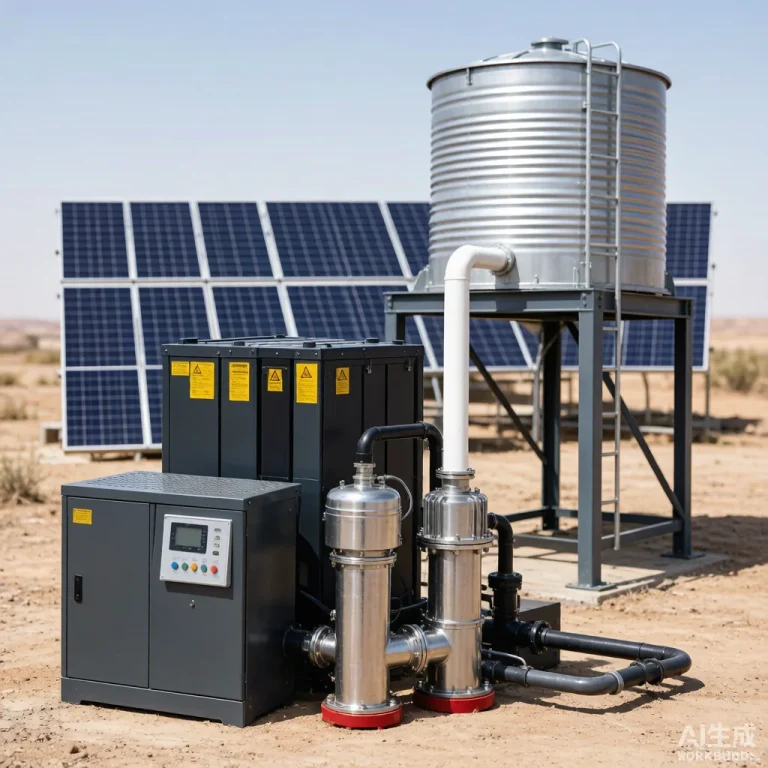
In practice, the storage-based architecture is the most robust choice for drip irrigation. The elevated tank acts as both an energy buffer and a pressure source, allowing precise, scheduled watering independent of cloud cover. For guidance on sizing that tank, see our article on solar pump water storage tank sizing.
Pump and Solar Array Sizing
Once demand and pressure are known, the pump and array can be sized. The process follows a standard sequence.
Step 1 — Determine total dynamic head (TDH): Add the static lift from the water source to the tank or the highest emitter, the friction losses in mainline and laterals, the filter pressure drop, and the required emitter pressure. Apply a 10 to 15 percent safety margin.
Step 2 — Determine required flow: Convert daily water demand into a flow rate based on available sunshine hours. A system needing 16,000 liters per day with 5 peak sunshine hours requires a pump delivering roughly 3.2 cubic meters per hour.
Step 3 — Select the pump: Choose a pump whose performance curve passes through the required duty point near its best efficiency point. For shallow sources, a solar surface pump is appropriate; for boreholes, a solar submersible pump.
Step 4 — Size the array: Oversize the solar array by 20 to 30 percent above the pump’s rated power to maintain flow during morning, afternoon, and partial-cloud conditions. The table below shows typical configurations.
| Plot Size | Daily Demand | Pump Power | Solar Array | Storage Tank |
|---|---|---|---|---|
| 0.5 ha | 8,000 L | 0.75 kW (1 HP) | 1.2 kW | 10,000 L |
| 1.0 ha | 16,000 L | 1.5 kW (2 HP) | 2.2 kW | 20,000 L |
| 2.0 ha | 32,000 L | 3.0 kW (4 HP) | 4.0 kW | 40,000 L |
Note: Reference points assuming moderate head, pressure-compensating emitters, and 5 peak sunshine hours. Actual sizing must be verified against manufacturer curves and local conditions.
For a deeper dive into the hydraulic side of matching flow to head, see our guide on solar pump flow rate and head performance curves.
Frequently Asked Questions
What pressure does a drip irrigation system need?
Most drip irrigation systems operate at 1.0 to 1.5 bar (10 to 15 meters of head), with pressure-compensating emitters able to work from 0.7 to 4 bar. The pump must supply the drip operating pressure plus static lift and friction losses in the distribution network.
How do I calculate water demand for drip irrigation?
Water demand equals the crop water requirement per plant times the number of plants, plus efficiency losses. A practical method is to multiply the number of emitters by their flow rate and expected operating hours. For example, 1,000 emitters at 4 liters per hour over 4 hours equals 16,000 liters per day.
Is drip irrigation compatible with solar pumps?
Yes, and the combination is highly water-efficient. The key design requirement is matching the pump’s variable output to the drip system’s pressure and flow needs. Using an elevated storage tank that fills during the day and gravity-feeds the drip network is a common, reliable design that avoids the need for batteries.
Why is filtration important in a solar drip system?
Drip emitters have tiny orifices that clog easily with silt, sand, or organic matter. A disc or screen filter placed before the drip network is mandatory to protect emitters and maintain uniform water distribution. Regular filter cleaning is part of routine maintenance.
Planning a Solar Drip Irrigation Project?
For B2B buyers and integrators building efficient drip systems, contact KINBO for competitive FOB pricing and technical specifications.
August 19, 2026 | Author: KINBO Editorial Team
Related Articles