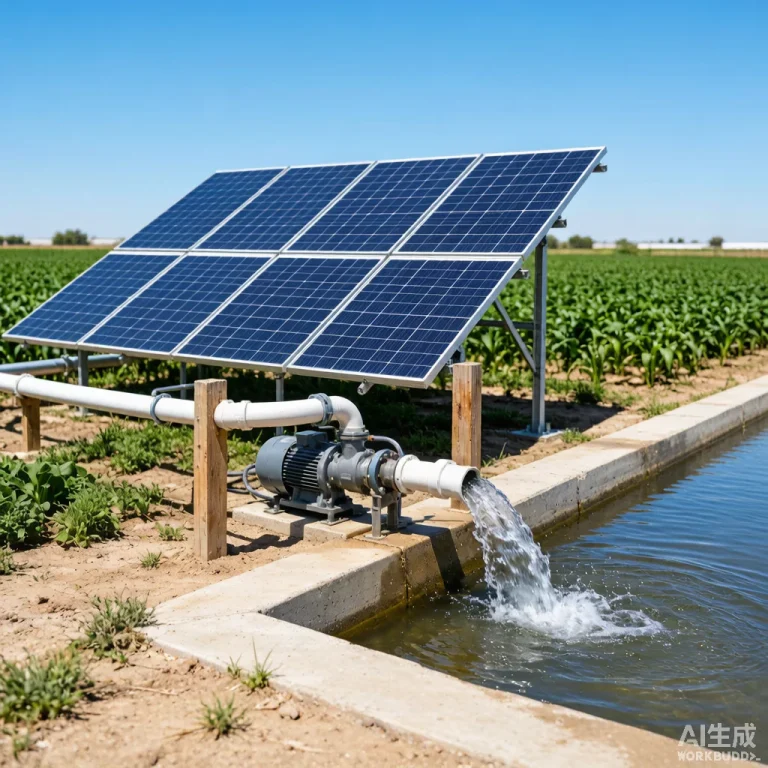
Solar Water Pumps for Greenhouse and Protected Crop Irrigation: Precise Watering for High-Value Plants
Introduction
Greenhouses and protected cultivation concentrate value per square meter, so water must arrive uniformly, on schedule and at the right pressure. A KINBO solar water pump can power drip lines and misting from a sunny roof or nearby array, cutting utility cost on high-value crops. This article covers greenhouse water demands, pressure and uniformity, integration with drip and mist, automation, and why solar is a natural fit for protected agriculture.
Table of Contents
Greenhouse Water Demands
Protected crops transpire steadily under cover, and many – seedlings, berries, flowers – need frequent, small doses rather than one big watering. Uneven supply means uneven growth and lost premium value.
A crop water demand reference helps translate canopy area and climate into litres per day, the basis for sizing both pump and tank.
Because the greenhouse already carries structure and often power for fans and lights, adding a solar pump leverages existing site infrastructure for water.
Pressure and Uniformity
Drip and mist emitters each need a narrow pressure band to deliver equal flow. Too low and far rows starve; too high and emitters blow off or mist unevenly. The pump plus a pressure regulator and header tank deliver that band.
- Header tank: smooths pulsation and buffers solar variability.
- Pressure regulator: holds emitter pressure steady.
- Filtration: protects tiny emitter orifices from clogging.
A daytime solar pump paired with a small tank keeps pressure stable even as clouds pass, since the tank supplies between pump cycles.
Integrating with Drip and Mist
Drip feeds the root zone precisely; mist or fog cools and humidifies the canopy. Both draw from the same pressurized line, so one solar pump can serve multiple zones through simple valving.
For a greenhouse, a surface pump from a reservoir is common, while a borehole-fed house uses a submersible. Filtration is non-negotiable: emitter clogging is the top cause of uneven greenhouse irrigation.
| Method | Best use | Pressure need |
|---|---|---|
| Drip | Root zone | Low, steady |
| Mist / fog | Cooling, humidity | Higher |
Zone valves let one pump serve propagation, growing and cooling circuits on separate timers.
Automation and Scheduling
Solar greenhouse pumping pairs well with timers or soil-moisture sensors. Daytime generation aligns with transpiration, so a simple schedule works; sensors add precision and save water.
Controllers can prioritize irrigation when the sun is strong and pause during low-light dips, with the tank covering gaps. KINBO controllers support dry-run and pressure-fault protection suited to automated houses.
Remote monitoring lets a manager verify zones from a phone, reducing the chance a stuck valve goes unnoticed for days.
Why Solar Fits Greenhouses
Greenhouses already value every input, and solar water pumping cuts a recurring electricity or diesel line while using roof or perimeter space that earns no crop yield.
The result is lower cost per premium plant, resilient supply during grid outages, and a greener story for buyers who pay for quality. For high-value protected crops, the payback is often faster than in open-field irrigation.
Estates running broader irrigation can read how solar pumps support large estates to scale the same approach.
Frequently Asked Questions
Why does a greenhouse need precise pump pressure?
Drip and mist emitters each need a narrow pressure band to deliver equal flow; without steady pressure, far rows starve and canopy growth becomes uneven, cutting premium value.
Can one solar pump serve both drip and misting?
Yes. A pressurized header tank and zone valves let one solar pump feed drip root zones and mist cooling on separate schedules, with a regulator holding emitter pressure.
Do greenhouse solar pumps need filtration?
Absolutely. Tiny emitter orifices clog easily, so filtration is essential to keep irrigation uniform and avoid uneven crop growth.
Why is solar a good fit for protected crops?
Solar uses roof or perimeter space that earns no yield, cuts electricity or diesel cost, and its daytime generation aligns with plant transpiration, speeding payback on high-value crops.
For B2B buyers solar greenhouse irrigation, contact KINBO for competitive FOB pricing and technical specifications.
Related Articles
- Solar Water Pumps for African Sugarcane Estates: Reliable Irrigation Supply and Industry Outlook
- Solar Water Pumps for African Grain and Cereal Farms: Supplemental Irrigation and Industry Outlook
- Explore KINBO Solar Surface Pumps