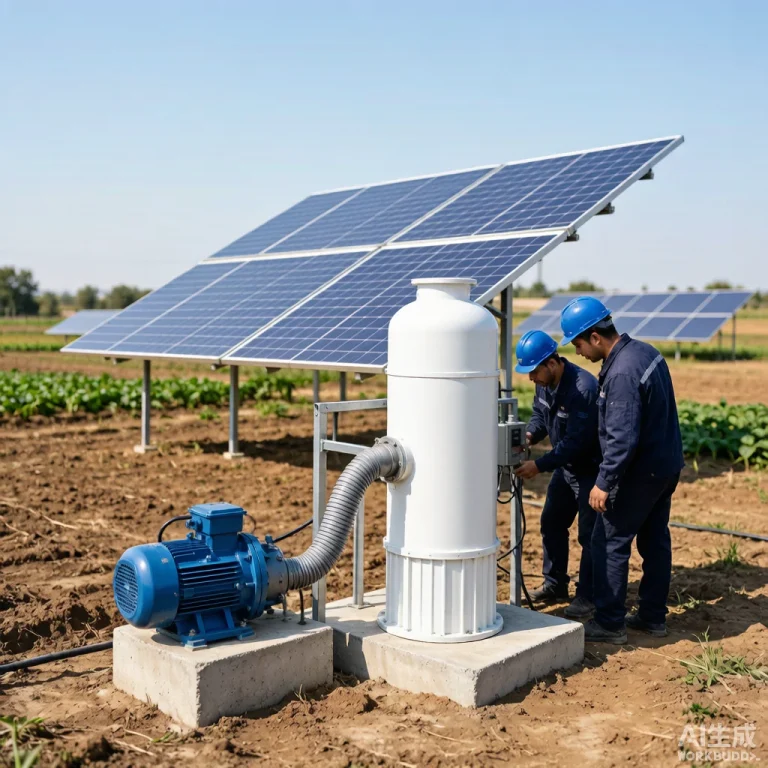
Solar Powered Drip Irrigation for Smallholder Vegetable Farms: A Low-Cost Precision Watering Guide
Introduction
Smallholder vegetable farmers compete on yield per small plot, and water is often the limiting input. Solar powered drip irrigation applies water exactly at the root zone, raising output while cutting labor and waste. KINBO supports compact systems built for small farms. This guide covers why solar drip works, the components, how to design for a small plot, which crops suit it, and the economics that make payback attractive.
Table of Contents
Why Drip with Solar
Drip delivers water and dissolved fertilizer straight to roots, so far less is lost to evaporation or runoff. Coupling it with solar removes the need for grid power or diesel at the field edge, where smallholders rarely have either reliably.
The sun powers pumping during the day, when plants need water most, and a small tank holds pressure between cycles. A crop water demand reference helps match litres to the vegetables grown.
For a family plot, the labor saved from not hauling water by hand is itself a major benefit alongside the yield gain.
System Components
A compact solar drip kit is simple: PV panels, a solar pump (often surface from a drum or shallow source), a header tank or pressure vessel, a filter, a mainline and drip laterals, and emitters at each plant.
- Panels and pump: sized to daily litres and head.
- Filter: protects emitters from clogging.
- Header tank: smooths pressure and buffers clouds.
- Drip line: placed along crop rows at root zone.
Keep the layout modular so the farmer can extend rows as the plot grows without replacing the pump.
Design for Small Plots
For a small plot, keep laterals short so pressure stays even end to end; loop or twin-feed long beds if needed. Place the tank slightly elevated to maintain gentle pressure without oversizing the pump.
A correct head calculation prevents an undersized pump that cannot push water to the far row. Mark beds so emitters align with plant positions before laying line.
| Plot size | Typical pump | Tank |
|---|---|---|
| 0.1-0.25 ha | Small surface | 500-1000 L |
| 0.25-0.5 ha | Surface / sub | 1000-2000 L |
Start small, prove the yield gain, then scale the array and lines in later seasons.
Crop Suitability
Drip suits high-value, frequent-watering vegetables: tomato, pepper, cabbage, onion, leafy greens and strawberries all respond strongly. Seedlings and nurseries benefit from gentle, consistent moisture.
Crops with low value per drop or flooded-field needs fit less well, though many can be rotated in once the system exists. Matching emitter spacing to plant spacing avoids water hitting bare soil.
KINBO advises laying demo rows with a cooperating farmer so neighbors see uniform emergence before adopting widely.
Economics and Payback
The business case is strong: higher and more uniform yields, less water and fertilizer waste, and labor saved from manual watering. For many smallholders the system pays back within one to two profitable seasons.
Solar removes the fuel bill entirely, and a simple, repairable design keeps service cost low. Group purchases across a village cut per-unit price and build shared spare-parts pools.
Framing the choice through a pump selection guide ensures the first system is sized right and trusted locally.
Frequently Asked Questions
Why use solar powered drip for a small plot?
Drip puts water at the root zone to raise yield and cut waste, while solar removes grid or diesel needs at the field edge; the labor saved from manual watering is a major bonus for family plots.
What components are in a small solar drip kit?
Panels, a small solar pump, a filter, a header tank or pressure vessel, mainline and drip laterals with emitters; keep it modular so rows can be extended later.
Which vegetables suit solar drip best?
High-value, frequent-watering crops like tomato, pepper, cabbage, onion, leafy greens and strawberries respond strongly; seedlings and nurseries also benefit.
How fast does a small solar drip system pay back?
Often within one to two profitable seasons through higher uniform yields, less input waste and eliminated fuel cost, especially with village group purchases lowering unit price.
For B2B buyers solar drip irrigation for smallholders, contact KINBO for competitive FOB pricing and technical specifications.
Related Articles
- Solar Pump Head Calculation: How to Size Static Lift, Friction Loss and Total Dynamic Head Correctly
- Pump Curve Explained: How to Read, Interpret and Use a Solar Water Pump Performance Curve Correctly
- Explore KINBO Solar Submersible Pumps