Solar Pump Selection for Tank Filling and Bulk Water Transfer: Sizing Volume, Lift and Runtime
Introduction
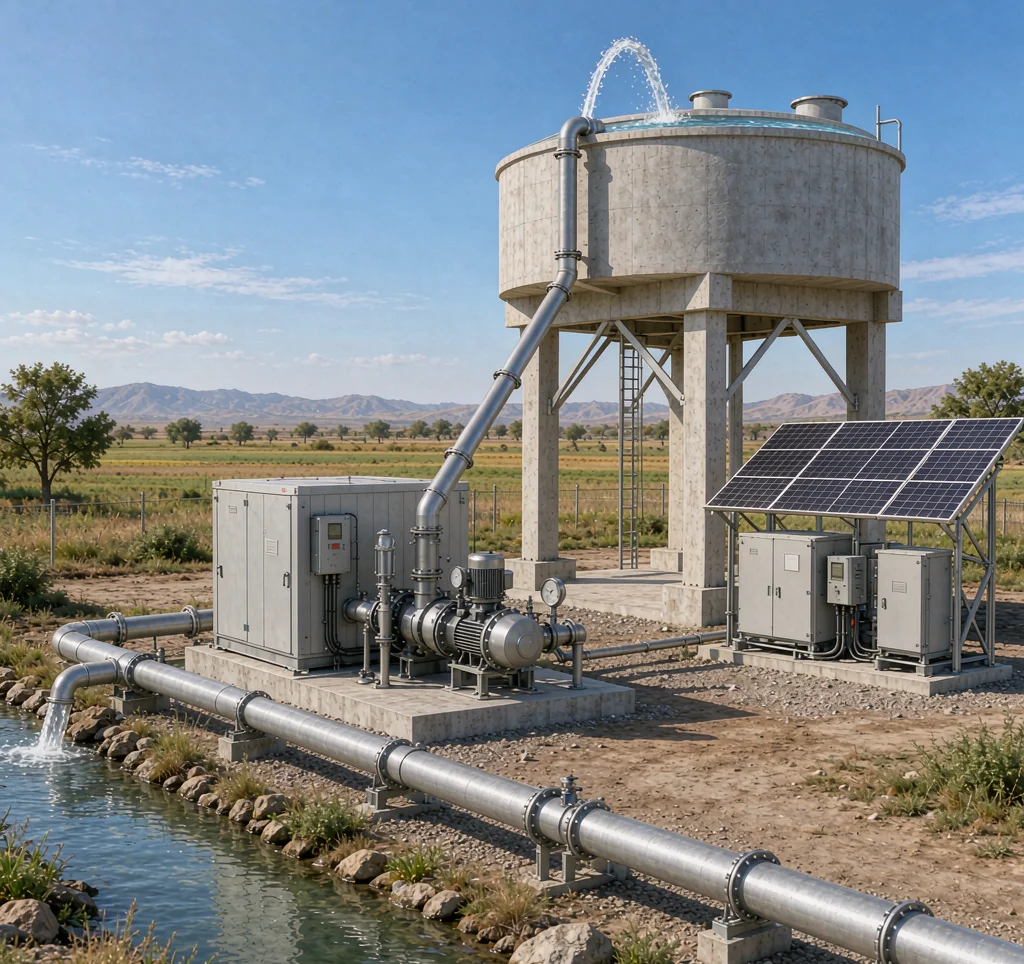
Tank filling and bulk water transfer are the most common, and most underestimated, solar pumping jobs. Moving water from a borehole, river or lower tank up into a storage tank—or shifting it across a site to where it is needed—sounds simple, but the numbers decide everything: total volume, lift, distance and how fast you need it done. Get them wrong and the pump runs all day and never fills the tank, or oversizes the array wastefully. The good news is that tank-fill duty is forgiving: because you are filling a store, the pump does not need to meet instantaneous demand, only average daily volume within the sun’s hours. This guide covers how to size a solar pump for tank filling and bulk transfer. Solar pumping specialists such as KINBO supply rugged transfer packages sized to your volume, lift and run-time so the tank fills reliably before sundown.
Table of Contents
Defining the Transfer Duty
Start from three numbers: the volume to move, the total head (vertical lift plus pipe friction), and the time you have to do it. The table shows how runtime drives pump size for a fixed volume and lift.
| Daily Volume | Fill Time | Required Average Flow |
|---|---|---|
| 10 m³ | 6 h sun | ~1.7 m³/h |
| 10 m³ | 3 h sun | ~3.3 m³/h |
| 50 m³ | 8 h sun | ~6.3 m³/h |
Doubling the available sun halves the pump you need; halving it doubles the pump. So before buying, decide how many sun-hours you can commit.
Flow vs Runtime Trade-off
This is the central choice in tank-fill sizing:
- Small pump, long runtime—cheapest array, but needs a big tank or many sun-hours; risky in winter or cloudy spells.
- Larger pump, short runtime—fills fast, tolerates poor weather, but costs more in panels and pump capacity.
- Right-sized pump—fills the tank within a normal sunny day with margin for one dull day; this is the usual target.
A buffer day’s storage (tank bigger than one day’s draw) lets a smaller pump serve reliably—the same principle used in our pressure tank sizing guide, applied at bulk scale.
Sizing the Solar Pump
Steps:
- Volume ÷ sun-hours = average flow required.
- Add total head—static lift + friction in the delivery pipe at that flow. (Our pipe diameter guide shows how undersized pipe quietly doubles the head.)
- Pick the pump curve at that flow and head; confirm it sits in the efficient band, not at the curve ends.
- Size the array to reach that duty around midday, with ~20% headroom for clouds.
- Confirm suction lift if the source is above the pump or the pump is far from the water; respect the pump’s prime limit.
Level Control and Overfill Protection
An unattended fill pump must stop automatically. Options:
| Method | How It Works |
|---|---|
| Float switch in tank | Simple on/off at high level; cheap, mechanical |
| Ultrasonic / pressure level | Non-contact sensing; better for dirty or large tanks |
| Controller setpoint | Stops pump at tank-full via the drive; needs compatible controller |
Also fit a dry-run sensor on the source side so the pump stops if the supply runs low, protecting the motor.
Frequently Asked Questions
Can one pump fill a tank and also supply pressure?
Not directly. Tank filling is low, steady flow; taps need higher pressure on demand. The usual design pumps to the tank, then a separate pressure pump or booster draws from it—see our rural pressure boosting guide.
How much sun do I need to plan for?
Use your worst realistic month, not the annual average. If you size for a clear summer day only, winter or rainy spells will leave the tank empty. Build in a buffer day of storage.
What if the source is far below the pump?
A surface pump has a suction-lift limit (usually a few metres). If the source sits well below, either place a submerged pump at the source or use a booster stage; otherwise the pump cannot prime.
Is a bigger tank or a bigger pump better?
For reliability, a bigger tank almost always wins: it absorbs weather variation and lets you run a smaller, cheaper pump. Size storage first, then the pump to fill it in a normal day.
Related Articles
- Solar Pump Pressure Tank Sizing
- Solar Pump Pipe Diameter and Velocity Optimization
- Explore KINBO Solar Pump Products
Get a Tank-Fill Solar Pump Specification
Tell KINBO your daily volume, lift, pipe run and available sun-hours, and we will size a transfer pump and array that fills your tank reliably—with float or level control and dry-run protection built in. Contact our team for a tailored quote.
Published by KINBO · September 21, 2026 · Category: Pump Selection Guide