Solar Pump Pipe Diameter and Flow Velocity Optimization: Sizing Delivery Lines for Rated Flow
Introduction
Most solar pump performance problems are not pump problems—they are pipe problems. A pump that can deliver 5 m³ per hour on paper may deliver half that if the delivery line is undersized, because friction loss eats the head the pump needs for flow. Choosing pipe diameter is therefore a selection decision as important as the pump itself: it trades pipe cost against energy and daily water output. This guide explains how flow velocity sets the limits, how to pick a diameter, and where the money actually goes. Manufacturers such as KINBO size pump packages together with recommended pipe diameters so the system delivers its rated flow in the field, not just on the curve.
Table of Contents
Flow Velocity: The Number That Matters
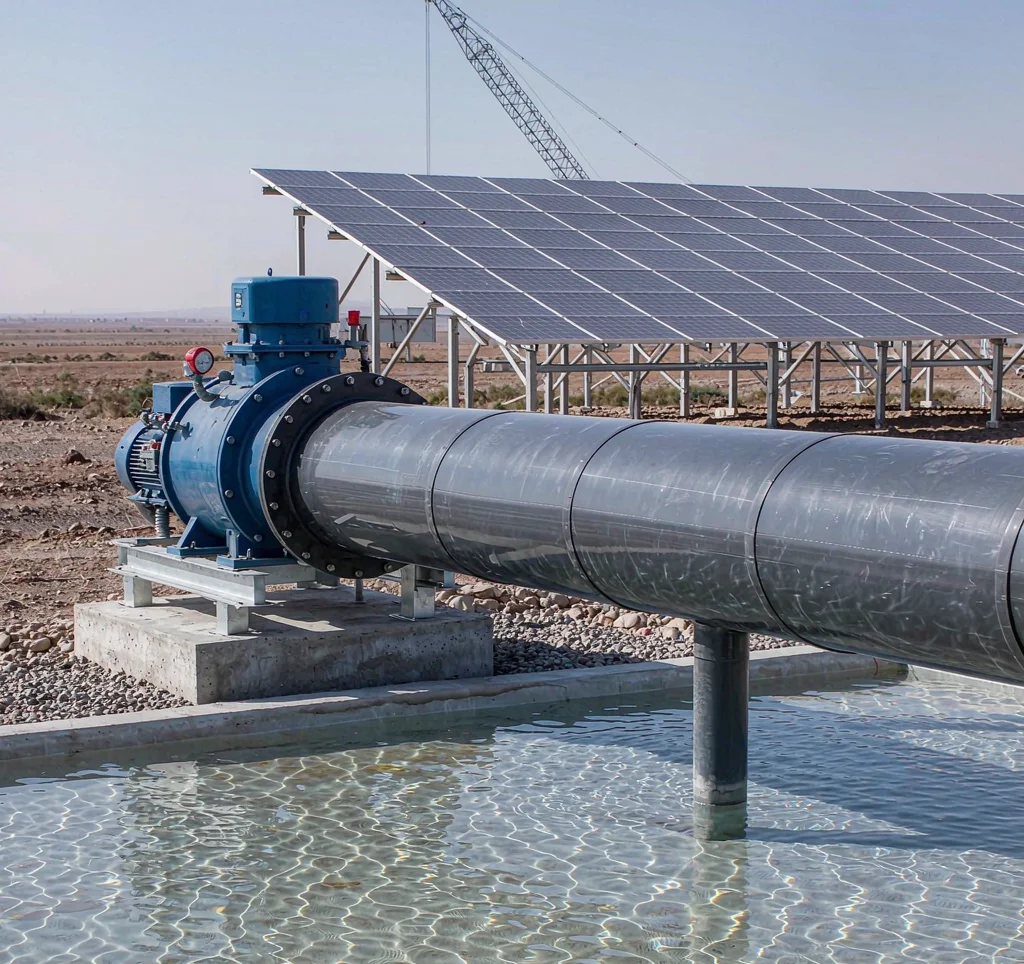
Friction loss rises roughly with the square of velocity, so a pipe that runs twice as fast loses four times the head. Water moving faster than about 2 m/s in a delivery line wastes energy and can hammer fittings; slower than about 0.6 m/s, sediment starts settling in the line. The design window for pumped water lines is therefore roughly 0.6–2.0 m/s, with long lines biased toward the lower end. Velocity is simply flow divided by pipe area, so every flow rate has a diameter that keeps it inside the window.
Choosing the Pipe Diameter
The table gives practical diameter targets for common solar pump duties (inner diameter, metric HDPE/PVC):
| Design Flow | Minimum ID | Comfortable ID | Velocity @ Comfortable |
|---|---|---|---|
| 1 m³/h | 20 mm | 25–32 mm | ~0.6 m/s |
| 3 m³/h | 32 mm | 40–50 mm | ~0.7 m/s |
| 5 m³/h | 40 mm | 50–63 mm | ~0.8 m/s |
| 10 m³/h | 50 mm | 75–90 mm | ~0.7 m/s |
Once the diameter is chosen, quantify the remaining losses with our guide on solar pump pipeline friction loss calculation, then add them to the static lift before final pump selection.
Cost vs Energy: The Trade-Off
Bigger pipe costs more but saves head—and on a solar system, saved head is saved PV area. The table illustrates the trade-off for a 200 m delivery line at 5 m³/h (illustrative):
| Pipe ID | Friction Head (200 m) | Extra PV Needed | Verdict |
|---|---|---|---|
| 40 mm | ~12 m | +1 panel class | Cheap pipe, costly system |
| 50 mm | ~4 m | ~none | Balanced choice |
| 63 mm | ~1.5 m | none | Best for long runs |
Note: friction figures assume smooth HDPE at 20°C; add fittings losses and verify against the pump curve before finalizing.
Long-Run Design Practices
For lines longer than a few hundred meters, diameter is only the first decision. Field-proven practices:
- Step up on long runs: start one size larger than the minimum and keep velocity under 1 m/s.
- Smooth the route: every bend and elbow adds loss; gentle grades and sweep bends cost less head.
- Watch the riser: inside the borehole the riser is fixed by well diameter—check its velocity separately.
- Anchor and bury: buried pipe avoids UV damage and thermal movement; anchor slopes against water hammer.
- Leave room to grow: if demand may double, oversizing the pipe now is cheaper than re-trenching later.
KINBO publishes recommended pipe diameters alongside each pump’s flow range, so specifiers can match both before ordering.
Frequently Asked Questions
What flow velocity should I target in a solar pump delivery line?
Aim for 0.6–2.0 m/s; bias toward the low end for long lines and toward the high end only for short runs.
Does a bigger pipe always save energy?
Up to a point—friction falls with diameter, but beyond roughly 1 m/s the gains flatten; also, very large lines risk sediment settling.
Can I mix pipe sizes on one system?
Yes—commonly a smaller riser in the well steps up to a larger delivery main; just calculate each section’s losses separately.
How does undersized pipe damage a pump?
It forces the pump to a higher head point, reducing flow; the motor may still draw power and run hot at the off-curve duty point.
For B2B buyers specifying solar pumping pipelines, contact KINBO for competitive FOB pricing and pump-and-pipe matched system design.