How to Select Solar Pump for Different Water Sources: Well, River, Lake, and Borehole
Introduction
Selecting the right solar water pump for a specific water source is one of the most critical decisions in any off-grid water supply project. Whether drawing from a deep borehole, a shallow well, a flowing river, or a calm lake, each water source presents unique challenges in depth, flow rate, water quality, and seasonal variation. A mismatch between pump type and water source can lead to insufficient delivery, premature failure, or unnecessary costs.
As a leading solar pump manufacturer, KINBO has helped thousands of customers worldwide match the correct pumping technology to their specific conditions. This guide covers the key characteristics of each water source type and provides practical selection criteria. For broader fundamentals, refer to our solar water pump selection guide. Understanding the relationship between water source parameters and pump performance ensures a reliable, efficient, and long-lasting solar pumping system.
Table of Contents
Understanding Different Water Source Characteristics
Before selecting a solar pump, evaluate four primary characteristics of your water source:
- Depth and static water level: The vertical distance from ground to water surface determines whether a submersible or surface pump is needed. Boreholes and deep wells require submersible pumps placed below the water level, while rivers and lakes can use surface or floating pumps.
- Flow rate and recharge capacity: The rate at which water naturally replenishes the source affects sustainable discharge. Over-pumping a slow-recharging borehole can cause the water level to drop below the pump intake, leading to dry-run damage.
- Water quality and sediment: River and lake water often contains suspended solids, algae, or organic matter that can clog impellers. Borehole water is generally cleaner but may contain mineral deposits. Abrasive particles may require wear-resistant impellers or pre-filtration.
- Seasonal variation: Water levels in rivers and shallow wells can fluctuate dramatically between rainy and dry seasons. Always design your system around the lowest expected water level for year-round reliability.
For help calculating the total dynamic head for your site, our guide on how to calculate required head provides step-by-step instructions.
Borehole and Deep Well Solar Pump Selection
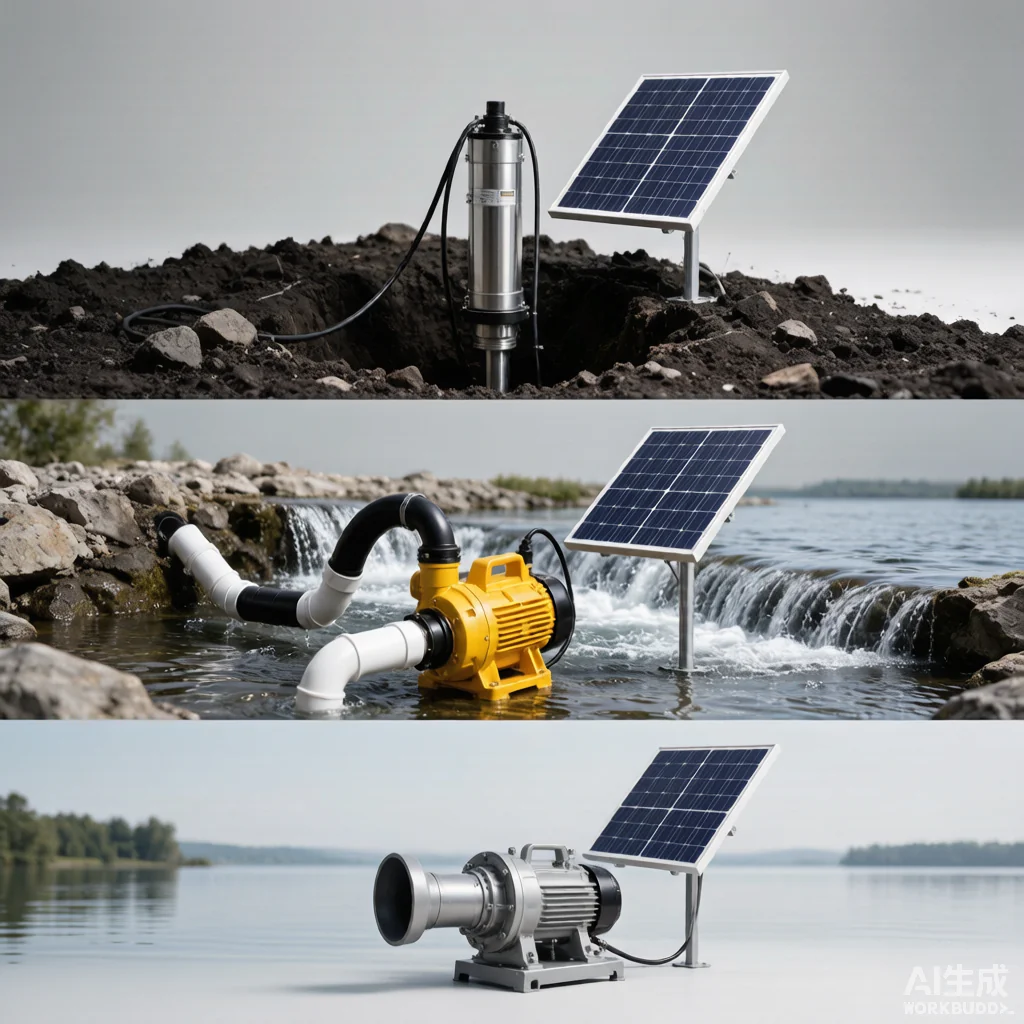
Boreholes and deep wells are the most common sources for solar pumping systems, typically ranging from 20 to over 150 meters in depth. These require submersible solar pumps lowered directly into the borehole.
Three parameters are paramount: borehole diameter, total dynamic head (TDH), and required daily output. Most residential and agricultural boreholes have an inner casing diameter of 100 mm (4 inches) or 150 mm (6 inches), so KINBO offers 3-inch and 4-inch submersible solar pumps to fit standard sizes. The TDH includes static water level, vertical lift to discharge, pipe friction losses, and outlet pressure. Always add a 10–15% safety margin for seasonal drops and pipe aging.
Practical Sizing Example
Consider a farm borehole with: static water level 30 m below ground, discharge point 5 m above ground, 80 m horizontal pipe run (≈3.2 m friction loss), required output 15 m³/day, and 100 mm casing.
The TDH = 30 m + 5 m + 3.2 m + 3 m (10% margin) ≈ 41 meters. A KINBO 4-inch DC submersible pump rated at 1.5 kW with 50 m maximum head and 2.5 m³/h flow rate would suit this scenario. Powered by a 2.0 kWp solar array, it delivers approximately 15–18 m³/day under typical irradiation. Always verify the pump’s outer diameter is at least 10 mm smaller than the casing inner diameter for installation clearance.
Surface Water Sources: River and Lake Pump Selection
Rivers and lakes present different challenges—the vertical lift is small, but horizontal distance to the storage tank can be significant. Surface solar pumps and floating solar pumps are the two primary options.
Surface solar pumps are installed on dry ground near the water’s edge and use suction to draw water. They are suitable where vertical suction lift does not exceed 7–8 meters—a physical limit imposed by atmospheric pressure. Install the pump as close to the water as possible to minimize suction-side friction. Surface pumps are easier to maintain since they are accessible above ground.
Floating solar pumps float directly on the water surface, eliminating suction lift entirely and ensuring consistent performance regardless of water level changes. They are ideal for lakes, ponds, and reservoirs with seasonal fluctuation, particularly for irrigation and livestock watering.
For both types, incorporate a pre-filtration system or settling tank to remove sediment, debris, and aquatic organisms before water enters the pump. This protects the impeller and significantly extends service life.
Water Source Comparison and Pump Type Matching
The following table summarizes key parameters for each water source type. Use it as a quick reference when planning your solar pumping system.
| Water Source | Depth Range | Recommended Pump Type | Typical Power Range | Key Considerations |
|---|---|---|---|---|
| Deep Borehole | 30–150+ m | DC submersible solar pump (3-inch or 4-inch) | 0.75–5.5 kW | Casing diameter limits pump size; verify recharge rate; high head required |
| Shallow Well | 5–30 m | Submersible or surface pump (depending on suction lift) | 0.15–1.1 kW | Monitor seasonal variation; ensure cooling in low-flow wells |
| River | Surface to 7 m suction | Surface solar pump with pre-filter | 0.37–2.2 kW | Sediment filtration essential; account for flood risk and flow changes |
| Lake / Pond | Surface to 7 m suction | Floating solar pump or surface pump | 0.25–3.0 kW | Floating design handles fluctuation; algae require filtration |
Frequently Asked Questions
Q1: Can I use a surface solar pump for a 15-meter-deep well?
No. Surface pumps rely on atmospheric pressure for suction, which has a practical limit of 7–8 meters at sea level. For a 15-meter-deep well, a submersible solar pump installed below the water surface is required. Submersible pumps push water upward, making them suitable for much greater depths.
Q2: How do I prevent my borehole pump from running dry?
Install a dry-run protection sensor (float switch or electrode probe) at the pump intake to shut off the pump when water drops below a safe threshold. Additionally, size your pump’s rated flow to 70–80% of the borehole’s sustainable yield. KINBO solar pump controllers include built-in dry-run protection as a standard feature.
Q3: What solar pump is best for a river with high sediment content?
Use a surface solar pump with a stainless steel or cast iron impeller for abrasion resistance, and install a multi-stage filtration system (settling tank, screen filter, and optional sand separator) before the intake. Schedule regular maintenance to clean the intake screen, especially during the rainy season when sediment loads peak.
Need Help Selecting the Right Solar Pump?
The KINBO technical team is ready to help you assess your site conditions and recommend the optimal pump for your borehole, well, river, or lake application. Contact us for free consultation and system design support.
August 12, 2026 | Author: KINBO Editorial Team