Solar Pump Selection for Sprinkler Irrigation: Flow, Pressure and Uniform Coverage
Introduction
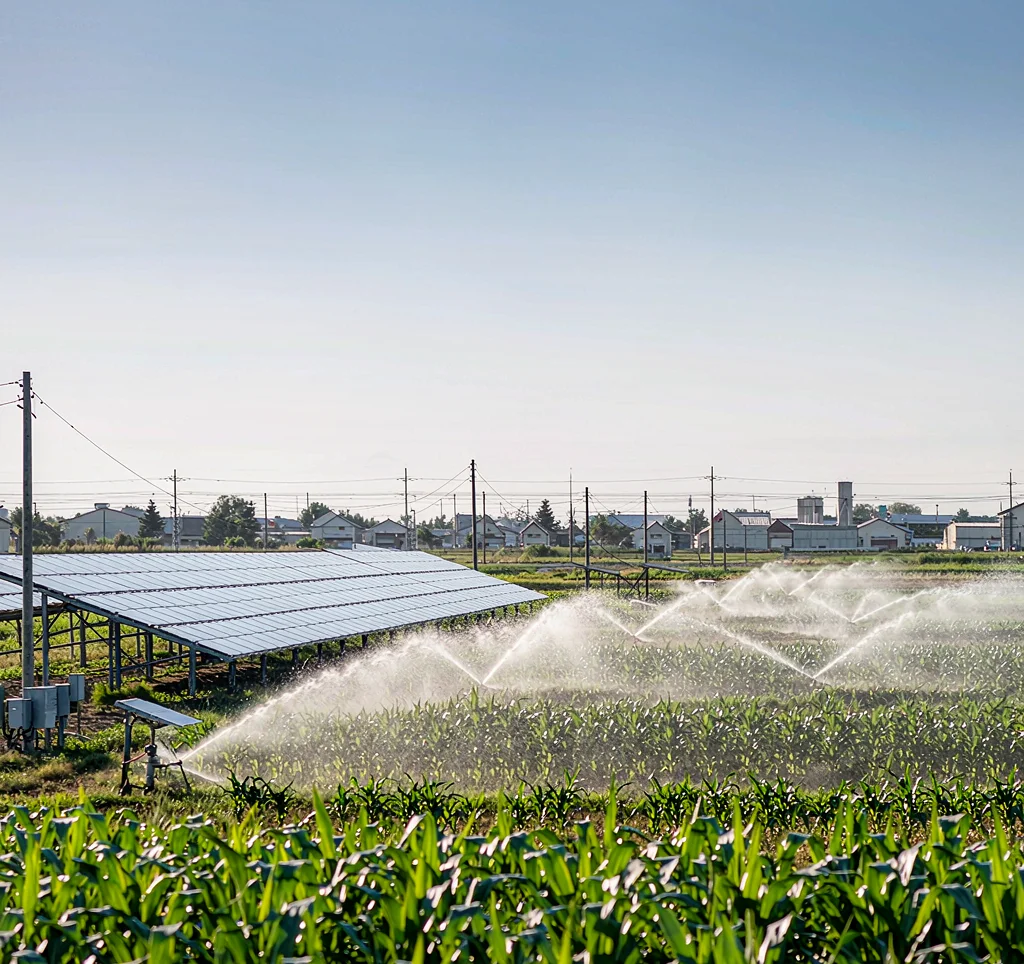
Sprinkler irrigation is the workhorse of broad-acre farming: it covers uneven ground, reaches tall crops and wets a wide radius without laying pipe row by row. But sprinklers are pressure-hungry. Unlike drip, which is happy at 1–2 bar, impact and spray sprinklers need higher, more uniform pressure to throw water evenly—and a solar pump that dips in output with every cloud will throw a lopsided pattern that starves one corner of the field. Selecting a solar pump for sprinkler irrigation means balancing flow, pressure and the pump’s natural power curve against the sprinkler package. This guide covers the selection decisions. Manufacturers such as KINBO supply solar pumping packages sized to common sprinkler pressures so the field gets even coverage from sunrise to sunset.
Table of Contents
Pressure Requirements by Sprinkler Type
Pressure drives throw radius and droplet size; too little and water lands at the base of the riser, too much and it atomizes and blows away. The table shows typical working pressures.
| Sprinkler Type | Working Pressure | Best For |
|---|---|---|
| Impact (gun) | 3–6 bar | Large areas, pasture |
| Spray (micro) | 1.5–3 bar | Vegetable, orchard |
| Center pivot / linear | 2–4 bar at pivot | Field crops, circles |
| Traveling irrigator | 4–7 bar | Rectangular fields |
Because these pressures sit above drip levels, the pump and its riser/pipe must be specified for the higher head. For the head math see our guide on calculating required head.
Matching Pump Flow and Pressure
A sprinkler system has a single operating point: a flow at a pressure. The pump must hit that point across the sun curve. Practical rules:
- Size to the zone, not the whole field—you irrigate one zone at a time, so match the pump to the active zone’s flow.
- Hold pressure, not just flow—a pump that delivers the m³/h but at 1 bar short will under-throw every sprinkler.
- Use a pressure tank or VFD to smooth the solar power swing so throw radius stays steady through the day.
- Leave a margin for filter and fitting losses, which are larger at sprinkler pressures.
KINBO controllers support pressure-hold operation so the sprinkler package sees a stable supply even as available sun varies.
Achieving Uniform Coverage
Even pressure is what makes coverage even. The table contrasts design choices that affect uniformity.
| Factor | Poor Practice | Good Practice |
|---|---|---|
| Pressure control | Direct pump to line | Pressure tank / VFD |
| Layout | Square spacing, overlap ignored | Head-to-head overlap |
| Nozzles | Mixed, worn | Matched, replaced in sets |
Zoning and Scheduling
Most solar sprinkler systems run better as zones than as one big blast:
- Divide the field into zones sized to the pump’s flow at the required pressure.
- Rotate zones through the day so the pump runs near its efficient point each cycle.
- Use a timer or float control so irrigation tracks morning and late-afternoon windows.
- On cloudy days, the lower output naturally extends runtime—plan the zone order so priority crops water first.
For the broader system design around variable demand, see our article on solar pump system design for variable water demand.
Frequently Asked Questions
Can a solar pump run impact sprinklers directly?
Yes if sized to the gun’s pressure (often 3–6 bar); a pressure tank or VFD keeps the throw steady as sun varies.
Why is my coverage uneven across the field?
Usually pressure drop along the line or mismatched nozzles; check pipe diameter, add pressure control, and replace nozzles as a set.
Should I use one big zone or several small ones?
Several small zones sized to the pump’s flow at pressure give even coverage and let the pump run efficiently all day.
How much PV do sprinklers need versus drip?
More—higher pressure means more power per m³; size the array to the sprinkler operating point with sun-hour margin.
For B2B buyers specifying solar pumping for sprinkler irrigation, contact KINBO for competitive FOB pricing and pressure-matched system design.