How to Size a Solar Water Pump for Livestock Watering: Head, Flow and Solar Panel Calculation
Introduction
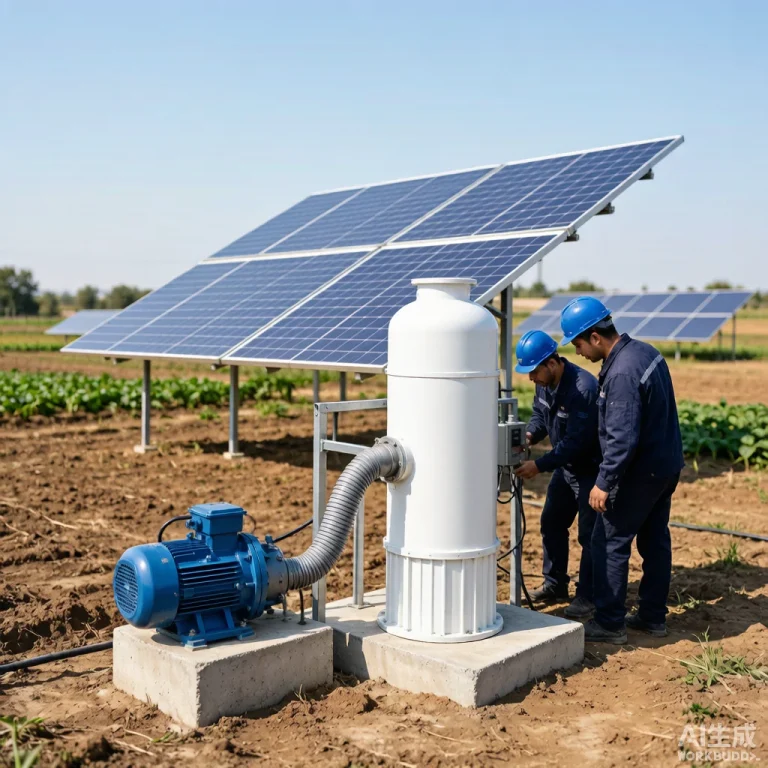
Providing reliable drinking water for livestock is one of the oldest and best-fitting jobs for solar pumping. A well-sized solar water pump for livestock can fill troughs automatically from a well, borehole, or storage tank without fuel or grid power. KINBO supplies complete DC solar pumping kits purpose-built for ranch and smallholding water supply across remote sites.
Table of Contents
Estimate Daily Livestock Water Demand
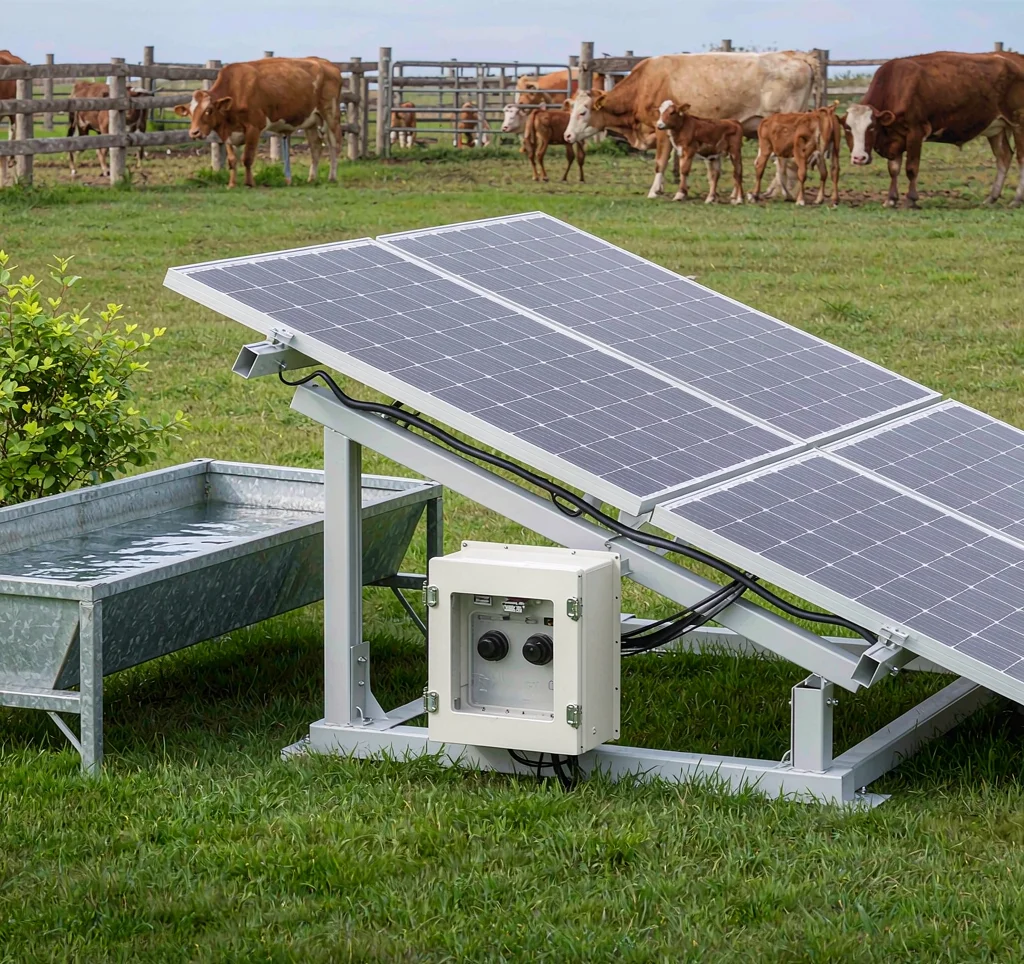
Start with the animals. Total daily volume sets the flow the system must deliver, and it varies widely by species, weight, and climate. Hot, dry regions push consumption to the top of the range.
| Animal | Typical liters / day |
|---|---|
| Beef cattle | 30 – 60 |
| Dairy cow | 70 – 110 |
| Sheep / goat | 4 – 10 |
| Horse | 30 – 50 |
| Poultry (per 100 birds) | 10 – 20 |
Calculate Total Dynamic Head
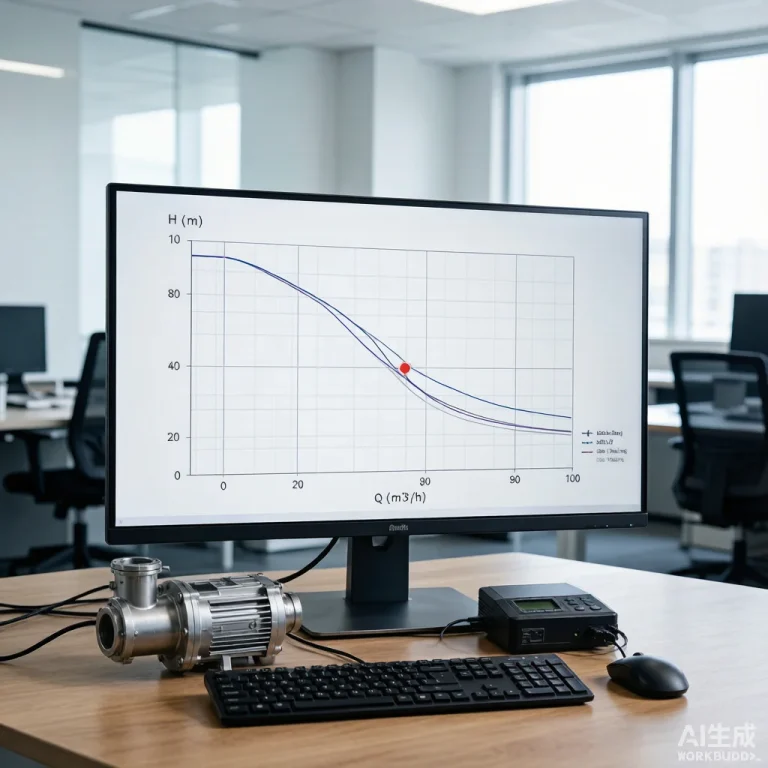
Next, work out the lift. Total Dynamic Head (TDH) is the vertical distance from the water source to the trough outlet plus friction losses in the pipe plus any pressure the delivery point needs. Underestimating TDH is the most common cause of a pump that “runs but never fills the tank.” Use our reference to calculate required head for pumps with your actual pipe length, diameter, and fittings.
Match Flow Rate and Pump Type
Flow and head point to a pump family. Low lifts with high flow favor surface pumps; deep wells need submersibles.
| Site condition | Recommended pump |
|---|---|
| Lift under 20 m, high flow | Solar surface pump |
| Deep well over 20 m | Solar submersible pump |
| Variable terrain, mixed stock | DC submersible with MPPT |
Size the Solar PV Array
Convert the daily water task into energy. Estimate the pump’s watt-hours per day, divide by average peak sun hours, and apply a 0.75 system efficiency factor to get the required panel wattage. In winter or at high latitude, oversize the array by 20-30% so troughs still fill on short, hazy days.
A practical example: 40 beef cattle at 45 liters per day need about 1,800 liters. Lifting that volume 12 m and pushing it through 60 m of pipe costs roughly 0.12 kWh per cubic meter, so the daily pumping energy is near 0.22 kWh. With 5 peak sun hours and 0.75 efficiency, the array math points to about 60 W, but real losses, start-up surges, and winter oversizing make a 750 W kit the sensible, future-proof choice. A small buffer tank lets the system ride out cloudy afternoons without stressing the pump or starving the herd.
Frequently Asked Questions
How many panels do I need for 50 head of cattle?
Roughly 50 beef cattle drink about 2,000-3,000 L/day. At a 15 m lift that is often a 750 W-1.1 kW pump, so budget around 1.2-1.5 kW of panels after efficiency losses.
Will the system work in winter?
Yes, but with fewer sun hours. Oversize the array 20-30% and consider a small storage tank so animals always have water even on overcast stretches.
How do I stop pipes freezing?
Use frost-free trough designs, bury supply lines below the freeze line, and let the pump run during the warmest part of the day where possible.
Can the same pump heat a trough?
Not directly. A heated trough needs AC power or a battery-backed inverter; size that load separately from the pumping load.
For B2B buyers specifying livestock and ranch water systems, contact KINBO for competitive FOB pricing and technical specifications.
Related Articles
- Solar Pump MPPT Controller Setup and Tuning
- Solar-Powered Fish Farm Aeration: A Case Study
- Explore KINBO Solar Submersible Pumps