Solar Water Pumps for Greenhouse and Hydroponic Farming Systems: Complete Design Guide
Introduction
Greenhouse and hydroponic farming systems represent the future of high-efficiency agriculture, offering precise control over growing conditions while dramatically reducing water consumption. However, these systems depend on reliable water circulation — for nutrient delivery, climate cooling, and root oxygenation — which traditionally means a constant draw on grid electricity or diesel generators. Solar water pumps eliminate that dependency by converting sunlight directly into pumping power, cutting operational energy costs to near zero after installation.
For growers managing everything from small polytunnels to multi-hectare glasshouses, integrating solar pumping technology requires careful matching of pump capacity, storage, and irrigation scheduling. **KINBO** has supplied solar pumping solutions to agricultural projects across more than 40 countries, bringing deep field experience to greenhouse and hydroponic applications. This guide covers water demand calculations, system design principles, real implementation cases, and full cost-ROI analysis to help growers and integrators plan confidently. For a broader look at agricultural applications, visit our irrigation solution page.
Water Requirements in Greenhouse and Hydroponic Systems
Accurately estimating daily water demand is the foundation of any solar pumping system design. Greenhouse water consumption varies widely based on crop type, growing method, local climate, and season. Hydroponic systems — including Nutrient Film Technique (NFT), Deep Water Culture (DWC), and ebb-and-flow beds — require continuous circulation rather than simple one-time delivery, which changes the pumping profile significantly.
Daily Demand Benchmarks:
- Soil-based greenhouse: 3–6 L/m²/day depending on crop and season
- Drip-irrigated hydroponics: 4–8 L/m²/day with 30–40% recirculation
- NFT hydroponic systems: Continuous flow of 1–2 L/min per channel, with daily makeup water of 2–5 L/m²
- Fogging / cooling systems: Additional 1–3 L/m²/day during peak summer
Beyond volume, pressure requirements matter. Drip irrigation typically needs 1.0–2.0 bar at the emitter, while overhead sprinklers and fogging systems may require 2.5–4.0 bar. Hydroponic NFT and DWC systems operate at lower pressures (0.5–1.5 bar) but demand longer run hours. Water quality is equally critical — hydroponic nutrient solutions require filtered, low-sediment water to prevent emitter clogging and nutrient ratio drift. **KINBO** solar pumps can be paired with multi-stage filtration and dosing systems to meet these standards.
System Design Considerations
Designing a solar pumping system for greenhouse and hydroponic use involves four interconnected decisions: pump sizing, nutrient delivery integration, circulation timing, and backup power strategy. Each must account for the solar profile of the installation site, because pumping capacity directly follows available irradiance.
Pump Sizing: The pump must deliver both the required flow rate (L/min) and the total dynamic head (TDH) — which includes vertical lift, pipe friction losses, and emitter operating pressure. A common rule is to size the solar array at 1.3–1.5 times the pump’s rated wattage to ensure performance during marginal irradiance hours (early morning, overcast days).
Circulation Timing: Hydroponic systems need circulation during daylight hours when plants transpire most. Solar pumping aligns naturally with this schedule. However, nighttime circulation may be necessary for DWC and NFT systems to maintain root oxygenation — this requires battery storage or a small grid/diesel backup.
Backup Power: A 12–24 hour battery buffer or hybrid grid connection prevents crop stress during extended cloudy periods. Many growers use a two-pump configuration: a primary solar pump for daytime demand and a smaller backup pump powered by battery or grid.
The table below compares typical system configurations across three greenhouse scales:
| System Size | Daily Water Demand (L) | Pump Power (kW) | Tank Size (m³) | Estimated Cost (USD) |
|---|---|---|---|---|
| Small (<500 m²) | 500–2,000 | 0.37–0.75 | 1–3 | 1,800–4,500 |
| Medium (500–2,000 m²) | 2,000–10,000 | 0.75–2.2 | 3–10 | 4,500–12,000 |
| Large (2,000–5,000 m²) | 10,000–30,000 | 2.2–5.5 | 10–30 | 12,000–35,000 |
Nutrient Delivery Integration: Solar pumps should feed into a header tank or pressurized reservoir rather than directly into the nutrient dosing line. This decouples pump output fluctuations from precise dosing ratios, ensuring stable EC and pH levels in the root zone.
Implementation Case Studies
The following cases illustrate how solar pumping systems have been deployed in greenhouse and hydroponic operations across different climates and scales.
Case 1: Tomato Greenhouse — Westland, Netherlands
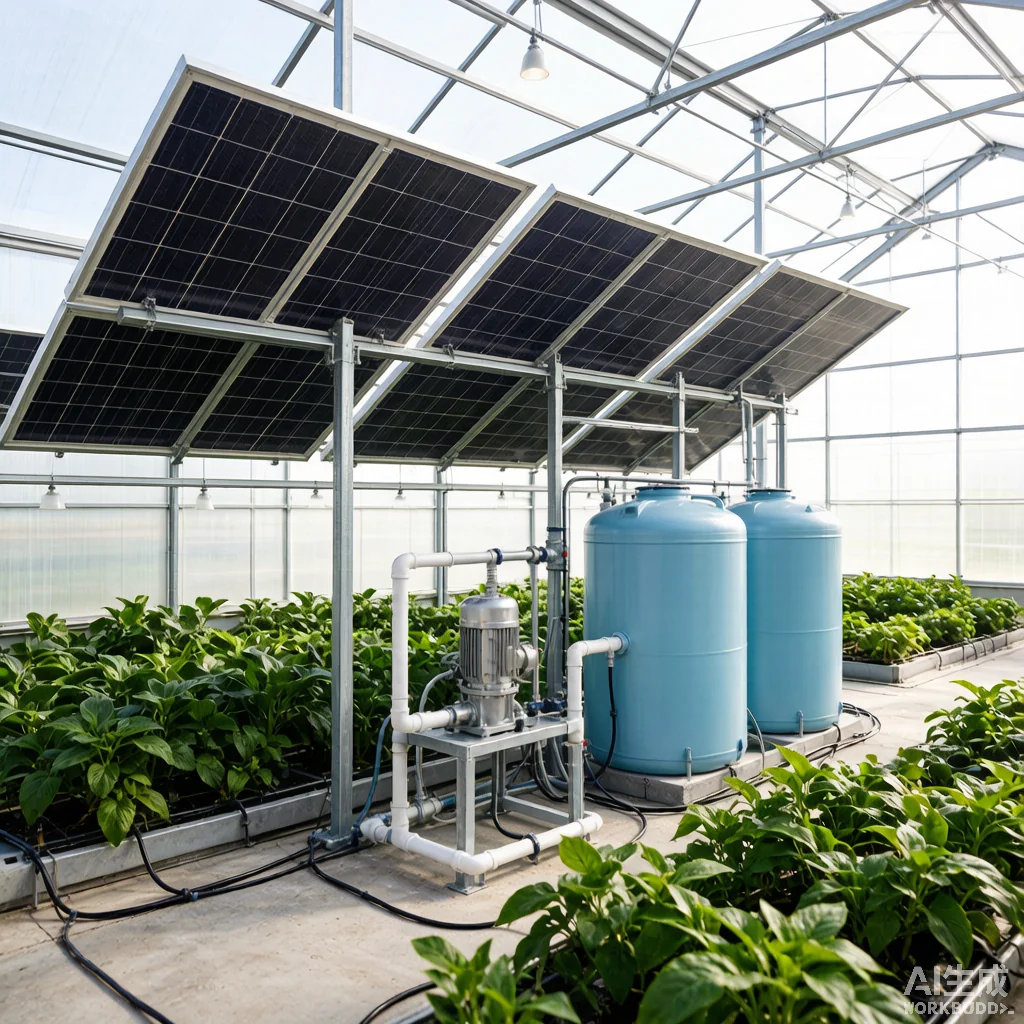
A 1,800 m² glasshouse growing hydroponic tomatoes replaced its grid-powered 1.5 kW circulator pump with a **KINBO** solar pumping system rated at 1.8 kW, paired with a 5 m³ buffer tank and 48V battery bank. The system runs NFT circulation during daylight hours with battery backup for 4 hours of nighttime circulation. Annual electricity savings reached approximately €2,400, with a measured payback of 3.1 years. Crop yield remained equivalent to the grid-powered baseline, confirming no performance compromise.
Case 2: Pepper and Cucumber Farm — Almería, Spain
A 3,200 m² multi-span greenhouse installed a 3.0 kW solar surface pump drawing from a groundwater well at 12 m depth. The pump feeds drip irrigation lines across 14 zones via a 15 m³ elevated tank. With 2,800 annual sunshine hours, the system covers 92% of irrigation demand solar-direct, with a small diesel generator for rare extended overcast periods in winter. The farm reported a 68% reduction in energy costs versus the previous diesel-only setup, and irrigation reliability improved due to consistent daytime pressure.
Case 3: Leafy Greens Vertical Hydroponics — Arizona, USA
A 600 m² indoor vertical farm growing lettuce and basil under LED lighting used solar pumping for its closed-loop recirculation system. A 0.75 kW DC submersible pump circulates nutrient solution through stacked NFT channels, powered by a 1.2 kWp solar array with 5 kWh lithium battery storage. The system achieves 24-hour circulation with zero grid draw for pumping. Total pump-system cost was $5,200, with estimated annual energy savings of $1,150, yielding a 4.5-year payback. The grower noted that eliminating grid dependency simplified permitting for the facility.
Cost Analysis and ROI
Understanding the full financial picture helps growers justify the upfront investment in solar pumping. The cost structure breaks down into four categories:
- Initial Investment: Solar panels, pump, controller, mounting structure, wiring, storage tank, and installation labor. Typically $1,800–$35,000 depending on system scale (see table above).
- Energy Savings: Elimination of grid electricity or diesel fuel costs. A medium 2 kW system replacing grid power saves $800–$2,500/year; replacing diesel can save $2,000–$6,000/year.
- Crop Yield Improvement: Reliable, consistent irrigation pressure and water availability can improve yield by 5–15%, particularly in regions with unstable grid power. For a 2,000 m² greenhouse generating $40,000–$80,000 in annual revenue, a 10% yield improvement adds $4,000–$8,000/year.
- Maintenance Costs: Solar pumps require minimal maintenance — primarily panel cleaning, controller checks, and occasional pump seal replacement — averaging $50–$200/year.
Combining energy savings and yield improvement, most greenhouse solar pump systems achieve payback within 2–4 years. Large systems replacing diesel in sunny climates can pay back in under 2 years. After payback, the system continues delivering near-free pumping for its 15–25 year lifespan, making it one of the highest-ROI investments available to modern greenhouse operators.
Frequently Asked Questions
Q: Can solar water pumps provide consistent pressure for hydroponic nutrient delivery?
A: Yes. When paired with a pressure tank and controller, solar pumps maintain steady pressure between 1.5 and 4 bar, sufficient for drip, NFT, and ebb-and-flow hydroponic systems. Battery backup ensures pressure stability during cloudy periods.
Q: How much water does a 1,000 m² greenhouse need per day?
A: A medium-sized 1,000 m² greenhouse typically requires 2,000 to 5,000 liters per day depending on crop type, climate, and irrigation method. Hydroponic systems with recirculation may need slightly less makeup water but higher circulation frequency.
Q: What is the payback period for a solar pump system in greenhouse farming?
A: Most greenhouse solar pump installations achieve payback within 2 to 4 years. Energy savings from eliminating grid electricity or diesel fuel, combined with improved crop yield from reliable irrigation, drive the return on investment.
Ready to Power Your Greenhouse with Solar?
**KINBO** provides end-to-end solar pumping solutions tailored to greenhouse and hydroponic applications — from pump selection and system sizing to installation support and maintenance. Our engineering team helps you design a system that fits your crop, climate, and budget.
August 12, 2026 | Author: KINBO Editorial Team
Related Articles
- Solar Pump Controller Programming for Irrigation
- Solar Water Pumps for Rural Schools
- Explore KINBO Solar Surface Pumps