Solar Water Pumps for Poultry Farm Water Supply: System Design and Sizing Guide
Solar Water Pumps for Poultry Farm Water Supply: System Design and Sizing Guide
Introduction
Water is the single most important input in poultry production after feed. A broiler consumes roughly twice as much water as feed by weight, and even a short interruption in supply — especially during hot weather — can cause immediate stress, reduced weight gain, and elevated mortality. For farms located off the grid or in areas with unreliable electricity, securing a consistent water supply is both an operational and an economic challenge.
KINBO supplies solar water pumping systems to poultry operations across Africa, Southeast Asia, and the Middle East. This guide explains how to calculate poultry water demand, design a reliable solar pumping and storage system, and evaluate the return on investment. For a broader view of solar pumping for livestock, see our livestock water solution.
Table of Contents
Calculating Poultry Water Demand
Accurate demand estimation is the foundation of any reliable water supply design. Underestimate it and birds go thirsty during peak summer; overestimate it and the system costs more than necessary.
The main components of daily water demand on a poultry farm are:
- Drinking water: The baseline requirement. Broilers drink approximately 2 liters per kilogram of feed consumed, and layers drink about 2.2 liters per kilogram of feed.
- Evaporative cooling and misting: In hot climates, cooling pads and misting systems can add 30 to 100 percent on top of drinking demand during the hottest months.
- Cleaning and sanitation: Between flocks, the house and equipment are washed down, creating a periodic high-volume demand.
As a practical starting point, a broiler house with 20,000 birds requires roughly 4,000 to 6,000 liters per day for drinking under temperate conditions, rising to 8,000 liters per day or more when summer cooling is included. Daily water consumption also climbs as birds age from chicks to market weight, so the design should be based on the peak (end-of-flock, hot-weather) scenario rather than the average.
System Design: Well, Pump, and Storage
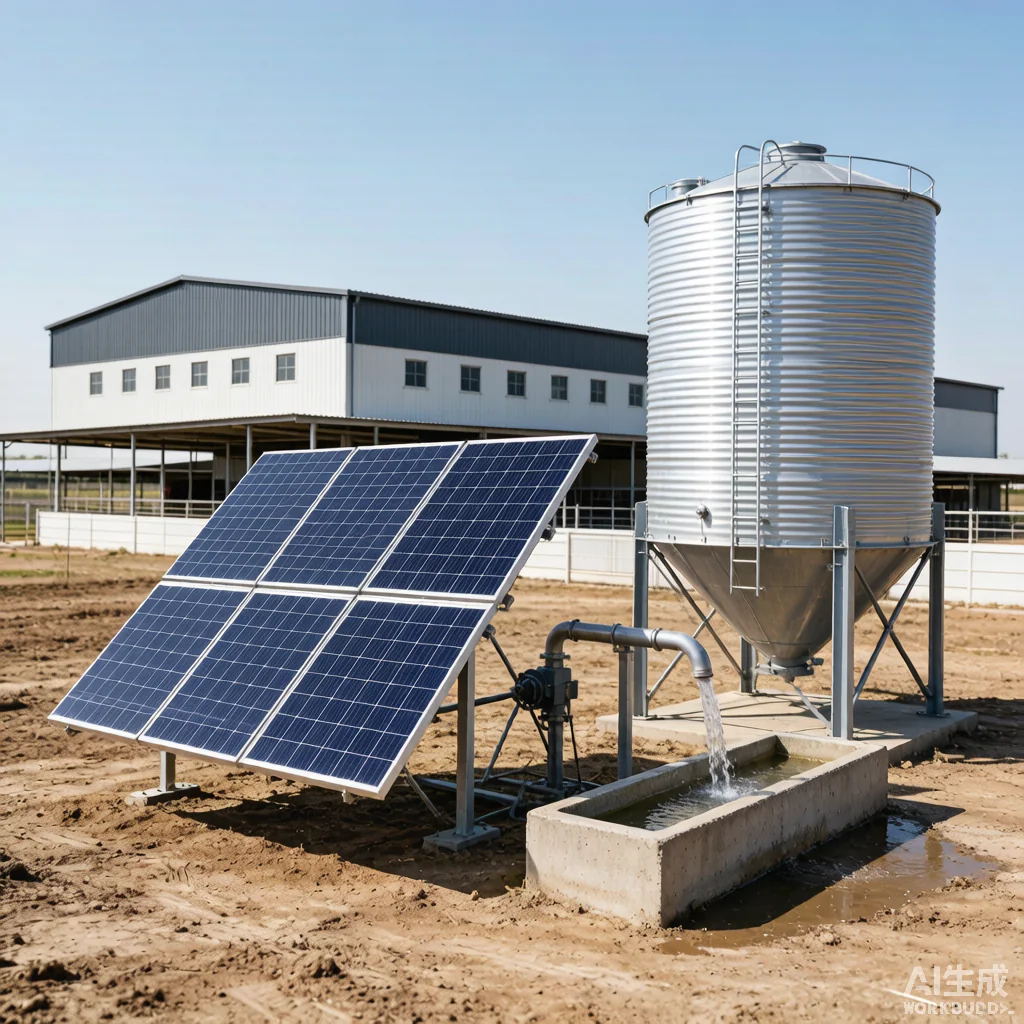
A well-engineered solar poultry water system has four main elements, each sized to work together.
Water source: Most poultry farms use a borehole or well as the primary source. The static and dynamic water levels determine the required pump head, which is the vertical lift plus friction losses in the pipe plus any residual pressure needed to fill an elevated tank.
Pump: For boreholes, a solar submersible pump is the standard choice. It is sized so that the full daily water requirement can be pumped during 5 to 6 peak sunshine hours. This means the pump’s hourly output need only be about one-fifth of the daily demand — a key advantage of solar, which spreads the work across the sunny period into storage.
Solar array: The array is typically oversized by 20 to 30 percent above the pump’s rated power to maintain flow during partial cloud and morning and afternoon low-light periods. This keeps the daily delivered volume consistent even when peak irradiance is not reached.
Storage tank: The tank is the system’s reliability backbone. It should hold 1.5 to 2 times the daily demand, so that birds always have water even if a cloudy day reduces pumping. For a 20,000-bird farm with 6,000 liters of daily demand, a 10,000-liter elevated tank is a sound design target. For guidance on sizing storage correctly, see our article on solar pump water storage tank sizing.
System Configuration by Farm Size
The table below provides starting-point configurations for three common farm scales, assuming a borehole depth of 40 meters and temperate-to-warm conditions.
| Farm Size | Daily Demand | Pump Power | Solar Array | Storage Tank |
|---|---|---|---|---|
| 5,000 birds | 1,500 – 2,000 L | 0.75 kW (1 HP) | 1.2 kW | 3,000 L |
| 20,000 birds | 6,000 – 8,000 L | 2.2 kW (3 HP) | 3.0 kW | 10,000 L |
| 50,000 birds | 15,000 – 20,000 L | 4.0 kW (5.5 HP) | 5.5 kW | 25,000 L |
These are reference points, not substitutes for site-specific engineering. Well depth, water table drawdown, pipe diameter and length, and local temperature all influence the final pump and array selection, which should always be verified against the manufacturer’s performance curves.
Reliability, Backup, and Water Quality
Poultry operations have a low tolerance for water interruption, so reliability is designed in from the start rather than added as an afterthought.
- Storage as buffer: A tank holding 1.5 to 2 times daily demand is the primary reliability mechanism, covering cloudy days and brief maintenance windows.
- Backup power: For critical operations, a small generator or a grid connection with an automatic transfer switch provides insurance against extended bad weather or equipment failure. Some farms add a modest battery bank, but direct-coupled solar-to-storage is usually more cost-effective.
- Water quality: Birds are sensitive to waterborne pathogens. Solar systems are often paired with filtration or a chlorination step at the tank outlet, and a well-placed system avoids contamination from runoff. For more, see our guide on how water quality affects solar pump lifespan.
- Monitoring: A low-tank-level float switch can automatically stop the pump to prevent dry running, protecting the motor and signaling when attention is needed.
Investment and ROI Analysis
The economic case for solar on a poultry farm rests on two pillars: avoiding diesel or grid electricity costs, and avoiding production losses from water interruptions. The table below shows a representative 5-year comparison for a 20,000-bird farm previously running a diesel pump 5 hours per day.
| Cost Item | Diesel | Solar |
|---|---|---|
| Upfront equipment | $400 | $3,200 |
| Annual fuel / energy | $1,400 | $0 |
| Annual maintenance | $250 | $70 |
| 5-year total | $8,650 | $3,550 |
| Payback period | — | ~2.1 years |
Note: Illustrative estimates for a 2.2 kW system in 2026, assuming 5 hours daily operation and typical rural fuel and maintenance costs. Actual figures vary by region, duty cycle, and local energy prices.
The under-three-year payback is compelling on its own, and it does not even account for the value of avoiding water-related production losses, which can be the largest hidden cost of an unreliable supply.
Frequently Asked Questions
How much water does a poultry farm need per day?
As a rule of thumb, broilers drink about 2 liters of water per kilogram of feed consumed, and water consumption roughly doubles in hot weather when cooling and misting are included. A 20,000-bird broiler house typically needs 4,000 to 8,000 liters per day depending on age, temperature, and whether evaporative cooling is used.
What size solar pump do I need for a poultry farm?
The pump size depends on daily water demand, the well or borehole depth, and available storage. For a 20,000-bird farm drawing from a 40-meter borehole, a 1.5 to 2.2 kW solar submersible pump with a 3 kW panel array and 10,000-liter storage tank is a common configuration, sized to deliver the full daily requirement during 5 to 6 peak sunshine hours.
Is solar power reliable enough for poultry farm water supply?
Yes, when designed with adequate storage. A properly sized storage tank of 1.5 to 2 times daily demand acts as a buffer, so birds receive water even during cloudy periods or brief pump downtime. Many farms also keep a small generator or grid connection as backup for extreme weather or emergencies.
Can a solar pump handle the extra water needed for evaporative cooling?
Yes, but the system must be sized for the combined drinking and cooling load during the hottest months. This is the peak-demand scenario, and both the pump and storage tank should be sized to meet it rather than the temperate-season average.
Planning a Poultry Farm Water System?
For B2B buyers and integrators building reliable poultry water supply, contact KINBO for competitive FOB pricing and technical specifications.
August 14, 2026 | Author: KINBO Editorial Team
Related Articles