Solar Water Pumps for Brackish and Saline Water Sources: Desalination-Ready Pumping Systems
Introduction
Coastal communities, arid inland basins and agricultural drainage zones often have water—just not fresh water. Brackish and saline sources are abundant, but they are corrosive and, for drinking use, demand treatment. A solar water pump for these sources must do more than move liquid: it must survive salinity and, where needed, feed a desalination stage. This article focuses on the pumping and materials side—intake, corrosion resistance and matching the pump to treatment—rather than the membrane process itself; for the treatment stage see our water treatment solution page. Manufacturers such as KINBO configure saline-duty packages with corrosion-rated materials so the pump outlasts the harsh chemistry.
Table of Contents
Why Brackish and Saline Sources Need Special Handling
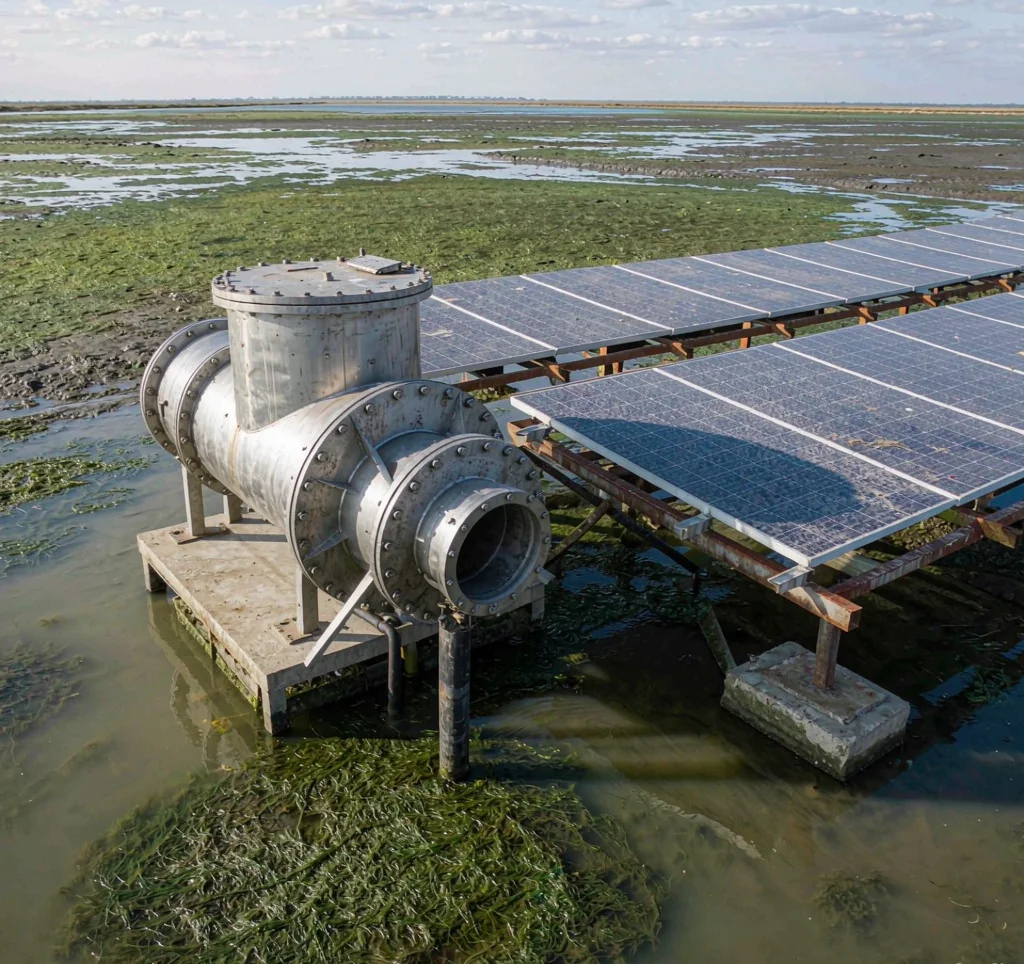
Saline water accelerates corrosion, scales wetted surfaces and quickly destroys standard seals and fasteners. Brackish (1–10 g/L total dissolved solids) is manageable with upgraded materials; seawater (>35 g/L) demands full marine-grade specification. The pumping design must also consider pre-filtration, since algae and silt in lagoons clog intakes fast. Get the materials wrong and a pump fails in a season; get them right and it runs for years in the same water.
Material Selection: Beating Corrosion
Every wetted part should be chosen for the chloride load it will see:
| Component | Recommended Material | Why |
|---|---|---|
| Pump body | Duplex stainless / reinforced composite | Resists chloride corrosion |
| Seals | FKM or FFKM (not standard NBR) | Withstands saline swelling |
| Fasteners | 316 stainless steel | No rust at joints |
| Cable | UV- and saline-rated jacket | Survives coastal exposure |
| Strainer | 316 SS or bronze | Corrosion-proof screening |
Pre-Treatment and Intake for Saline Water
Before the pump sees the water, protect it:
- Fit a coarse strainer sized to the pump’s solids tolerance.
- Add a settling or first-flush stage to drop sediment before the pump.
- Rinse strainers on a fixed schedule during algal blooms.
- Keep suction lines full and air-free to limit cavitation.
- Monitor TDS so scaling-prone sources get periodic descaling.
Matching the Pump to a Desalination Stage
Where the water becomes potable, the pump’s job changes by stage. A low-pressure lift moves raw saline water to a holding tank; a high-pressure feed pump then drives reverse osmosis or electrodialysis. KINBO supplies both duty points—often from one PV array—so the solar resource is shared between intake and treatment rather than doubled. Sizing the high-pressure stage to the membrane’s rated flux avoids both starvation and membrane damage, and a small buffer tank decouples the two pumps for stable operation.
Frequently Asked Questions
Can a standard solar pump handle brackish water?
Not safely long-term; upgrade to corrosion-rated materials and seals, or expect rapid failure in saline water.
What material is best for seawater?
Marine-grade duplex stainless or titanium wetted parts with FKM/FFKM seals and 316 stainless fasteners.
Do I need a special pump for desalination?
For the RO/ED feed you need a high-pressure pump matched to the membrane flux, plus a low-pressure intake pump.
How do I stop the intake clogging in a lagoon?
Use a coarse strainer with a settling stage and rinse on a fixed schedule, especially during algal growth.
For B2B buyers specifying solar pumping for brackish or saline sources, contact KINBO for competitive FOB pricing and corrosion-rated system design.