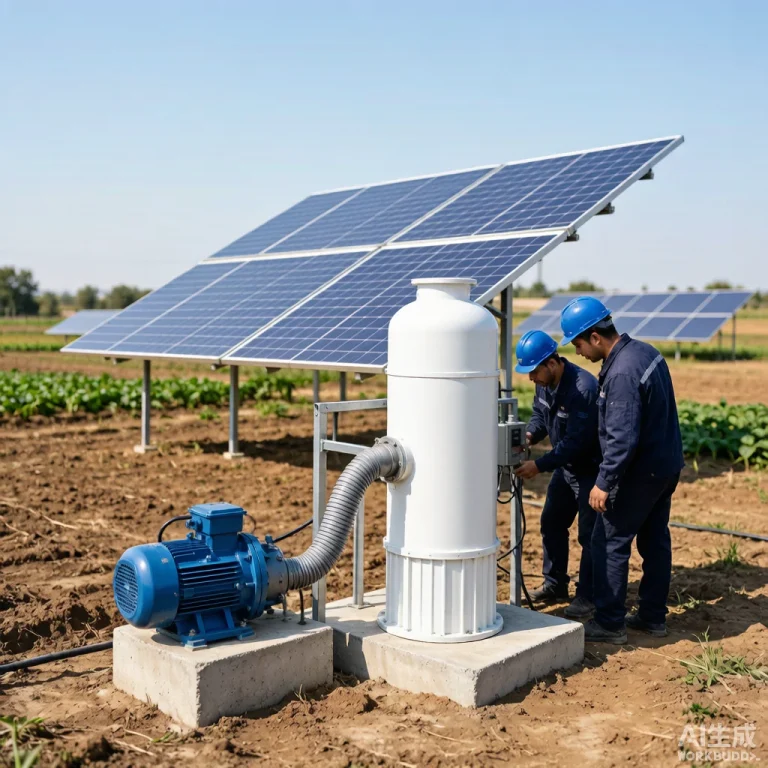
Solar Pump Systems for Gold Mine Heap Leach Irrigation
Introduction
Heap leaching is one of the most common ways gold is recovered across Africa: ore is stacked on a lined pad and a cyanide or thiosulfate solution is sprinkled over it, dissolving the gold so it can be collected and precipitated. That irrigation duty runs continuously, day after day, over months—exactly the kind of steady, daytime water load a solar pump excels at. A solar heap-leach pump removes the diesel bill from the single largest recurring water duty on a leach operation. This guide, from solar pumping specialists at KINBO, covers solar pump systems for gold-mine heap leach irrigation.
Table of Contents
The Heap-Leach Irrigation Duty
- Solution delivery—barren or recirculated leach solution is pumped from the pond to sprinkle or drip over the pad at a controlled application rate.
- Recirculation—the pregnant solution collected underneath is returned to process, so the pump also moves rich liquor to the recovery plant (our process-water guide).
- Continuous, daytime—irrigation runs through sunlight hours; a buffer pond carries brief gaps and lets the system coast at night without stopping dissolution.
- Scale—pad size sets flow; small camps may need a few m³/h, large pads tens to hundreds.
Selecting the Irrigation Pump
- Centrifugal pump—the default for moving bulk leach solution at the pressures sprinklers or drippers need.
- Materials—cyanide solution is corrosive, so specify chemical-resistant wet-ends (HDPE, PP, stainless or lined) to survive the duty; our reagent-dosing guide covers compatible materials thinking.
- Reagent integration—the same system often feeds the cyanide dosing point, so size for both irrigation and dosing draw.
- Control—a VFD-style solar controller holds application pressure as the array output swings through the day.
Solar Drive and Storage
- Array sizing—size to peak irrigation energy with ~20% headroom; heap leach is a daylight duty, so battery needs are modest.
- Buffer pond—an on-pad or central tank/sump decouples pumping from application, so cloud never stalls the leach front.
- Hybrid backup—where a pad must never go dry, a hybrid controller adds a small generator only when the buffer is low.
Solar vs Diesel Leach Irrigation
| Factor | Diesel Leach Irrigation | Solar Leach Irrigation |
|---|---|---|
| Energy cost | Per run-hour, perpetual | Zero after install |
| Fuel logistics | Daily convoy risk | One-time delivery only |
| Downtime | Fuel-out stops the pad | Buffer keeps leaching |
| Best fit | Grid-connected pads | Remote African leach ops |
For the full cost case, our solar-vs-diesel analysis shows remote sites typically pay back in 1–3 years.
Frequently Asked Questions
Can solar handle corrosive leach solution?
Yes—specify chemical-resistant wet-ends and compatible seals; the pump type is the same, only the materials change. Size for both irrigation and dosing draw so the system is balanced.
What if the pad must run at night?
A buffer pond carries irrigation through the night; for a true 24/7 pad, add a battery or the hybrid backup so dissolution never stops.
Does solar integrate with recovery?
The same pump moves pregnant solution to the recovery plant, so solar carries both irrigation and the first stage of recovery recirculation.
How big an array do I need?
It scales with pad flow and head; we size from your application rate and pond-to-pad lift using our sizing methodology.
Related Articles
- Solar Pump Selection for Gold Mine Process Water
- Solar Pump Selection for Gold Mine Chemical and Reagent Dosing
- Solar Pump Sizing and Design Methodology for Gold Mines
- Explore KINBO Solar Pump Products
Get a Solar Heap-Leach Irrigation Pump
Share KINBO your pad area, application rate, pond-to-pad lift and solution chemistry, and we will specify a corrosion-resistant solar irrigation pump with the right buffer and control to keep your leach front moving off-grid. Contact our team for a tailored quote.
Published by KINBO · September 23, 2026 · Category: Application Cases