Solar Pump Selection for Sugarcane Irrigation: Sizing High-Volume Water Duty from Seedling to Grand Growth
Introduction
Sugarcane demands 1,500–2,500 mm of water across a ten- to twelve-month growth cycle — more than almost any other commercial crop. For sugar estates, outgrower schemes and contractor-irrigated blocks across Africa, South Asia and Latin America, that duty has traditionally been met by diesel or grid-electric pumps with punishing energy bills. Solar pumping changes the economics: with the right pump, array and irrigation method, a cane block can be irrigated at near-zero marginal energy cost. Manufacturers such as KINBO supply complete solar pumping packages — submersible borehole pumps, surface pumps, hybrid controllers and inverters — engineered for high-volume agricultural duty. This guide covers the full selection process, from water-demand planning to PV sizing and control.
Table of Contents
Why Sugarcane Demands a High-Volume Pumping Design
Unlike lightly irrigated crops, sugarcane concentrates most of its water use in one phase. During grand growth — months four to nine after planting or harvest — the crop transpires 6–8 mm per day, and stress in this window directly cuts cane tonnage and sugar recovery. Germination and tillering need moderate volumes; ripening is often deliberately stressed to raise sucrose. Size the pumping system for the grand-growth peak, not the season average.
| Growth Stage | Typical Period | Water Demand | Share of Season Total |
|---|---|---|---|
| Germination | 0–35 days | 3–4 mm/day | ~10% |
| Tillering | 35–120 days | 4–6 mm/day | ~25% |
| Grand growth | 120–270 days | 6–8 mm/day | ~55% |
| Ripening (controlled stress) | 270–360 days | 2–4 mm/day | ~10% |
Assumes a 10–12 month plant-cane cycle in a tropical climate; confirm against local evapotranspiration data. See our crop water demand reference table.
At 7 mm/day peak duty, each hectare consumes about 70 m³ per day — a 50-hectare block needs some 3,500 m³ daily, a volume that dictates pipe diameter, pump and array size alike.
Design Inputs to Collect Before Selecting a Pump
Before selecting a model, a site survey should fix five variables; skipping this step is the most common cause of undersized or overpriced systems.
- Irrigated area and application method. Drip needs 1–2 bar at the emitters but uses 30–50% less water than furrow; sprinkler shifts the duty toward pressure.
- Water source and static lift. Borehole depth and dry-season river levels set the lift component.
- Total dynamic head (TDH). Static lift plus mainline friction — see how to calculate required head for a pump before choosing a model.
- Solar resource. Peak sun hours set the daily pumping window; 5.0–6.5 PSH is typical across the main cane belts.
- Water quality. Sandy or high-silt sources call for sand-resistant impellers and intake screens.
Matching Pump Type and System Layout to the Field
Three architectures dominate sugarcane projects; the right choice depends on where the water sits relative to the field.
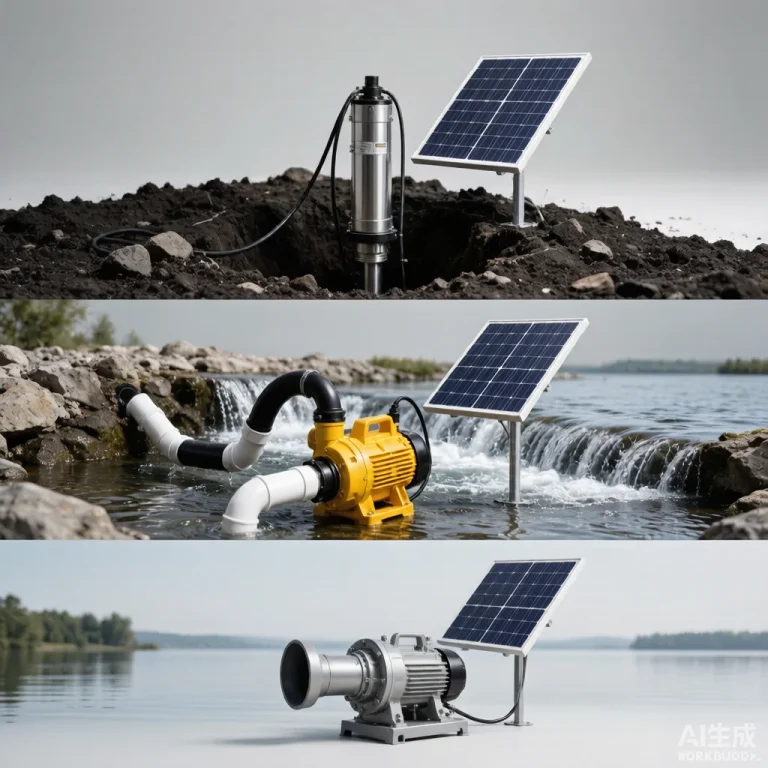
| Parameter | Solar Submersible Pump | Solar Surface Pump | AC/DC Hybrid System |
|---|---|---|---|
| Water source | Borehole / deep well | River, canal, pond | Any, with grid or genset backup |
| Typical head range | 20–250 m | 5–40 m | As per pump selected |
| Flow range | 1–60 m³/h | 5–120 m³/h | Day and night |
| Best fit for sugarcane | Inland blocks on boreholes | River-bank estates | Estates needing night irrigation |
| Relative system cost | Medium | Low–medium | Higher (controller/inverter) |
For drip cane on borehole supply, a multistage solar submersible pump feeding a balancing reservoir is the most common layout: the pump fills the reservoir during sun hours and drip headers draw at constant pressure. Where a river borders the estate, self-priming surface pumps keep installation cost low. Both layouts appear in our guide to solar pump system design for irrigation.
Worked Sizing Example and PV Array Planning
The example below illustrates sizing logic for a mid-sized drip-irrigated block; figures are indicative and must be recalculated against site data.
| Design Input | Example Value | Note |
|---|---|---|
| Irrigated area (drip) | 40 ha | Single block or staged sub-blocks |
| Peak water duty | 6.5 mm/day | Grand-growth stage |
| Daily volume | 260 m³/day | 4 sub-blocks in rotation |
| Static lift + friction | 45 m + 15 m = 60 m TDH | River intake, dry-season level |
| Pump shaft power | ≈ 9.5 kW | ~10 h pumping window |
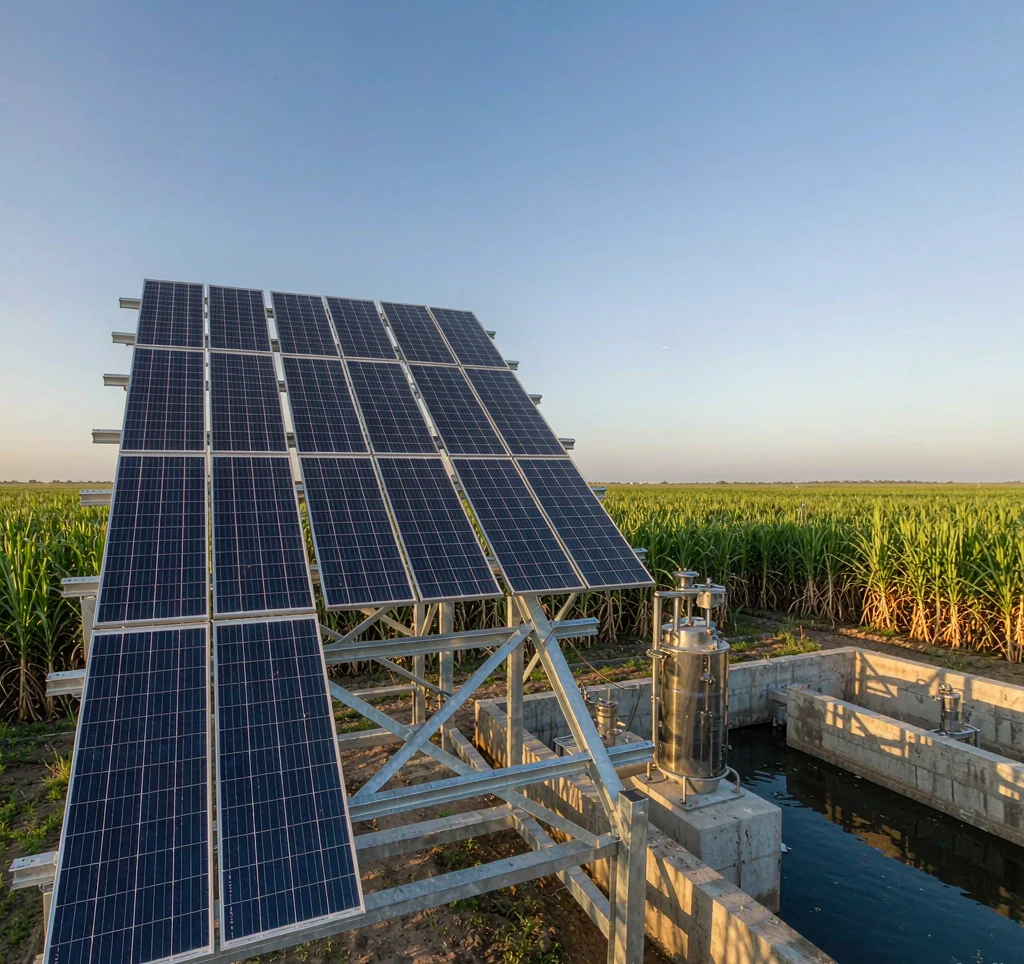
| PV array | ≈ 14 kWp | 5.5 PSH, 0.75 derate |
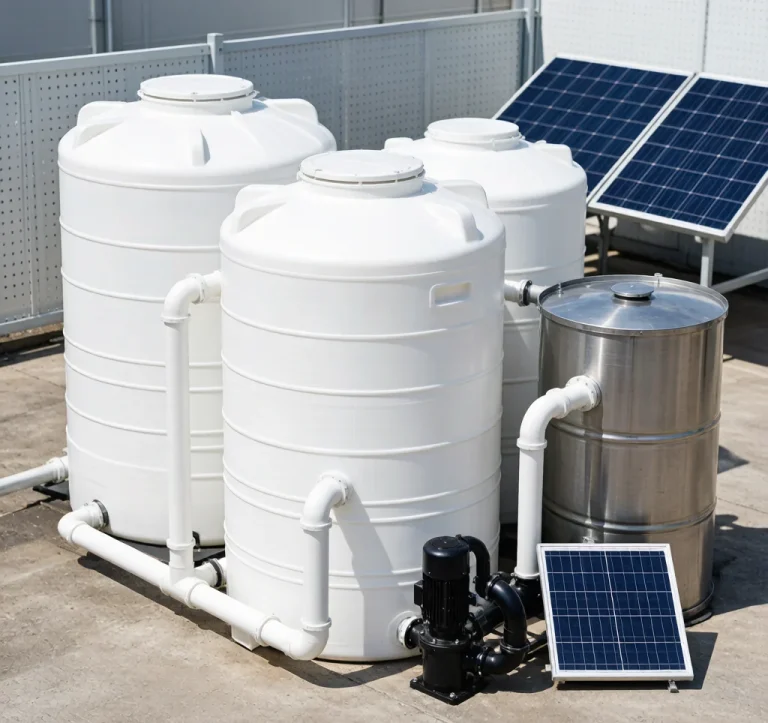
| Balancing storage | 150–260 m³ | 0.5–1 day of duty |
Assumes drip efficiency of 90%, pump wire-to-water efficiency of 45%, no generator backup.
The rule of thumb: drip-irrigated sugarcane at moderate lift needs roughly 0.3–0.5 kWp of PV per hectare, while furrow can push that above 0.8 kWp/ha — converting the application method first usually saves more than any pump optimization. Array orientation follows our guide on configuring solar panels for water pumps.
Scheduling, Control and Protection
Cane tolerates alternate-day and night irrigation during grand growth, letting the system do more with less array. Good practice includes:
- Sub-block rotation. Divide the estate into 3–5 irrigation sets and rotate daily; this halves instantaneous flow and hence pump and array size.
- VFD or MPPT control. Maximum power point tracking keeps the pump on curve through cloud transients; variable frequency drive trims speed to match reservoir level and header pressure.
- Dry-run and sensor protection. Float switches stop the pump on low source level; pressure switches protect drip laterals.
- Mill-season alignment. Timer programming should mirror the harvesting and rotation calendar.
- Preventive maintenance. Quarterly intake-screen inspection and pre-season panel cleaning follow our solar water pump maintenance guide.
KINBO supplies these controllers — including hybrid AC/DC units that auto-switch to grid or generator in monsoon weeks — as matched packages with protection pre-configured.
Frequently Asked Questions
Can solar pumps handle a whole sugar estate, or only smallholder plots?
Pumps can be staged in parallel and block rotation keeps single-pump duty manageable. Estates of several hundred hectares are typically served by multiple medium-sized pumping stations rather than one giant unit, which also improves resilience.
What happens during extended cloudy or rainy periods?
Either oversize the array by 20–30% to hold output through light overcast, or specify a hybrid AC/DC controller that switches to grid or generator automatically. Most estates ride through short cloudy spells on storage alone.
Is drip irrigation necessary, or can solar pumps run furrow systems?
Solar pumps can run furrow, but it is rarely economic: furrow needs 40–100% more water for the same yield, inflating pump, pipe and array cost proportionally. Drip usually pays back its premium within one to three seasons.
How much PV power is needed per hectare of sugarcane?
For drip at moderate lift, plan on 0.3–0.5 kWp per hectare. Deep boreholes, long mainlines or furrow application can double that; always recalculate with actual TDH and daily volume.
For B2B buyers planning sugarcane irrigation schemes, outgrower block conversions or mill water-supply upgrades, contact KINBO for competitive FOB pricing and technical specifications.
Related Articles
- Solar Pump Selection for Rice Paddy Irrigation
- Solar Pump Selection for Sprinkler Irrigation: Flow, Pressure and Uniform Coverage
- Solar Water Pumps for Palm Oil Plantation
- Explore KINBO Solar Submersible Pumps