How to Select the Right Solar Water Pumps for Rice Paddy Irrigation: High-Flow Low-Head Sizing Guide
Introduction
Flooded rice cultivation is one of the most water-intensive forms of agriculture on earth, yet it is also one of the most forgiving when it comes to pump hydraulics. Unlike orchard or greenhouse systems that demand precise pressure, a paddy field mostly needs a large volume of water moved across a very small elevation change. Manufacturers such as KINBO have responded to this reality with solar pumping packages built around high flow and low head rather than the deep-lift performance that dominates borehole markets. For project engineers and B2B procurement teams planning seasonal or continuous paddy irrigation, the selection logic is therefore distinct: get the flow right first, then worry about the modest head.
Table of Contents
Why Rice Paddy Irrigation Is Different
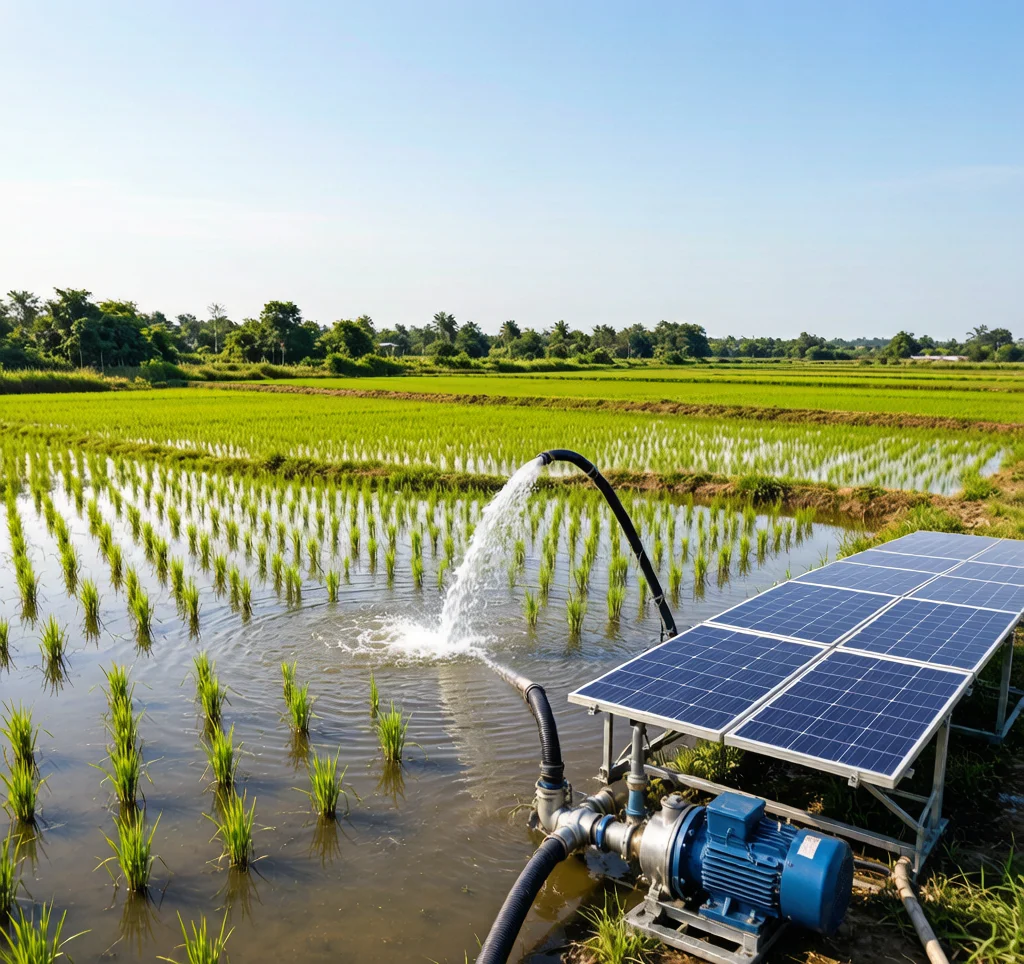
A typical paddy requires a standing water layer of 5 to 15 cm maintained for most of the growing season. The pump does not need to fight gravity over a tall column; it needs to deliver tens or hundreds of cubic meters per hour across a head that often stays below 15 meters. This shifts the entire selection conversation toward volumetric efficiency and daily energy yield rather than maximum lift. A system that pumps 50 m³/h at 8 m head is far more valuable here than one that pumps 5 m³/h at 80 m head, even if the second unit is the “stronger” sounding specification.
Choosing Pump Type: Submersible vs Surface
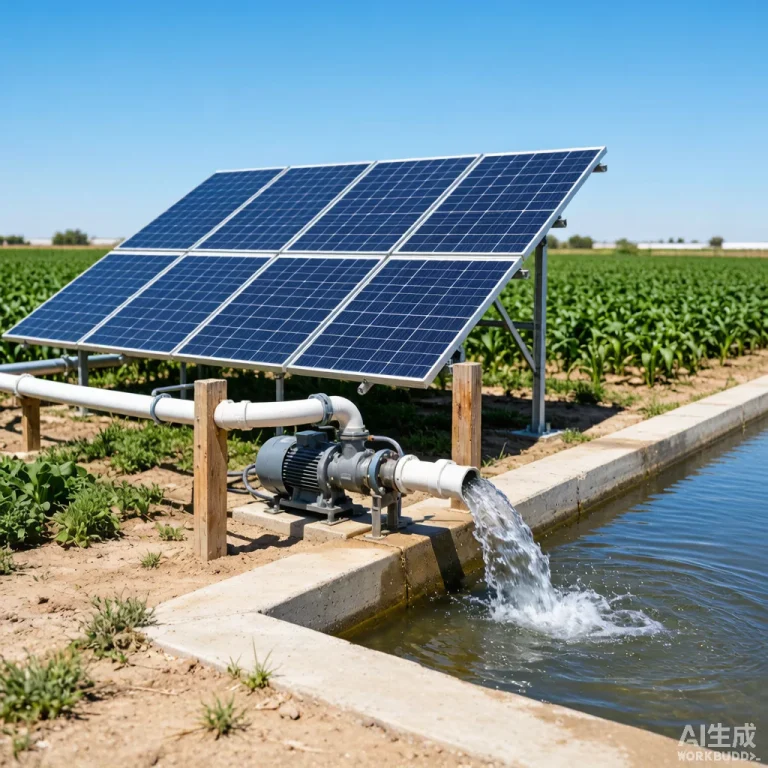
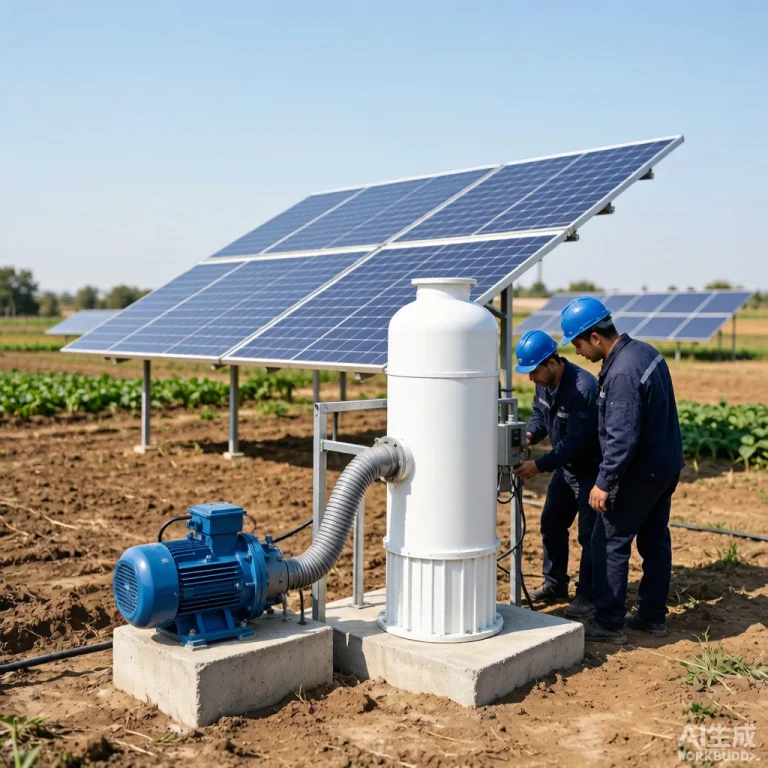
The two mainstream architectures for paddy supply are the submersible pump drawing from a well, river or canal, and the surface pump (centrifugal or multi-stage) drawing from a shallow open source. The right choice depends on the water source geometry, not on brand preference. For fields fed from a nearby river or reservoir with a suction lift under 7 meters, a surface pump is cheaper, easier to service and less exposed to silt. For supply from a deep well or a canal bed below the field, a submersible is unavoidable.
| Parameter | Submersible Pump | Surface Pump |
|---|---|---|
| Typical source | Deep well, canal bed, river bottom | Shallow river, reservoir, pond |
| Max suction lift | Not limited by lift | ~7 m practical limit |
| Service access | Pull unit from well | On-bank, easy inspection |
| Silt vulnerability | Moderate (sealed motor) | Higher (open impeller) |
| Best fit for paddy | Deep groundwater supply | Surface water supply |
Sizing Flow Rate and Operating Head
Start from the field area and the required refill rate. A 1-hectare paddy losing roughly 10 mm per day to percolation and evaporation needs about 100 m³/day, and if you want it delivered in 6 solar peak hours the pump must average ~17 m³/h. Add a 20% margin for uneven sun and you land near 20 m³/h. The operating head is the static lift plus friction loss in the delivery pipe plus any field-level rise. Because paddy heads are short, friction loss from undersized pipe is the most common cause of undersized real-world flow. KINBO application notes recommend reading our solar pump system design for irrigation before fixing the final pipe diameter.
| Field Size (ha) | Daily Demand (m³) | Pump Flow @ 6h Sun (m³/h) | Typical Head (m) |
|---|---|---|---|
| 0.5 | 50 | 10 | 6–10 |
| 1.0 | 100 | 20 | 6–12 |
| 2.0 | 200 | 40 | 8–15 |
| 5.0 | 500 | 100 | 10–18 |
Assumptions: 10 mm/day water loss, 6 equivalent peak sun hours, 20% design margin. Local evapotranspiration and soil permeability will shift figures.
Sizing the Solar PV Array
Once flow and head define the hydraulic power, convert to electrical input using pump efficiency (often 35–55% for small solar units) and add controller losses. A 20 m³/h unit at 10 m head delivers about 0.55 kW of hydraulic power; at 45% efficiency the motor needs ~1.2 kW, and the PV array should be rated ~1.5 kWdc to cover losses and low-light mornings. Oversizing the array by 15–25% is cheap insurance against dust and aging panels. KINBO packages pair the pump curve directly with a matched PV recommendation so the field performs on the worst month, not just at noon in summer.
Piping, Channels and Water Distribution
Delivery design matters as much as the pump. Use the largest practical PVC or HDPE main line to keep friction loss under 10% of total head, then branch into field channels or low-pressure lay-flat hose. Avoid throttling valves to “slow the pump” — on a solar system that wastes harvested energy. Instead let the pump run at its efficient point and manage runtime with a float switch or timer. For clustered smallholdings, a single higher-flow source feeding a shared channel is usually cheaper than many tiny pumps.
Maintenance and Reliability
Paddy water carries silt, algae and organic debris, so intake screening is the single highest-leverage maintenance task. Inspect and rinse the foot valve or strainer weekly during peak season. Check electrical connectors and the controller enclosure for moisture before each planting cycle, and log daily run hours to spot the gradual flow drop that signals wear. With these basics, a well-specified solar paddy pump runs for years with almost no fuel cost.
Frequently Asked Questions
Can a solar pump maintain the standing water level during cloudy periods?
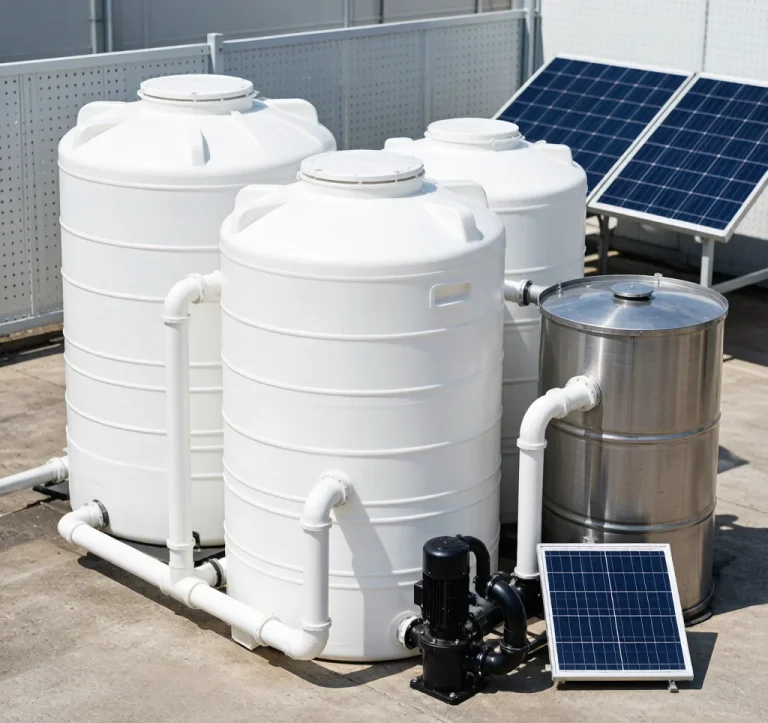
Size the array for the worst solar month and include a small storage tank or channel buffer; during multi-day cloud the system tops up slowly but the field retains standing water from prior sunny days.
Is a submersible or surface pump better for paddy irrigation?
Surface pumps win for shallow rivers and ponds thanks to low cost and easy service; submersibles are required when the only source is a deep well or a canal bed below field level.
How much PV capacity do I need per hectare?
For a 1 ha paddy with 10 mm/day loss, plan roughly 1.5 kWdc of PV to deliver ~20 m³/h across a 6–12 m head; adjust upward for higher evapotranspiration regions.
Do I need a battery for paddy irrigation?
Almost never. Pumping happens in daylight when the sun is available, so direct PV-to-pump operation is the most economical configuration.
For B2B buyers specifying solar pumps for rice paddy or lowland irrigation, contact KINBO for competitive FOB pricing and technical specifications.