How to Size and Select Solar Water Pumps for Greenhouse Irrigation in Africa: A Practical Guide
Introduction
Greenhouse cultivation is expanding across Africa as growers chase export-quality vegetables and year-round yields. But a greenhouse is only as productive as its water delivery, and grid power is often unreliable where these structures are built. Knowing how to size and select solar water pumps for greenhouse irrigation in Africa turns sunlight into a precise, pressurized water supply for drip lines. KINBO offers controllers and pumps tuned for the steady, moderate-flow duty that greenhouses demand. This guide covers the calculations and choices that determine success.
Table of Contents
Why Greenhouses Suit Solar Pumping
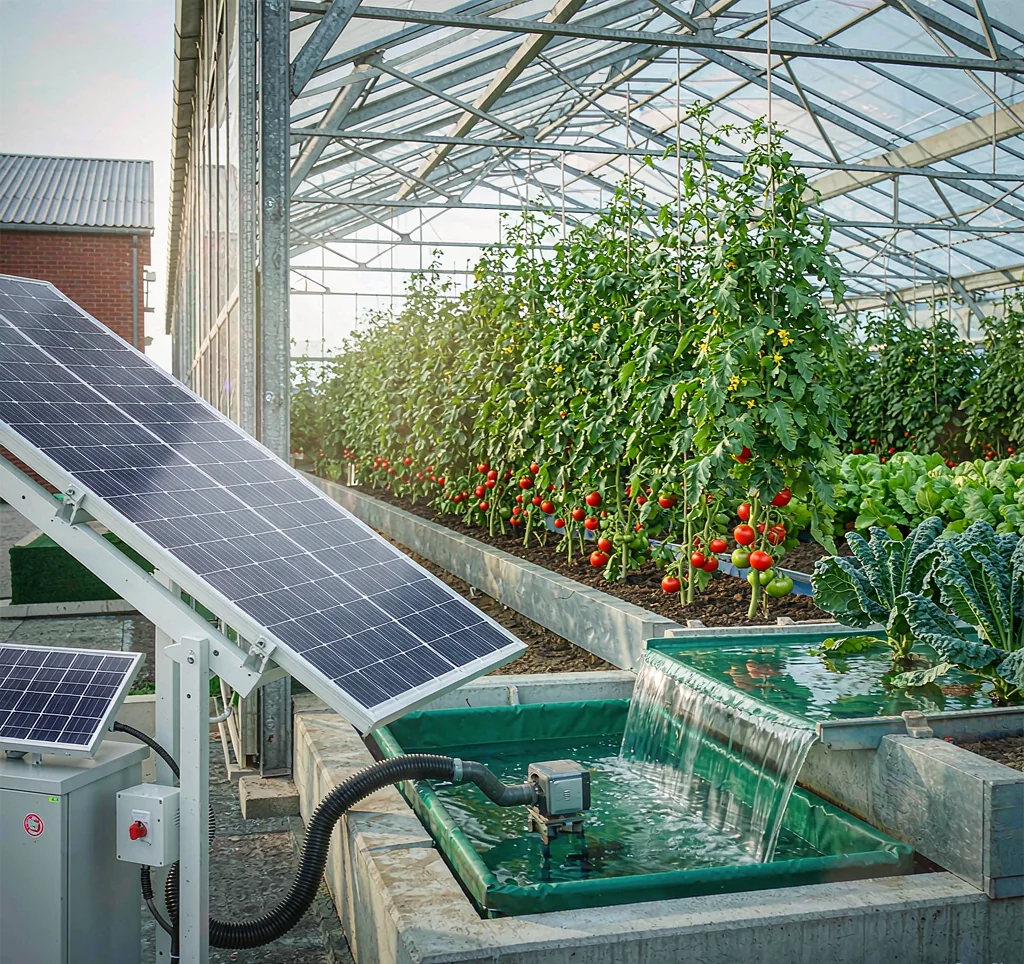
Greenhouses concentrate value per square metre, so a modest, reliable water flow protects a high-value crop. Solar pumping aligns perfectly: peak irrigation coincides with peak sun, and a battery-less direct system is both cheap and dependable. Growers avoid diesel fumes near produce and remove a recurring operating cost.
Because greenhouse demand is steady rather than peaky, it is easier to match a pump curve than for flood irrigation. That predictability is why solar is often the lowest-risk choice here.
Estimating Greenhouse Water Demand
Start from crop evapotranspiration and greenhouse area. A 500 m2 greenhouse of tomatoes in a warm climate may need 3-5 m3 per day in the hottest month. Drip systems apply that volume in several short cycles to keep root zones moist without runoff.
| Greenhouse area | Peak daily demand | Suggested flow |
|---|---|---|
| 250 m2 | 2 m3/day | 0.1 L/s |
| 500 m2 | 4 m3/day | 0.2 L/s |
| 1000 m2 | 8 m3/day | 0.4 L/s |
Estimates assume drip irrigation in warm conditions; adjust for climate and crop.
Understanding Head and Pressure Requirements
Drip lines need a working pressure of roughly 1-2 bar at the manifold. Total dynamic head equals that pressure (as metres of lift) plus the water-source lift plus friction losses in pipes and filters. A source 20 m below the greenhouse plus 15 m of pressure equivalent gives about 35 m of head to design for.
Underestimating head is the most common cause of weak emitters, so add a 20%% safety margin when reading the pump curve.
Sizing the Solar Array and Controller
Once flow and head give the pump wattage, size the PV array with a margin for hot-weather panel derating and dust. A 200 W pump normally pairs with 300-350 W of panels. The MPPT controller should be rated above the motor’s starting current.
- Calculate daily volume and duty hours.
- Convert required flow and head into pump watts.
- Add 30% to panel wattage for margin.
- Pick a controller rated above starting current.
- Include a tank if evening irrigation is required.
A clear walkthrough of how to choose a solar water pump complements these greenhouse-specific steps.
Selecting the Right KINBO Pump
For greenhouse duty, a surface pump with an integrated driver is often ideal: it sits near the tank, is easy to service, and pairs with a built-in controller solar pump for the simplest wiring. Where water is drawn from a deep well, a submersible model is the better match. KINBO’s documented curves let integrators confirm pressure at the emitter before purchase.
Choosing the right family up front prevents the weak-emitter problems that plague under-specced installations.
Frequently Asked Questions
What flow rate does a greenhouse irrigation pump need?
A 500 m2 tomato greenhouse in warm Africa typically needs about 0.2 L/s to deliver 4 m3 per day through drip lines, though crop and climate change the figure.
Do greenhouse solar pumps need a pressure tank?
A pressure tank smooths pulsation and protects emitters, and a storage tank lets you irrigate outside sunlight hours if batteries are not used.
Should I use a submersible or surface pump for a greenhouse?
Use a surface pump when the source is a nearby tank or shallow well; choose a submersible when drawing from a deep borehole below the structure.
How much PV is needed for a 500 m2 greenhouse?
Around 300-350 W of panels usually covers a 200 W pump with margin for heat and dust, delivering the daily volume within sun hours.
For B2B buyers greenhouse irrigation projects for high-value crops in Africa, contact KINBO for competitive FOB pricing and technical specifications.
Related Articles
- Choosing Solar Water Pumps for African Conditions
- Solar Water Pumps for African Smallholder Agriculture
- Explore KINBO Built-in Controller Solar Pumps