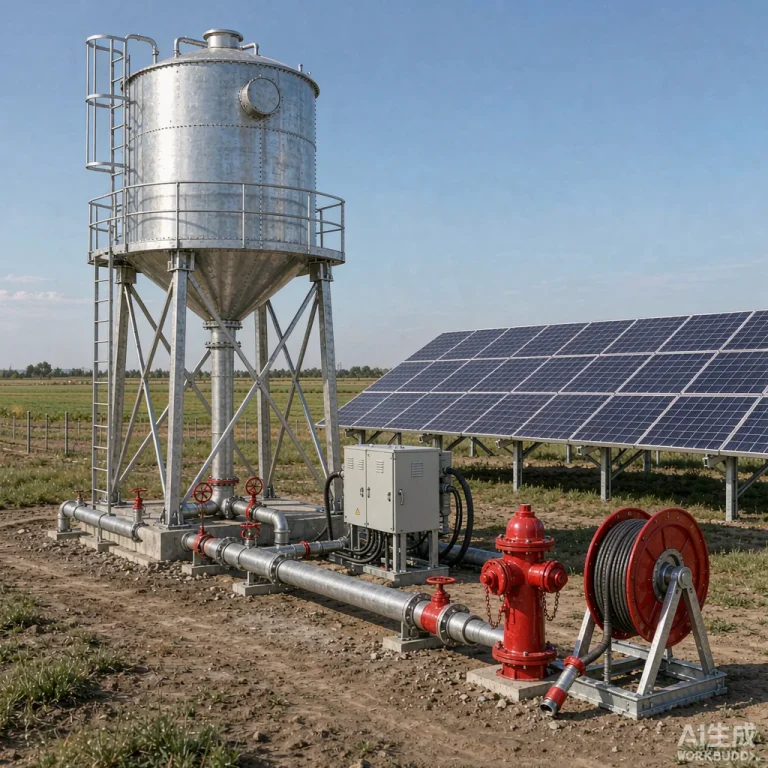
Solar Water Supply Systems for Rural Villages in Africa: Community Water Application Case Study
Introduction
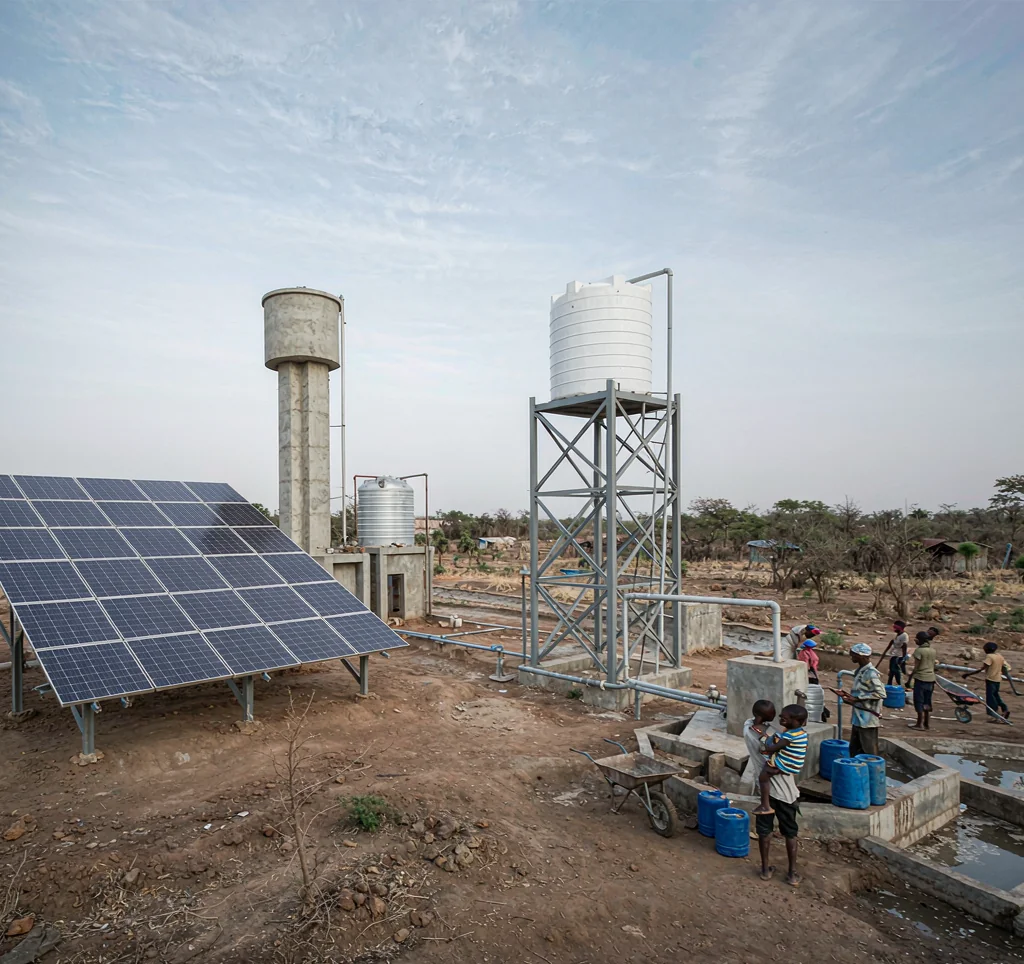
Millions of people in rural Africa still walk long distances for water, and hand pumps frequently break down without funds for spare parts. Solar water supply systems for rural villages in Africa replace that uncertainty with a solar array, a submersible or surface pump, and an elevated tank that delivers water by gravity. KINBO supports these deployments with robust DC pumps sized for communal draw and minimal upkeep. This case study walks through a representative village installation, the design choices made, and the operational lessons that matter for scaling.
Table of Contents
Why Villages Need Solar Water Points
In many rural settlements the nearest safe source is a hand-dug well or a seasonal stream. Hand pumps reduce carry distance but fail often, and diesel pumps are too expensive to run daily for a whole community. Solar pumping matches supply to daylight demand: panels drive the pump through the day, filling a tank that serves taps and public standposts around the clock.
Beyond drinking water, a reliable point supports school gardens, small livestock, and hygiene that lowers disease burden. The social return on a single shared system is therefore far larger than the hardware cost suggests.
Planners should anchor designs on a proven drinking water solution framework rather than ad-hoc borehole conversions.
System Design for a Community Water Point
A typical village point serves 300-600 people at 20-40 litres per person per day. That implies a daily volume near 15 m3, lifted from a borehole at 30-60 m and stored in a 10-20 m3 elevated tank. The pump must deliver that volume within the sun hours available.
| Parameter | Low-demand village | High-demand village |
|---|---|---|
| Population served | 300 | 600 |
| Daily volume | 10 m3 | 20 m3 |
| Borehole depth | 40 m | 60 m |
| PV array | 1.5 kW | 3 kW |
Core Components and Layout
The bill of materials is intentionally simple so local technicians can service it:
- Borehole submersible pump with stainless housing for potable water.
- MPPT solar controller sized to the motor.
- PV array on a secure ground mount or rooftop.
- Elevated tank (steel or molded plastic) on a tower.
- Distribution lines to public standposts and a tap at the school.
- Float switch to stop overflow when the tank is full.
KINBO kits ship with clear wiring diagrams so accredited installers can commission them without specialist training.
Operation and Maintenance Realities
Solar systems have no fuel to buy, but they are not maintenance-free. Panels must be cleaned during dry, dusty seasons; the float switch and tank inlet need periodic checks; and the pump should be pulled for inspection if flow drops. Communities that fund a small tariff for spare parts see far better uptime than those relying on occasional donor visits.
Training two local operators per village turns a fragile asset into a durable service. KINBO documentation emphasizes this handover step.
Lessons for Scalable Deployment
Across multiple African deployments, three lessons stand out. First, oversizing the tank beats oversizing the pump: storage buffers evening and cloudy-day demand cheaply. Second, involving the water committee in procurement builds ownership and protects the asset. Third, standardizing on one pump family across a district simplifies spare-part logistics.
These principles let a single maintenance technician support many villages, which is the real key to scale.
Frequently Asked Questions
How much solar capacity does a village water point need?
A 300-person village typically needs about 1.5 kW of PV with a 10 m3 tank; a 600-person settlement approaches 3 kW. The tank size often matters more than extra panels.
Can a solar village system work in the rainy season?
Yes. Modern arrays still produce meaningful output under diffuse light, and the storage tank covers multi-day cloudy periods if correctly sized.
Who maintains the pumps after installation?
Best practice is to train two local operators and collect a small community tariff for spare parts, rather than depending on infrequent external service visits.
Is solar better than a hand pump for rural Africa?
For communities above a few hundred people, solar with a tank delivers far more water per day with less manual labour, though hand pumps remain useful as low-cost backups.
For B2B buyers community water supply projects in off-grid African villages, contact KINBO for competitive FOB pricing and technical specifications.
Related Articles
- Solar-Powered Water Supply for African Schools Case Study
- Solar Water Pumps for African Pastoralists
- Explore KINBO Solar Surface Pumps