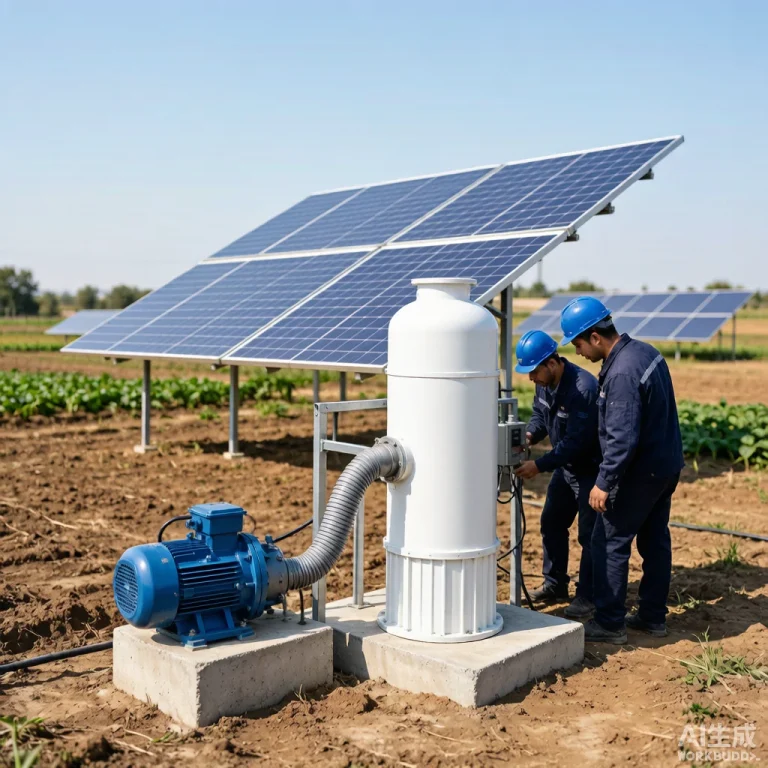
Solar Pump Installation & Commissioning for Gold Mines in Sudan: Get Rated Output from Day One
Introduction
A well-specified solar pump fails if it is installed poorly. This article covers solar pump installation and commissioning for gold mines, using Sudan’s remote desert and riverine sites as the worked example, written by the solar-pumping specialists at KINBO. Correct mounting, wiring, priming and commissioning decide whether the system hits its rated output on day one—and keeps running through dust storms and heat. This is the practical, field-level companion to our sizing methodology.
Table of Contents
Why Installation Quality Matters
- Output is set at install—misaligned arrays, undersized cable and poor earthing silently cut output for the system’s whole life.
- Reliability—dust-sealed joints and strain-relieved cables survive Sudan’s heat and grit; lazy work fails in months.
- Safety—correct DC isolation and bonding protect both the pump and the crew.
- Commissioning proves the math—a proper flow-and-head test confirms the sizing actually delivers.
Sudan Site Conditions
Sudan’s gold operations—the Nubian Shield belt and riverine artisanal pits—run hot, dusty and far from service. Our dewatering guide, process-water guide and community-water guide frame the duties; the installation must cope with extreme heat, blowing sand and long cable runs from array to pump.
Installation Step-by-Step
- Site & shade survey—confirm array placement is shade-free 9–4 and oriented to the site’s sun path.
- Mounting—secure, ventilated racking with tilt set to latitude; allow airflow under panels to limit heat loss.
- Cabling—size DC cable for the run and current (voltage drop <3%), use UV-stable, buries where possible, strain-relieve every entry.
- Controller & pump—earth and bond, fit DC isolation, prime (if surface) or wet (if submersible), then power up at low sun.
- Commission—measure flow at duty head, log against the sizing target, and set any hybrid/governor limits.
Good vs Poor Installation
| Aspect | Good install | Poor install |
|---|---|---|
| Cable sizing | Drop <3%, buries | Thin, exposed, hot |
| Dust sealing | Glanded, sealed | Open joints |
| Commissioning | Flow logged vs target | Never measured |
| Result | Rated output, years | Underperform, fail |
For the economics of getting it right, our solar-vs-diesel analysis shows a correctly commissioned Sudan system pays back in 1–3 years.
Frequently Asked Questions
Can installation really change output that much?
Yes—undersized cable and shade can silently cut 10–30% of output every sunny day for the life of the system.
Do I need a professional to commission?
A trained technician should commission and log flow vs the sizing target; it is quick and proves the system works before handover.
How do I protect against Sudan’s dust and heat?
Use dust-sealed glands, ventilated array mounting, UV-stable cable and strain relief; our remote-operations guide helps monitor from afar.
How do I start a project in Sudan?
Define flow, head, water quality and hours, then we size and scope the install—our sizing methodology applies directly.
Related Articles
- Gold Mine Solar Pump Sizing Methodology
- Remote Operations for Gold-Mine Solar Pumps
- Solar vs Diesel Cost Analysis for Gold Mines
- Explore KINBO Solar Pump Products
Get a Properly Installed Solar Pump System for Your Gold Mine
Tell KINBO your Sudan or Sahel site’s duties—desert pit, riverine camp or community borehole—and we will specify and scope a solar pump system installed and commissioned to rated output. Contact our team for a tailored quote.
Published by KINBO · September 30, 2026 · Category: Application Cases