Solar Water Pumps for High-Altitude Mountain Communities: Reliable Off-Grid Water Supply Solutions
Introduction
Mountain communities from the Andes to the Himalayas face a distinctive water-access problem: the source is often abundant in springs and snowmelt, but it sits far below the village and far from any grid connection. For these settlements, solar water pumps have become the most practical way to lift clean water up steep terrain without diesel or expensive grid extensions. Manufacturers such as KINBO have developed off-grid pumping packages specifically tuned for thin air, sub-zero nights and long static lift, because a standard lowland pump rarely survives a single mountain winter. This article explains the engineering realities of high-altitude solar pumping and the deployment patterns that keep remote villages supplied year round.
Table of Contents
Why Mountain Communities Need Off-Grid Solar Pumping
In rugged terrain, laying a power line to a distant spring or borehole is often more expensive than the entire water system itself. Solar pumping removes that barrier: panels mount on the hillside, the controller and pump do the lifting, and gravity storage at the village finishes the distribution. For communities above two thousand meters, the combination of free solar energy and zero fuel cost is not a luxury but the only economically viable option.
The Burden of Manual Hauling
Before a pumped system arrives, villagers, usually women and children, carry water uphill in heavy containers several times a day. Beyond the lost labor hours, the physical toll and the risk of waterborne disease from unsafe sources are severe. A reliable solar lift directly improves health, school attendance and local livelihoods.
Key Engineering Challenges at Altitude
High altitude changes the physics of pumping in ways that catch inexperienced suppliers off guard. Air density falls, ambient temperature swings widely between day and night, and the vertical rise can exceed what a single pump stage handles comfortably. Designers must respect these constraints from the first calculation.
Thin Air, Low Temperature and Long Rises
Reduced air density lowers the cooling capacity of the motor and the output of some forced-draft components, while freezing nights threaten exposed pipe and seals. The table below maps common mountain supply scenarios to the technical response that keeps the system running.
| Mountain Source Type | Recommended KINBO Solution | Primary Engineering Challenge |
|---|---|---|
| Deep borehole above 2000 m | Multistage solar submersible | High static lift, cooled motor |
| Spring at mid-slope | Surface pump with long suction | Prime loss on steep suction line |
| Snowmelt stream | Protected surface pump house | Freeze protection of intake |
| Village roof tank | Booster with pressure control | Pressure stability on varying demand |
Note: actual selection depends on measured static head, daily volume and local low-temperature records; values are illustrative.
Sizing the System for Steep Terrain
Correct sizing begins with an honest hydraulic survey. Engineers must calculate required head for a solar pump that includes not only the vertical lift but also the friction losses along a long, often winding mountain pipeline. Underestimating either parameter leads to a pump that runs hot and delivers a trickle when the village needs a stream.
Head, Pipe Route and Freeze Protection
A disciplined design process follows a clear sequence:
- Measure static lift from source to the highest delivery point with GPS elevation.
- Map the pipe route and compute friction loss for the chosen diameter.
- Select panel capacity for the worst-case winter irradiance at altitude.
- Specify freeze-proof intake and insulated valve boxes for sub-zero nights.
- Add a gravity buffer tank so demand peaks never stall the pump.
Real-World Deployment Patterns
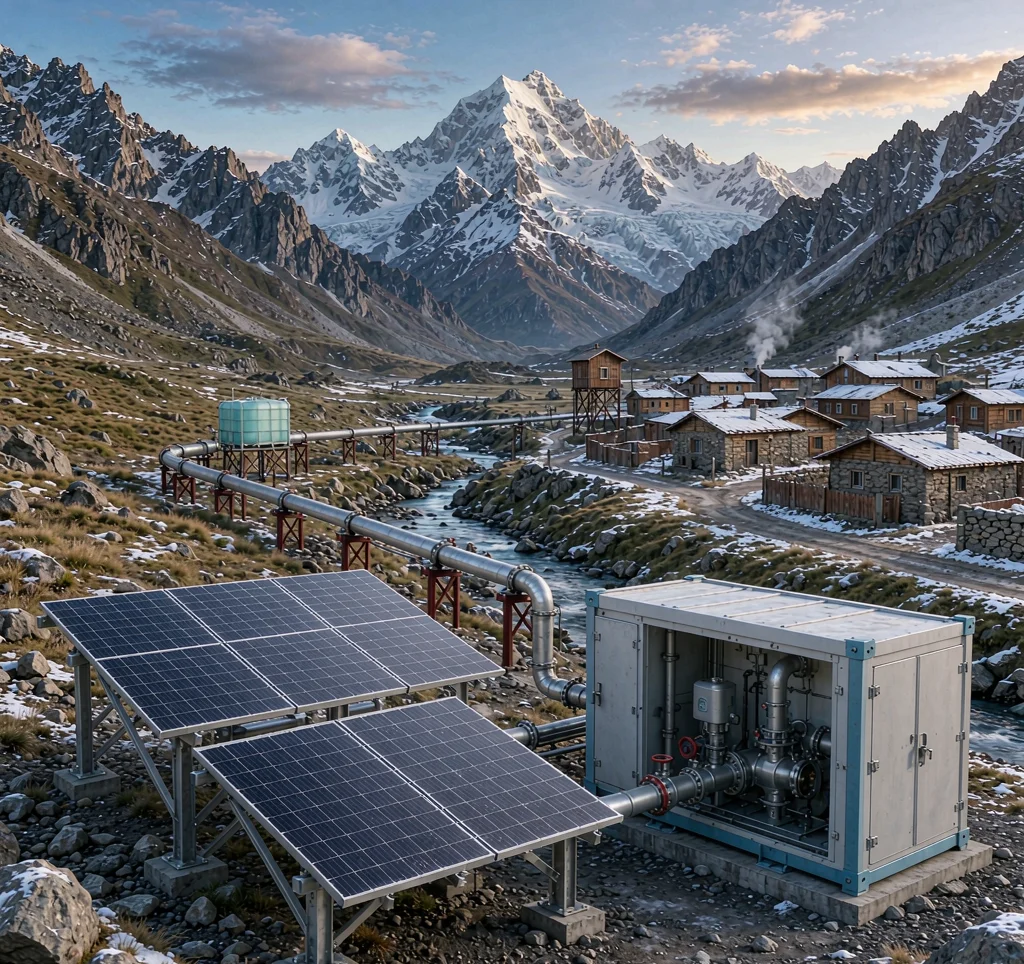
Successful mountain programs share a common shape: modest daily volume, robust freeze protection and strong local maintenance training. Whether the site is a cluster of stone houses on a Himalayan ridge or an alpine Andean settlement, the system works best when the village itself can swap a seal or reset the controller without waiting for a city technician.
From Himalayan Villages to Andean Slopes
In high-plateau deployments, installers often place the array on a south-facing slope well above the village to capture low winter sun, then run a protected line down to the source. In contrast, Andean sites frequently use a spring box lower on the mountain with a surface pump pushing water to a ridge tank. The geography changes the hardware, but the principle of solar independence stays constant.
How KINBO Packages High-Altitude Kits
KINBO ships high-altitude kits that pair a thermally protected motor, an MPPT controller with low-temperature compensation and a freeze-resistant intake assembly, all pre-configured to the surveyed head. By bundling spare seals, a bilingual maintenance card and remote diagnostic access, KINBO lets local NGOs commission and service mountain systems without repeated factory visits, which is essential when the nearest road is a half-day walk away.
Frequently Asked Questions
Do solar pumps work in snowy mountain conditions?
Yes, provided the intake, valves and exposed pipe are specified for sub-zero operation. Panels actually perform slightly better in cold, dry mountain air, so the limiting factor is freeze protection rather than sunlight availability.
How is the required head calculated for a steep village supply?
Engineers sum the vertical lift from source to the highest tap plus the friction loss of the pipeline at the design flow. For long mountain runs this friction term is often larger than buyers expect, so an on-site survey beats a desktop estimate.
Can a single solar pump serve both drinking and irrigation needs?
Often yes, by splitting the daily output between a potable tank and an irrigation buffer. The controller can prioritize drinking supply in the morning and divert surplus to fields when the village tank is full.
What maintenance does a mountain system need?
Minimal but regular: panel cleaning after dust or ash, seal inspection each season, and a winter check of freeze protection. Because travel is hard, kits are designed so a trained villager can perform these tasks with the supplied tools.
Conclusion
High-altitude mountain communities are among the toughest environments for water supply, yet solar pumping has made reliable off-grid delivery practical where it was once impossible. Success depends on respecting altitude physics: accurate head calculation, freeze protection and local serviceability matter more than raw pump power. For B2B buyers, NGOs and government programs operating above two thousand meters, a properly engineered solar system is the difference between a village with running water and one that still hauls it by hand.
For B2B buyers planning mountain or off-grid village water projects, contact KINBO for competitive FOB pricing, altitude-specific sizing and technical support.