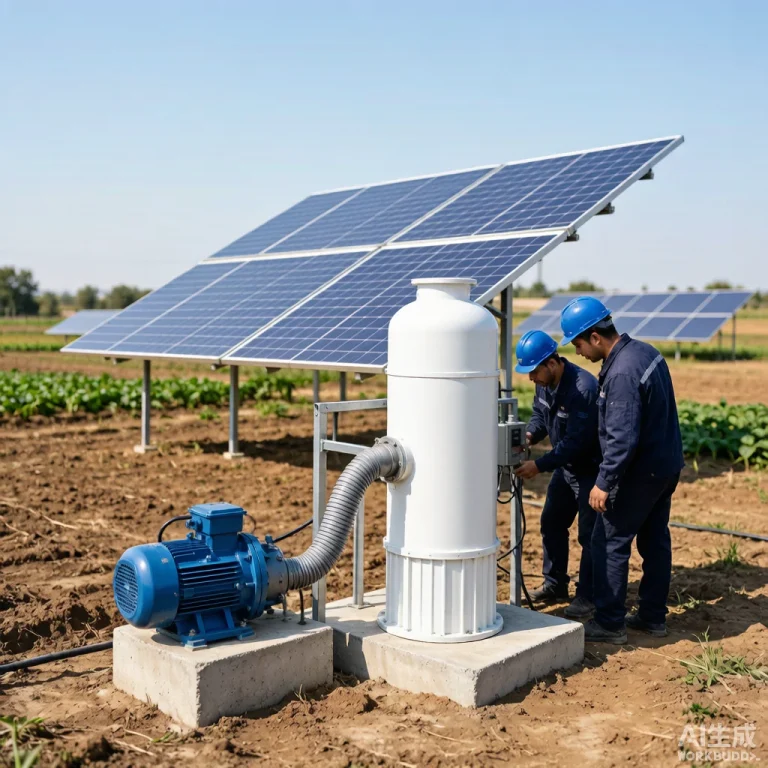
Solar Water Pumps for Firefighting and Fire-Suppression Water Supply: Reliable Pressure Off-Grid
Introduction
Fires move faster than fuel deliveries. Remote farms, forests and facilities need water and pressure ready at all times, independent of grid or diesel. A KINBO solar water pump keeps a suppression system charged using only sun. This article covers why solar fits fire protection, high-pressure design, storage strategy, selection guidance and reliability for life safety.
Table of Contents
Why Solar Fits Fire Protection
Fire protection cannot wait for a fuel truck or a grid to return. Solar pumping, paired with stored water, provides always-ready pressure using the most available resource on a dry, fire-prone site: sunlight.
During a fire, grid and diesel often fail together; a solar-plus-tank system is the resilient choice. It also serves daily needs, so the asset is never idle.
A pump selection guide helps match duty to the hazard, not just to routine use.
High-Pressure Design
Suppression needs pressure far above domestic use. Multistage or booster pumps deliver it, sized to the sprinkler or monitor nozzle requirement, not to garden flow.
| Duty | Pressure need |
|---|---|
| Sprinkler | Moderate-high |
| Monitor / cannon | High |
A head calculation converts nozzle pressure and pipe loss into the real pump duty.
Storage Strategy
Water must be on hand, not pumped during the fire. A large tank or pond holds the reserve; the solar pump quietly refills it afterward and tops it up daily.
This decouples supply from the emergency moment: the pump’s job is readiness, not firefighting in real time. Sizing the tank to the hazard is the core design act.
KINBO sizes the refill pump to restore reserve between events, not to fight the fire live.
Selection Guidance
Choose pump type by source and pressure: submersible for a borehole reserve, surface for a pond, booster for the final pressure stage. Match the curve to the nozzle duty with margin.
A submersible versus surface comparison clarifies placement. Oversize the array so pressure holds on hot, smoky, low-sun days.
Redundancy – a second pump or a manual backup – is justified where life safety is at stake.
Reliability for Life Safety
Fire systems fail dangerously silent, so build in self-test: periodic auto-run, pressure alarms and remote status. A controller that logs faults proves the system was ready.
Protect intake from debris and freezing where relevant, and keep the path from tank to nozzle unobstructed. A controller settings review keeps protection active.
Treat the pump as life-safety equipment in every inspection, not as irrigation gear.
Frequently Asked Questions
Why solar for firefighting water supply?
Fire protection cannot wait for fuel or grid; solar with stored water gives always-ready pressure using sunlight, and stays resilient when grid and diesel fail together.
What pressure does fire suppression need?
Far above domestic use – multistage or booster pumps sized to sprinkler or monitor nozzle duty, with a head calculation converting nozzle pressure to real pump duty.
How is water stored for fire use?
A large tank or pond holds the reserve; the solar pump refills it daily and after events, so supply is ready rather than pumped during the emergency.
How do I select a fire-protection pump?
By source and pressure: submersible for borehole reserve, surface for pond, booster for final stage; match the curve to nozzle duty with margin and redundancy for life safety.
For B2B buyers solar pumps for firefighting, contact KINBO for competitive FOB pricing and technical specifications.
Related Articles
- Solar Pump Head Calculation: How to Size Static Lift, Friction Loss and Total Dynamic Head Correctly
- Solar Submersible vs Surface Pumps: How to Choose the Right Pump Type for Your Water Source
- Explore KINBO Solar Surface Pumps