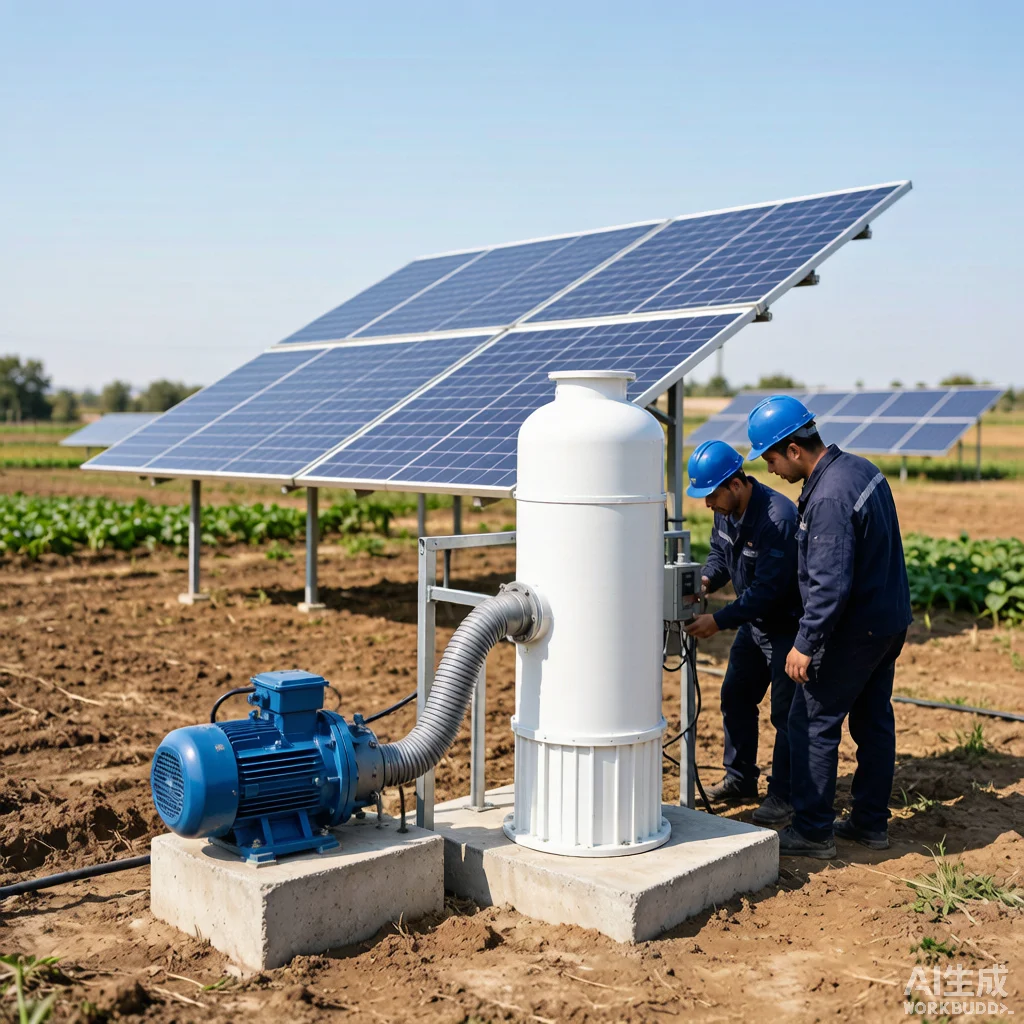
Solar Pump Motor Winding Insulation and Thermal Management
Introduction
The motor winding is the heart of any submersible solar pump — a precision-manufactured assembly of magnet wire, slot liners, phase separators, and impregnating varnish that converts DC power from a photovoltaic array into the rotating magnetic field that drives the pump. When a winding fails, whether from insulation breakdown, thermal aging, or moisture ingress, the pump does not degrade gracefully — it stops. For B2B distributors managing pump fleets across multiple installation sites, understanding winding insulation classification, thermal management dynamics, and diagnostic testing protocols translates directly into warranty cost reduction and customer retention. At KINBO, every motor winding undergoes a five-stage vacuum pressure impregnation (VPI) process and passes a 2,500 VDC surge comparison test before leaving the factory — because a winding defect that escapes quality control in Zhejiang becomes a field failure in Zambia or Bangladesh, and the cost of that failure is never just the replacement pump.
Table of Contents
Winding Insulation Materials and Classes
The insulation system in a submersible motor is not a single material but a composite of magnet wire enamel, slot liner film, phase-to-phase insulation, and impregnating resin — each contributing to the overall thermal class rating defined by IEC 60085 and NEMA MG 1 standards.
Magnet wire enamel forms the primary turn-to-turn insulation. Polyester-imide (PEI) enamel, rated for Class H (180°C), has been the industry workhorse for decades, offering a balanced combination of thermal stability, chemical resistance, and cost. A significant upgrade is polyamide-imide (PAI) enamel, which pushes the thermal rating to 200°C (Class C) and provides approximately 3 times the abrasion resistance of PEI — critical for automated winding processes where wire tension and insertion forces can damage enamel during stator slot filling. For solar submersible motors operating on variable-frequency drives, an additional consideration is corona (partial discharge) resistance: the fast voltage rise times (dV/dt) typical of PWM inverters — even at the modest switching frequencies of solar pump controllers (4–16 kHz) — can generate voltage spikes between adjacent turns that exceed the dielectric strength of standard enamel. Corona-resistant magnet wire, incorporating an inorganic nano-filler layer (typically silica or alumina) between the conductor and the organic enamel, suppresses partial discharge by distributing electrical stress more uniformly and has become standard in KINBO‘s BLDC motor windings since 2024.
Slot liners and phase separators provide ground-wall insulation — the dielectric barrier between the copper winding and the laminated stator core. Nomex aramid paper (DuPont), rated Class H (180°C), dominates the submersible motor segment because of its exceptional tear strength and moisture resistance compared to the older Dacron-Mylar-Dacron (DMD) composite (Class F, 155°C) still found in cost-engineered pumps. The ground-wall insulation thickness in a 4-inch submersible motor is typically 0.18–0.25 mm single-layer Nomex 410, providing a dielectric strength exceeding 15 kV/mm — approximately 3 kV total withstand, comfortably above the 2 × U_n + 1,000 V test voltage required by IEC 60034-1 for a 400 V motor. For deep-well pumps exceeding 300 meters where hydrostatic pressure can compress insulation and reduce effective dielectric thickness, KINBO specifies 0.30 mm double-layer Nomex slot liners.
| Insulation Class | Max Hot Spot Temp (°C) | Typical Life at Rated Temp (hours) | Common Materials |
|---|---|---|---|
| Class B | 130 | 20,000 | Polyester enamel, Dacron-Mylar, asphalt varnish |
| Class F | 155 | 20,000 | Modified polyester-imide, DMD composite, epoxy varnish |
| Class H | 180 | 20,000 | Polyester-imide/Polyamide-imide dual coat, Nomex, silicone varnish |
| Class C (N) | 200+ | 20,000+ | Polyamide-imide enamel, mica tape, ceramic-filled resin |
The practical significance of the thermal class for solar pumping applications lies in the Arrhenius relationship: insulation life halves for every 10°C increase in operating temperature above the rated class. A Class B winding operated continuously at 140°C instead of 130°C loses 50% of its design life. In solar applications where ambient well water at 25°C provides aggressive cooling (discussed in the next section), the margin between the motor’s actual hotspot temperature and its insulation class rating determines whether the pump survives 5 years or 15 years in the field.
Thermal Management in Submersible Motors
Submersible motors enjoy a thermal advantage that surface-mounted motors can only envy: direct liquid cooling of the stator housing by the pumped water flowing past the motor exterior at velocities typically between 0.1 and 0.5 m/s. This forced-convection heat transfer mechanism, quantified by a convective heat transfer coefficient of 500–1,500 W/m²·K for water flowing over a cylindrical motor housing, is approximately 20–50 times more effective than natural air convection — which is why a 5.5 kW submersible motor can be packaged in a 4-inch diameter housing while an equivalently rated air-cooled TEFC motor requires a frame size 4–6 times larger by volume.
The heat path within the motor follows a well-defined thermal circuit: copper winding losses (I²R) and iron core losses (hysteresis and eddy current) generate heat at the stator, which conducts radially outward through the slot insulation, through the laminated stator core, across the stator-to-housing interference fit (typically 0.02–0.05 mm shrink-fit interference), through the stainless steel housing wall, and finally into the pumped water at the housing outer surface. The dominant thermal resistances in this path are the slot insulation (0.4–0.8 K/W for a 4-inch motor) and the housing-to-water interface (0.1–0.3 K/W depending on flow velocity).
Motor sizing for thermal margin is the most consequential design decision for solar pumping reliability. A motor sized at exactly the pump’s shaft power demand with zero service factor will run at or near its insulation class temperature limit under worst-case conditions — high irradiance (1,000 W/m²), maximum flow (low head), and minimum water velocity (large-diameter borehole). The industry guideline of a 1.15 service factor (15% thermal margin above nameplate rating) is entirely insufficient for solar duty. KINBO‘s engineering standard specifies a minimum 1.25 service factor for solar pump motors and recommends 1.30 for wells where the pump is installed opposite a perforated or screened casing section that may partially bypass cooling flow. This margin, combined with Class H insulation, results in a typical hotspot temperature of 110–130°C under full-load solar conditions — a 50–70°C margin below the 180°C insulation limit that translates to approximately 60,000–100,000 hours of theoretical insulation life using the 10°C halving rule.
A less appreciated thermal consideration is the motor cable voltage drop in deep installations. A 200-meter drop cable carrying 15 A at 300 VDC dissipates approximately 60–90 W of I²R heating along its length. While this does not directly heat the motor, the voltage drop forces the motor to draw higher current to deliver the same shaft power, increasing winding I²R losses by the square of the current increase. A 5% voltage drop at the motor terminals produces approximately 10% additional winding heating — equivalent to operating the insulation system 10–15°C hotter. For this reason, KINBO ships deep-well solar pump packages with oversized drop cables calculated to limit voltage drop to below 3% at maximum power point current.
Insulation Resistance Testing and Diagnostics
Insulation resistance (IR) testing is the single most informative non-destructive diagnostic for submersible motor winding condition, and the test protocol matters as much as the measured value.
The polarization index (PI) test — the ratio of the 10-minute IR reading to the 1-minute reading at a constant test voltage (typically 500 or 1,000 VDC) — distinguishes between surface moisture contamination (low PI, typically below 1.5) and genuine insulation aging (normal PI of 2.0+ with low absolute IR). A motor that measures 50 MΩ at 1 minute and 55 MΩ at 10 minutes (PI = 1.1) has wet windings — the leakage current is dominated by surface conduction along moisture paths, which stabilizes quickly. The same motor dried to a PI of 3.0 at 500 MΩ absolute IR is electrically sound and can be returned to service. A motor that measures 5 MΩ at 1 minute and 15 MΩ at 10 minutes (PI = 3.0) has dry but thermally aged insulation — the absolute IR value below the commonly cited 1 MΩ minimum (IEEE 43) indicates a winding approaching end of life that should be scheduled for replacement or rewinding.
Surge comparison testing detects turn-to-turn insulation defects that IR testing — which only measures ground-wall insulation — cannot identify. A surge tester applies a fast-risetime voltage pulse (0.1–0.5 µs rise time) to two phases simultaneously and compares the resulting ring waveforms on an oscilloscope. A phase-to-phase waveform deviation exceeding 10% indicates shorted turns, even if the IR value reads normal. This test is the gold standard for factory acceptance testing and post-rewind quality verification because turn shorts are the most common field failure mode in PWM-driven motors, where voltage reflections at the motor terminals can produce transient overvoltages up to twice the DC bus voltage at the first few turns of each phase winding.
Scheduled testing protocol for fleet management should follow a tiered approach. (1) Annual IR spot test for all pumps, using the PI method. (2) Surge test at commissioning and at any point where IR drops below 10 MΩ. (3) Continuous DC bus current monitoring via the pump controller, with automated alerts when running current exceeds the pump’s baseline by more than 10%. Controllers that log this data to a cloud platform — as KINBO‘s IoT-enabled solar pump controllers do — enable predictive maintenance scheduling that eliminates both unnecessary pump pulls and catastrophic failures.
Rewinding vs Replacement Economics
The decision to rewind a failed submersible motor or replace it entirely is an economic calculation that depends on motor size, failure mode, local labor cost, and the availability of factory-quality materials. The common field rule — rewind motors above 10 HP, replace below — is an oversimplification that can cost distributors significant margin.
Rewinding cost economics for a failed 4-inch, 3 HP submersible motor typically break down as follows: magnet wire (1.5–2.0 kg of Class H enameled copper), slot liners, varnish, and consumables total approximately $18–25 USD at wholesale cost; skilled labor for stripping, winding, connecting, VPI processing, and testing takes 4–6 hours at a shop rate of $8–15 USD per hour depending on region. Total rewinding cost: $50–115 USD. A replacement motor of equivalent specification costs $180–280 USD at wholesale — a 60–80% savings from rewinding. However, this calculation assumes the shop has a functioning burn-out oven (to strip old windings without damaging the stator lamination insulation), a VPI tank, a surge tester, and a dynamic balancer for the rotor assembly. A shop rewinding motors without VPI impregnation — simply dipping the wound stator in varnish and air-drying — produces windings with partial void content that will fail from partial discharge within 12–18 months of PWM service.
Replacement is indicated when the stator core itself is damaged — detected by a core loss test (loop test) that reveals hotspots from shorted laminations — or when the motor has been flooded with sand-laden water that has abraded the slot liners and scored the stator bore. Rewinding a motor with a damaged core produces a motor that runs hot and fails rapidly, regardless of winding quality. For motors below 1 HP (0.75 kW), the economics reverse: the cost of labor for rewinding often exceeds the wholesale cost of a new motor, and replacement is the economically rational choice. KINBO maintains regional rewind kit inventories — pre-cut magnet wire sets, slot liners, and connection diagrams — to support authorized service centers in performing factory-grade rewind operations, because a properly rewound KINBO motor with Class H materials and VPI processing delivers a service life within 85–95% of a new motor.
Frequently Asked Questions
Q: What is the difference between Class F and Class H insulation for solar pump motors?
A: Class F insulation is rated for a maximum hotspot temperature of 155°C with a design thermal life of 20,000 hours at that temperature, while Class H is rated for 180°C — a 25°C higher threshold. This 25°C difference translates to approximately 5–6 times longer insulation life at the same operating temperature, per the Arrhenius 10°C halving rule. In practical terms, a solar pump motor with Class H insulation operating at a winding hotspot of 120°C has a theoretical insulation life exceeding 100,000 hours (12+ years of daily solar operation), while the same motor with Class F insulation at the same hotspot temperature provides approximately 20,000–25,000 hours (3–4 years). The materials differ across the entire insulation system: Class H requires polyester-imide or polyamide-imide magnet wire enamel (versus modified polyester for Class F), Nomex aramid slot liners (versus DMD composite), and silicone-based impregnating varnish (versus epoxy). KINBO standardizes on Class H across all solar pump motors because the incremental material cost — roughly 8–12% of the motor bill of materials — is recovered through a single avoided warranty claim over the pump’s service life.
Q: How often should insulation resistance be tested on solar submersible pumps?
A: For pumps in continuous or daily solar operation, annual polarization index (PI) testing is the minimum recommended frequency. For installations in aggressive water chemistry — specifically total dissolved solids above 1,000 mg/L, chloride above 250 mg/L, or pH outside the 6.5–8.5 range — semi-annual testing is warranted because accelerated insulation degradation from electrochemical attack can reduce winding life from 10+ years to 2–3 years without visible external symptoms. Pumps that have been idle for more than 30 days — common in seasonal irrigation applications — must be tested before restart because moisture ingress through cable splices and motor lead penetrations during idle periods is the leading cause of startup failures. The test voltage should be 500 VDC for motors rated up to 500 V (per IEEE 43), and the minimum acceptable IR value is 1 MΩ for motors below 1 kV rating. An IR value below 10 MΩ that does not improve by at least 20% after 2 hours of drying at the controller’s lowest pump speed warrants pulling the motor for shop inspection. All test results should be logged and trended; a declining IR trend is far more informative than any single reading.
Q: Can a submersible solar pump motor be rewound in the field?
A: Field rewinding — meaning rewinding at or near the installation site with portable equipment — is technically possible but rarely produces a reliable result. The minimum equipment set for a quality rewind includes a burn-out oven (300–350°C controlled ramp to strip old windings without damaging lamination insulation), a coil winding machine with programmable turn counting, slot wedge insertion tooling, a vacuum pressure impregnation (VPI) system, a curing oven (150–180°C for 4–6 hours), and a surge comparison tester. This equipment set is not portable. What is practical and recommended is a regional service center model: the failed motor is pulled and shipped to a KINBO-authorized service center equipped with the above tooling, rewound using factory-specification materials and processes, surge-tested to verify winding balance, and returned to the site within 5–10 working days. For sites where downtime cannot be tolerated, the preferred approach is to maintain a spare pump in inventory, rotate the failed unit to the service center, and reinstall the rewound motor as the new spare — a hot-swap fleet management strategy that eliminates well downtime entirely. KINBO supports this model with regional rewind kits and training programs for authorized service partners across our distributor network.
For motor winding diagnostics, rewind kit orders, or technical training for your service team, contact KINBO After-Sales Service.
Related Articles
- Solar Pump Motor Types: BLDC vs PMSM vs Induction — Selection Guide for B2B Buyers
- Solar Pump Troubleshooting Field Guide: Systematic Diagnostic Workflow