Solar Water Pumps for Aquaculture and Fish Farm Aeration: Design, Sizing and Payback Guide
Introduction
Aquaculture lives and dies by dissolved oxygen. When a summer night stalls the wind and a algae bloom sucks the water flat, fish at the bottom of a pond can suffocate within hours—and a single mass mortality event wipes out a season of profit. Traditional aeration depends on grid power or noisy diesel, both vulnerable to outages and rising tariffs. KINBO has deployed solar pumping and aeration packages on fish and shrimp farms from freshwater carp ponds to coastal brackish enclosures, and the economics are compelling: the sun peaks exactly when oxygen demand peaks, and a properly sized system runs the aerators through the riskiest afternoon hours for free. This guide covers how solar pumps drive both water circulation and paddlewheel or diffuser aeration, walks a concrete 10-acre carp pond design with real numbers, and lays out the return on investment that makes the switch obvious for most operations.
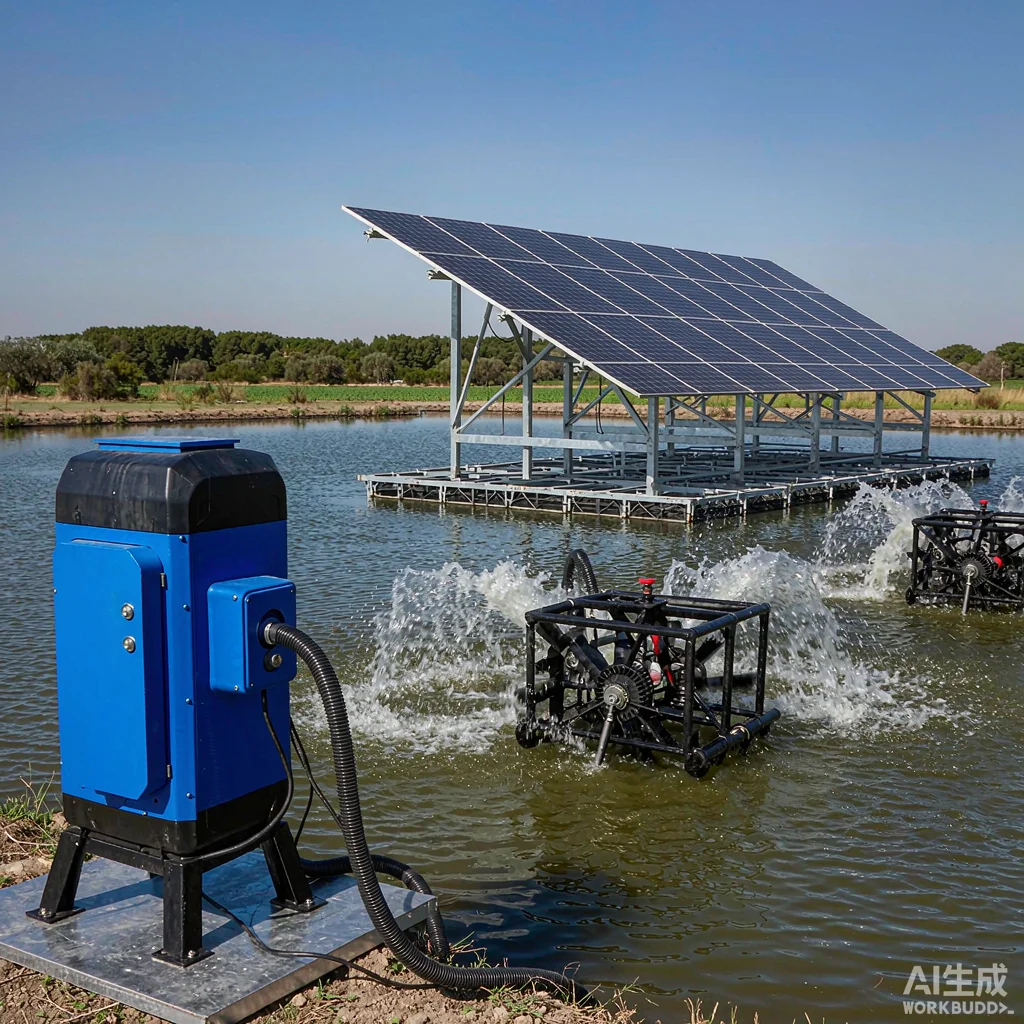
Why Oxygen Drives Everything
Fish consume oxygen continuously, but production is lopsided. Photosynthesis by pond algae adds oxygen by day and consumes it at night. Warm water holds less oxygen, and a dense bloom can flip a pond from safe to hypoxic between dusk and dawn. Target a minimum of 4–5 mg/L; below 3 mg/L carp and tilapia stop feeding, and below 1 mg/L they die.
When Risk Peaks
The danger window is the pre-dawn hours of hot, still, overcast days—precisely when solar input is lowest. That is why a hybrid design matters: solar carries the heavy afternoon load, and a battery or grid backup covers the vulnerable night. A solid livestock water supply solution uses the same logic of pairing sun with storage.
Solar Aeration System Options
Paddlewheel Aerators Driven by Solar Pumps
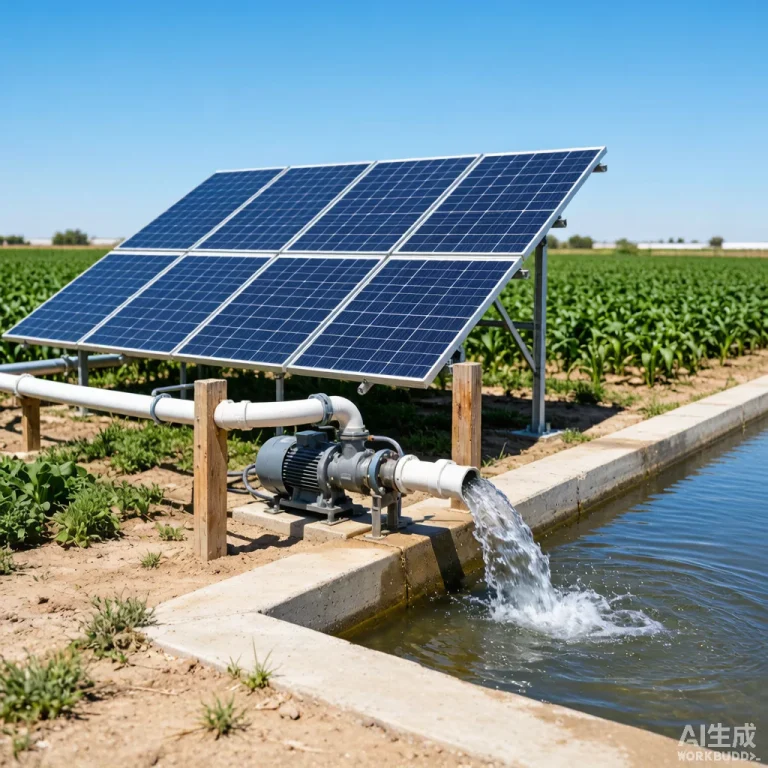
A solar pump pushes water to a paddlewheel or fountain that throws a sheet of water into the air, maximizing air contact. Best for surface mixing and algae control on medium ponds.
Diffused Air via Submersible Boost Pump
A submersible or surface pump feeds a blower-compressed airline to bottom diffusers, bubbling oxygen up from depth. Superior for deep ponds and uniformly lifting the whole column, not just the surface.
Circulation Pumps
Simple circulation breaks thermal stratification and prevents dead zones. Lower power than active aeration but a useful complement.
| Method | Power Need | Best For |
|---|---|---|
| Paddlewheel | Medium | Surface mixing, algae control |
| Diffused bottom air | Higher | Deep ponds, full-column DO |
| Circulation only | Low | Stratification break, supplement |
Case Study: 10-Acre Carp Pond
A 10-acre (about 40,000 m²) earthen carp pond, average depth 2 m, holding roughly 8,000 kg of stock. Summer peak oxygen demand with active feeding calls for about 1.2 kW of aeration per acre during the afternoon—roughly 12 kW total at the worst hour, shared across four aeration zones.
System Sizing
- Four solar surface pumps (48 V, ~750 W each) feeding four paddlewheels, plus a 1.5 kW submersible boost pump for diffusers in the deepest corner.
- Total pump power ~4.5 kW; with aerator load and losses, design the PV array at ~6 kWp to cover the peak sun window.
- 10 kWh lithium buffer sized for 4 hours of pre-dawn backup from grid or generator.
- Elevated 5 m³ header tank smooths flow if a pump trips.
Cost and Payback
The table below uses indicative 2026 prices and a grid tariff of $0.12/kWh with 6 h/day aeration through the risk season (roughly 200 days/year).
| Item | Cost (USD) |
|---|---|
| 6 kWp array + mounts | 4,800 |
| 4× surface pumps + 1 boost pump | 3,200 |
| Aerators, diffusers, piping | 2,500 |
| 10 kWh battery + controller | 3,000 |
| Installation | 1,500 |
| Total installed | 15,000 |
Assumptions: $0.12/kWh grid tariff, 200 aeration days/year, 6 h/day, diesel alternative at $0.30/kWh equivalent. Actual figures vary by site and local prices.
Replacing ~7,200 kWh/year of grid aeration at $0.12 saves about $864/year; avoiding one diesel-run equivalent and one avoided mortality event easily adds another $1,500–$4,000 in value. Simple payback lands near 3–5 years, after which the system runs the riskiest hours essentially free for its 15–20 year life.
Design Checklist
- Match total aeration kW to stock density and feed rate, not pond area alone.
- Oversize the array 20–30% over pump nameplate to cover losses and cloudy days.
- Always include night backup—solar alone cannot cover the pre-dawn danger window.
- Distribute aerators across zones; a single central unit leaves dead corners.
- Add a dissolved-oxygen sensor with alarm so staff act before fish stress.
Frequently Asked Questions
Can solar alone run aeration through the night?
Not safely. Night is the highest-risk window and solar produces nothing then. You need battery storage, grid, or generator backup for the pre-dawn hours; solar covers the heavy daytime load.
How many aerators for a 1-acre pond?
As a rule of thumb, budget 1–1.5 kW of aeration capacity per acre at peak summer stocking. A single 1 kW paddlewheel often suffices for light stock; dense feeding needs two smaller units split across the pond.
Do I need a battery if the grid is reliable?
If the grid is stable and cheap, a small battery or none may do—grid covers nights and the solar trims daytime bills. Battery pays off where outages are frequent or tariffs are high.
Will solar aeration work for shrimp too?
Yes. Shrimp are even more oxygen-sensitive than carp, so diffused bottom aeration on a solar boost pump is popular in shrimp ponds, often with higher aerator density per area.
Design Your Pond System with KINBO
KINBO sizes the array, pumps, aerators, and backup together from your pond area, depth, and stocking plan so dissolved oxygen stays safe around the clock. Talk to our aquaculture specialists for a site-specific layout.
Related Articles
Solar Water Pumps for Poultry Farm Water Supply: System Design and Sizing Guide