Solar Water Pumps for Vertical Farming and Urban Rooftop Agriculture: Complete System Design Notes
Introduction
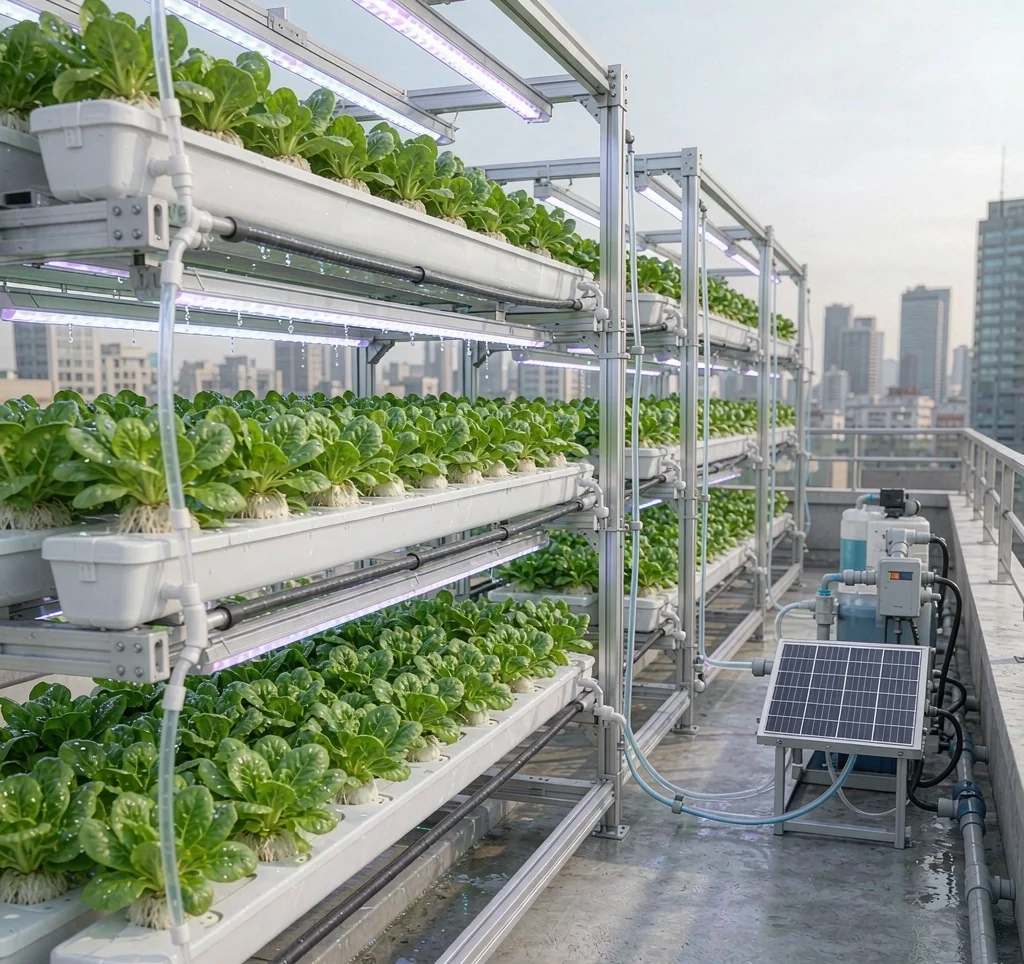
Urban agriculture is moving upward. Across dense cities from Singapore to Rotterdam, vertical farms and rooftop greenhouses are turning unused roof area into productive growing space. These systems depend on precise, recirculating water delivery—nutrient film technique channels, drip lines, and misting headers stacked several metres high. A solar water pump is an ideal fit: it runs silently, needs no grid connection, and can be sized to the building’s own rooftop PV. For B2B growers and EPC contractors, KINBO supplies solar pumping sets that pair naturally with rooftop arrays. This article covers the hydraulic realities of stacked cultivation, how to specify flow and pressure for multi-tier systems, and the design notes that keep an urban solar irrigation loop stable through summer peaks. For a broader look at crop systems, explore our solar irrigation solution.
Table of Contents
Why Vertical Farms Suit Solar Pumps
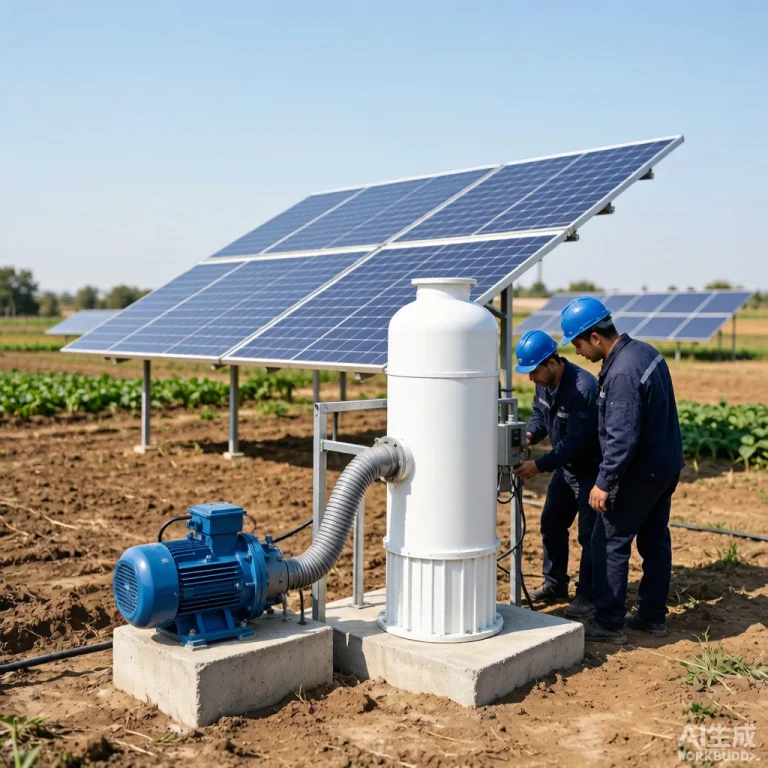
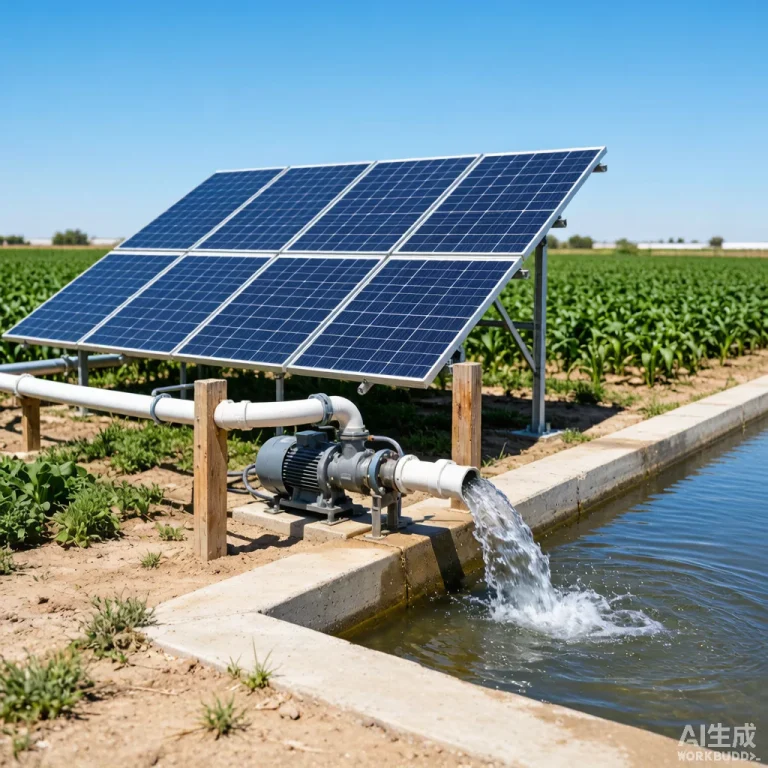
Vertical farming is water-efficient by design—closed-loop systems can use up to 95 % less water than open-field irrigation—but they still need reliable pressurization to lift nutrient solution to the top tier and maintain even distribution. A solar surface pump mounted at the sump tank handles this elegantly. Because the daily water demand of a rooftop farm peaks with light and temperature, solar generation naturally tracks the load: more sun means more pumping when plants are transpiring most. KINBO surface units with built-in controllers are compact enough to sit inside a rooftop plant room, and their soft-start drives avoid the pressure spikes that can dislodge delicate seedling trays.
What Makes Rooftop Different
- Space constraints: Equipment must be quiet, odour-free, and visually unobtrusive for neighbours.
- Height head: Lifting water 6–12 m to upper tiers dominates the system curve.
- Grid independence: A solar-direct loop keeps growing through power outages.
- Noise limits: Low-vibration pumps protect both plants and permits.
Sizing Flow and Pressure for Stacked Systems
Start from the crop water budget rather than the pump catalogue. A typical leafy-greens vertical rack consumes 1.5–3.0 L per square metre per day across all tiers. Multiply by total growing area, add recirculation turnover (most designs cycle the reservoir 2–4 times daily), and you have the daily volume. Convert to peak flow by dividing by effective sunlight hours. Pressure must cover static lift to the highest emitter plus friction losses in the distribution manifold—usually 1.0–1.5 bar for a three-tier rack. Oversizing by 15 % absorbs summer evapotranspiration without forcing the controller into constant current limit.
Recirculation vs. Top-Up Design
The two dominant hydraulic architectures lead to very different pump duties. Choose deliberately, because the pump that serves a recirculating loop is sized for turnover, while a top-up system is sized for deficit.
| Parameter | Recirculating loop | Top-up (make-up) feed |
|---|---|---|
| Pump duty | Continuous, moderate flow | Intermittent, demand-based |
| Typical flow | 2–4× reservoir volume/day | Matches daily crop deficit |
| Pressure need | Stable, low pulsation | Must reach top header |
| Best solar match | DC surface pump, soft start | DC pump with level switch |
Assumption: based on small-scale rooftop racks (20–200 m² growing area); larger commercial farms require engineered hydraulics.
Rooftop PV and Pump Integration
A vertical farm already carries roof load for grow lights and structure, so adding a 1–3 kWp PV array for the water loop is usually straightforward. Match the array’s open-circuit voltage to the controller’s input window and orient panels to true south (northern hemisphere) or true north (southern hemisphere) at the local latitude tilt. Because the pump and the PV share the roof, conduit runs are short and losses minimal. A small battery or the building’s existing storage can bridge cloudy periods, but for most rooftop loops a well-sized array alone covers the daytime watering window.
Practical Installation Notes
Field-proven details that keep an urban solar irrigation system running:
- Place the pump below the reservoir water level (flooded suction) to avoid prime loss on every restart.
- Fit a 120–200 mesh filter on the suction to protect emitters from algal debris.
- Use food-grade, UV-stable piping; avoid dark materials that heat the nutrient solution.
- Add a float or pressure switch so the pump stops at target level and prevents overflow.
- Secure all roof-mounted equipment against wind load and insulate the controller from direct sun.
Frequently Asked Questions
Can a solar pump run a vertical farm completely off-grid?
For the water loop, yes—if the array is sized to the daily volume and the farm accepts daytime watering. Grow lighting usually still needs grid or battery power, so most sites run a hybrid approach.
How much head can a rooftop solar surface pump handle?
Typical DC surface pumps deliver 10–25 m of head, enough for three-to-five-tier racks. For taller structures, stage the lift or use a small booster.
Do I need a battery for rooftop solar irrigation?
Not necessarily. A direct PV-to-pump loop waters during sunlight, which aligns with plant demand. A battery helps only if you must water at night or through long cloudy spells.
What flow rate suits a 100 m² leafy-greens rack?
Approximately 150–300 L/day for crop uptake, plus 2–4× recirculation, giving a peak pump flow around 0.3–0.8 m³/h depending on sunlight hours.
For B2B growers and EPC contractors planning rooftop agriculture, contact KINBO for competitive FOB pricing and system design support.