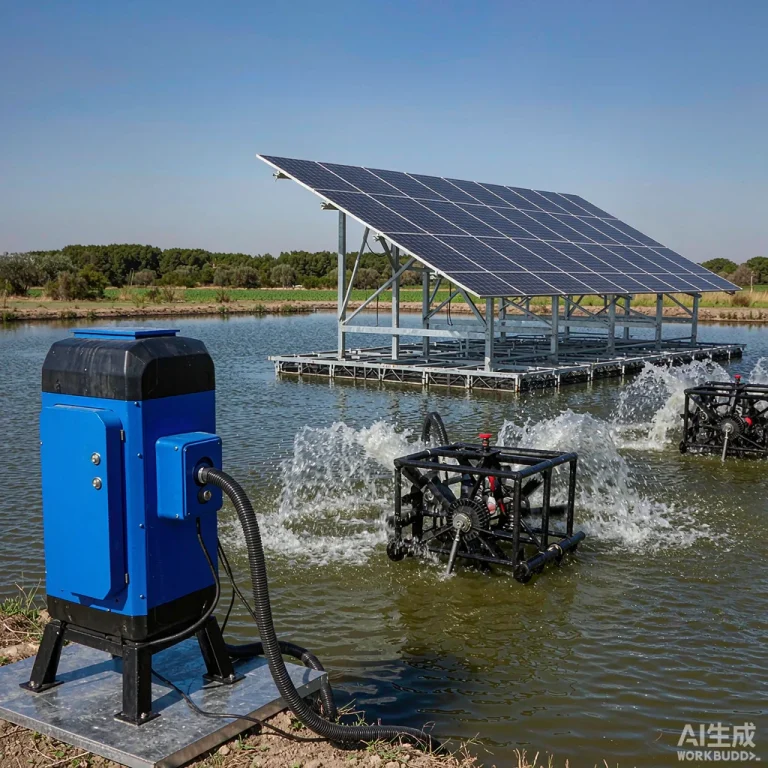
Solar Water Pumps for Aquaponics and Controlled-Environment Agriculture: Design Notes
Introduction
Controlled-environment agriculture—aquaponics, hydroponics, and vertical farms—depends on moving water continuously and gently between fish tanks, biofilters, and plant beds. Unlike field irrigation, these systems cannot tolerate long interruptions: a few hours without circulation can stress fish and collapse beneficial bacteria. Solar water pumps are an increasingly popular fit because the peak sunlight that powers photosynthesis also drives water movement, and battery or grid hybrid options bridge the night. Manufacturers such as KINBO offer low-head, high-flow solar surface and inline pump configurations suited to the gentle, constant circulation that aquaponic loops require.
Table of Contents
Why Aquaponics Needs Reliable, Low-Pressure Circulation
Aquaponics couples fish and plants in one loop: fish waste is converted by bacteria into plant nutrients, and plants clean the water returned to the fish. This loop only works if water moves constantly. The hydraulic demands, however, are unusual compared with farmland irrigation:
- Low head, steady flow: Most loops move water a few meters vertically, favoring high-volume, low-pressure pumps over high-head units.
- Continuous operation: Beneficial nitrifying bacteria die back within hours of stagnation, so downtime is costly.
- Gentle handling: Strong turbulence stresses fish and suspends solids that clog grow media; smooth, moderate flow is preferred.
- Shared water quality: Pump materials must be food-safe and non-toxic to fish and edible crops.
Solar Pump System Layout for Aquaponics
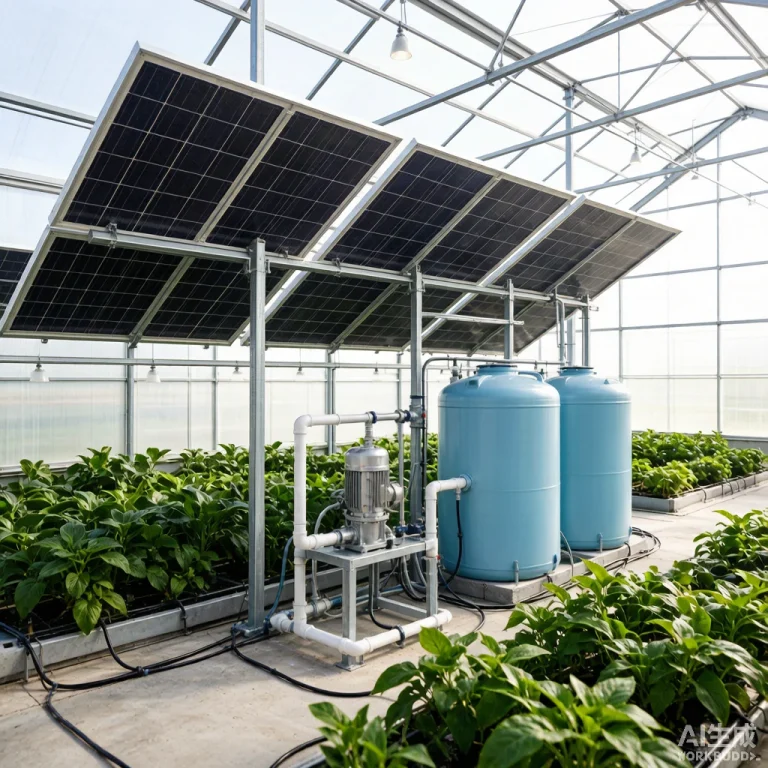
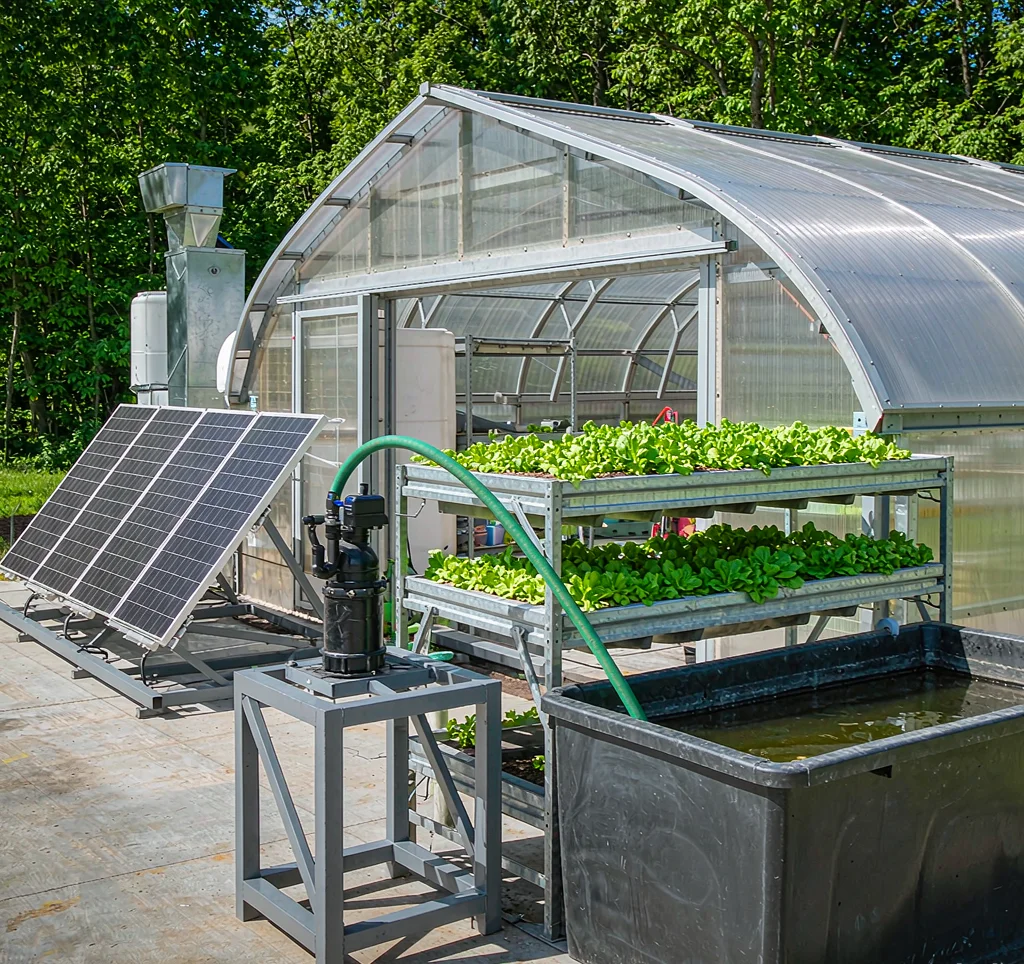
A common solar-driven water management layout places a PV array and a variable-speed surface or inline pump near the fish tank. The pump lifts water to a biofilter and then to the grow beds by gravity; filtered water drains back to the fish tank. A surge tank or sump smooths the flow and provides a small buffer if the pump briefly stops.
| Loop Segment | Typical Head | Pump Role |
|---|---|---|
| Fish tank → biofilter | 1–2 m | Main lift pump |
| Biofilter → grow beds | 0.5–1.5 m | Gravity / booster |
| Grow bed → fish tank return | 0 m (gravity) | None (passive) |
| Sump → main lift | 1–3 m | Buffer circulation |
Note: Dimensions are representative of a small-to-medium greenhouse aquaponics system of 20–200 m² of grow area; scale all values to the actual tank volume and bed count.
Balancing Fish Tank and Grow Bed Flow
The pump must move enough water to turn the entire system volume through the biofilter several times per hour, but not so fast that solids never settle or fish are stressed. A practical design approach:
- Calculate system volume (fish tank + sump + pipes, excluding grow media).
- Target 1–2 turnovers per hour for the biofilter to sustain nitrification at typical stocking densities.
- Size the pump at the operating head (not the maximum), using the pump curve rather than the nameplate flow.
- Use variable speed control so flow tracks daylight: slower circulation at dawn/dusk, full flow at midday, without manual intervention.
- Add flow balancing valves between parallel grow beds so each receives even distribution.
Water Quality and Filtration Considerations
Solar pumps in aquaponics touch the same water the fish and crops rely on, so material choice and pre-filtration matter more than in irrigation. KINBO systems intended for food loops use stainless-steel or food-grade wetted parts and dry-run protection that shuts the pump before it overheats on a low sump.
- Mechanical pre-filtration: A swirl or radial-flow separator removes coarse solids before they reach the pump impeller.
- Biological stage sizing: Keep the biofilter volume at or above the recommended ratio to the fish biomass so the pump flow is not throttled to compensate.
- Avoid dead-heading: Never run the pump against a fully closed valve; use a bypass or VFD to protect seals and motor.
Backup Power and Seasonal Operation
Pure solar operation works in sunny seasons but leaves a gap at night and on overcast days. For aquaponics, even a short outage is risky, so most installations add one of the following:
| Backup Option | Best For | Trade-off |
|---|---|---|
| Battery + inverter | Nightly 8–12 h circulation | Higher capital cost |
| Grid / generator tie-in | Urban or grid-connected sites | Less CO₂ saving |
| Gravity sump buffer | Short outages (1–3 h) | Limited duration |
| Oversized PV + oversized tank | Cloudy but not dark days | More panel area |
Seasonal operation also affects sizing: winter sunlight in high latitudes may not sustain full circulation, so either oversize the array or accept a grid/battery assist during low-sun months.
Frequently Asked Questions
Can a solar pump run an aquaponics system at night?
Only with storage. Pure PV produces nothing after dark, so continuous night circulation requires a battery bank, grid tie-in, or a gravity buffer tank sized for the outage period. Many small systems combine a modest battery with a sump buffer to cover typical nights.
What flow rate does an aquaponics loop need?
A useful starting point is 1–2 complete turnovers of the fish-tank-plus-sump volume per hour through the biofilter. Exact flow depends on fish stocking density, feed rate, and biofilter design, so size from the actual system volume rather than a generic rule.
Is a submersible or surface pump better for aquaponics?
Surface or inline pumps are common because the water source is shallow and accessible, maintenance is easier, and suction lift limits are rarely an issue in a tank-based system. Submersible pumps suit deep sumps or where silent, fully submerged operation is preferred.
Do solar pumps harm fish or plants?
Not when specified correctly. Use food-grade wetted materials, avoid dead-heading, keep flow gentle, and add pre-filtration. With those precautions, solar pumps are safe for both fish and edible crops.
Conclusion
Solar water pumps are well matched to the steady, low-head circulation that aquaponics and controlled-environment agriculture demand, provided the system is designed around continuous flow rather than intermittent irrigation logic. The right layout pairs a variable-speed pump with a biofilter, balanced grow-bed distribution, food-safe materials, and a backup strategy for night and cloudy periods. Done well, a solar aquaponics loop lowers operating cost while keeping fish healthy and plants productive.
For B2B buyers building solar aquaponics or greenhouse circulation systems, contact KINBO for competitive FOB pricing and system design support.