Solar Water Supply for Gold Mining Camps and Workers in Remote Africa
Introduction
A gold mine is a village. Even a small artisanal or mid-tier site supports dozens of workers who need water for drinking, cooking, washing and sanitation—and in remote African locations there is no municipal supply, only what the mine provides. Hauling water by truck is expensive and unreliable; a solar pump drawing from a borehole, surface source or rainwater store delivers it for free once installed. Because camp demand is steady and daytime-peaking, it is one of the simplest, most reliable solar duties on a mine. This article covers solar water supply for gold mining camps and workers in remote Africa. Solar pumping specialists such as KINBO supply robust camp-water packages with the treatment and storage needed for safe, uninterrupted supply.
Table of Contents
Camp Water Demand
Plan per person per day; the total sets the pump size. Typical figures:
| Use | Litres / person / day | Note |
|---|---|---|
| Drinking & cooking | 5–10 L | Must be safe to consume |
| Washing & sanitation | 20–40 L | Largest share |
| Camp laundry / mess | 10–20 L | Peaks mid-day |
A 50-person camp thus needs roughly 2–3.5 m³/day—well within a modest solar pump’s daytime output, with a tank covering the evening peak.
Source Options
- Borehole—most reliable in the bush; a submersible solar pump lifts to a raised camp tank (see our high-lift selection guide).
- Surface water—river or dam; use a floating intake to keep debris out (our floating intake guide).
- Rainwater—seasonal top-up; pairs with storage for the dry months.
Treatment Before Use
Source water is rarely safe to drink untreated. A defensible camp treatment chain:
- Settle / filter—remove silt and coarse material first.
- Disinfect—chlorination or UV for pathogens.
- Split quality—drinking water gets full treatment; wash water may need only basic filtration.
- Test—periodic bacterial testing, especially after rain.
Even wash water benefits from basic filtration; our reuse guide covers screening and settling approaches that transfer well here.
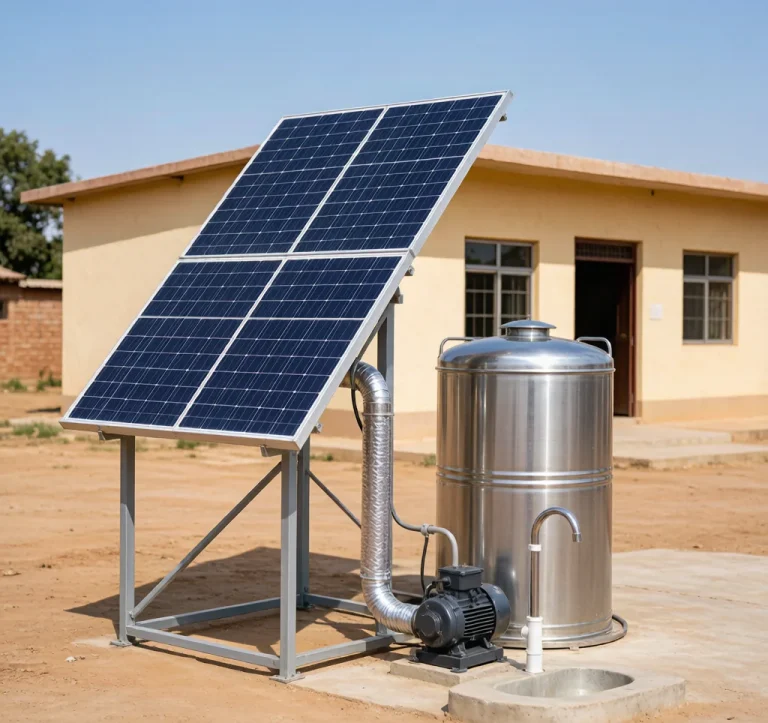
The Complete Camp Water System
A camp supply is a complete small system:
- Source pump—solar, sized to daily volume and lift.
- Raised storage tank—gravity-feeds the camp, covers evening demand.
- Treatment unit—filters + disinfectant at the point of use.
- Distribution—simple gravity lines to taps and the mess.
- Level control—float or ultrasonic stops the pump at tank-full.
For the fill-and-store logic, our tank-fill guide applies directly.
Frequently Asked Questions
How big a solar pump for a 50-person camp?
Roughly 2–4 m³/day depending on amenities. That is a small pump and a single panel or two, plus a tank to carry the evening peak—cheap and very reliable.
Can the same water serve the mine and the camp?
Process and camp water should be kept separate for quality reasons. Camp drinking water needs treatment; process water does not. Use distinct sources or at least distinct treatment paths.
Is borehole better than surface water?
In the African bush, usually yes—more consistent and cleaner at source. Surface water works but needs more filtration and a floating intake to stay debris-free.
What if the camp grows?
Size the tank for growth and the pump with ~30% headroom; adding panels later is easier than replacing a tank. Keep the distribution layout expandable.
Related Articles
- Solar Pump Selection for Tank Filling and Bulk Transfer
- Solar Pumps for Floating Intake from Lakes and Reservoirs
- Explore KINBO Solar Pump Products
Get a Camp Water Solar Package
Tell KINBO your camp size, source type and whether you need drinking-grade treatment, and we will specify a complete solar camp-water system—source pump, tank, filtration and disinfection—built for remote African sites. Contact our team for a tailored quote.
Published by KINBO · September 22, 2026 · Category: Application Cases