Solar Pump Selection for High-Head and High-Lift Applications: Sizing Deep and Ridge Water Supply
Introduction
High-head, or high-lift, solar pumping is the tough end of the spec sheet. Where a typical garden or field system might lift water a few metres, high-head duties push water tens or even hundreds of metres up a borehole, a hillside, or into an elevated tank. Every extra metre of lift multiplies the work the pump must do, so small mistakes in selection become large shortfalls in delivered water. Getting a high-lift solar pump right means reading the pump curve carefully, respecting the motor’s pressure ceiling, and often splitting the job across stages. This guide covers how to size a solar pump for high-head applications and the failure modes to design around. For challenging lifts, solar pumping specialists such as KINBO supply multi-stage and borehole packages rated for deep, high-pressure duty so the water actually reaches the top.
Table of Contents
What “Head” Really Means
Head is the vertical height the water must be raised, plus friction losses in the pipe and any pressure the outlet needs. For high-lift work, static head dominates. The table below shows how quickly the pumping task grows with lift at a fixed flow.
| Static Lift | Work at 1 m³/h (approx.) | Typical Use |
|---|---|---|
| 0–10 m | Low | Surface supply, low tanks |
| 10–50 m | Moderate | Hillside farms, village tanks |
| 50–150 m | High | Deep boreholes, ridge tanks |
| 150–300+ m | Very high | Deep wells, mountain supply |
Note that friction in long delivery pipes adds “dynamic” head on top of the static lift, so the real duty point is always higher than the raw metres.
Sizing a High-Head Solar Pump
The selection steps are the same as any solar pump, just with less margin for error:
- Fix the duty point—required flow × (static lift + pipe friction + outlet pressure). Do not underestimate friction on long rises.
- Read the pump curve at your flow—confirm the pump delivers the needed head at the flow you want, not just at its peak efficiency point.
- Check the array—high head needs more watts per litre; size the panels so midday sun reaches the duty point with headroom to spare.
- Confirm motor rating—the motor must sustain the pressure the duty implies without overheating or exceeding its voltage limit.
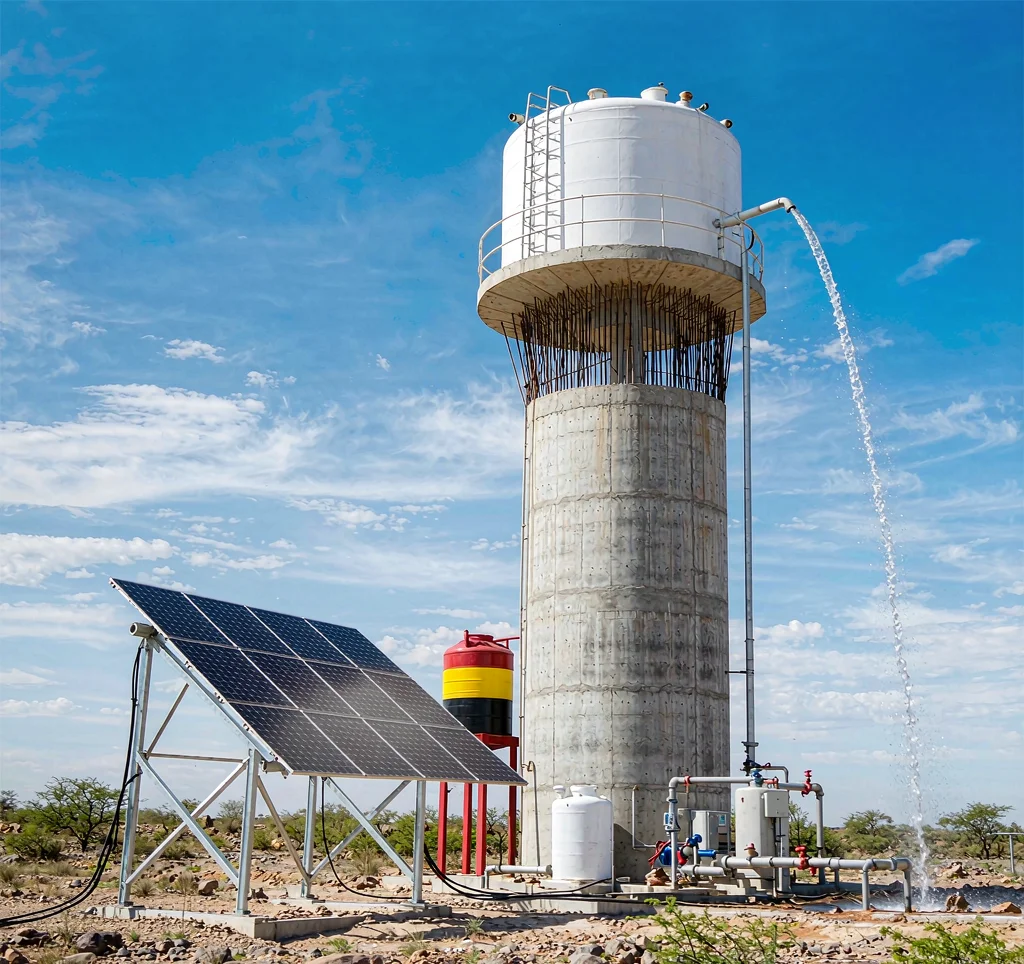
- Plan the storage—pump to a tank at the top and gravity-feed down; this lets a modest solar pump fill slowly through the day instead of fighting peak demand instantly.
Single-Stage vs Multi-Stage
For very high lifts a single impeller cannot reach the needed pressure, so multi-stage (centrifugal) or positive-displacement (helical rotor / diaphragm) pumps are used. The table contrasts the common options.
| Pump Type | Lift Range | Best With | Watch Out For |
|---|---|---|---|
| Single-stage centrifugal | Low–moderate (<30 m) | High flow, surface water | Fails above its head ceiling |
| Multi-stage centrifugal | Moderate–high (30–200 m) | Boreholes, ridge tanks | Sensitive to sand/abrasion |
| Helical rotor (PD) | High (100–300+ m) | Deep wells, steady lift | Lower flow, more torque need |
Pressure Limits and Failure Modes
High-head systems fail in predictable ways. Design against them:
- Closed discharge—if the top tank fills and a valve shuts, pressure spikes; fit a pressure relief or a level switch that stops the pump at full.
- Dry run—in a borehole, low water trips the pump; a dry-run sensor protects the motor and seals.
- Over-speed—on a clear midday with a light load the pump can overspeed; the controller should cap output.
- Abrasion—deep sandy water chews multi-stage impellers; pre-filter or choose a sand-tolerant design.
- Voltage ceiling—long cable runs to a deep pump drop voltage; size cable or step the array to keep the motor in range.
For background on protecting distribution from pressure spikes, see our guide on solar pump water hammer protection and surge control.
Frequently Asked Questions
Can one solar pump lift water 200 metres?
Yes, but it needs a high-head design—typically a multi-stage centrifugal or a helical rotor pump—and a correctly sized array. A standard low-head pump will simply stall at that lift.
Why pump to a tank instead of straight to the tap?
A tank at the top turns a continuous, weather-dependent solar flow into a steady gravity supply. It also lets a smaller pump run all day rather than needing to meet peak demand instantly, which is cheaper and more reliable.
How much extra does friction add to the head?
It depends on pipe diameter, length and flow. Undersized pipe on a long rise can add tens of metres of equivalent head, so size the delivery pipe generously—our pipe diameter and velocity guide explains the trade-off.
Is a deep borehole pump different from a surface high-lift pump?
Functionally similar, but borehole pumps are slim multi-stage units built to sit underwater in a narrow casing, whereas surface high-lift pumps sit above ground. The lift math is the same; the packaging differs.
Related Articles
- Solar Pump Pipe Diameter and Velocity Optimization
- Solar Pump Water Hammer Protection and Surge Control
- Explore KINBO Solar Pump Products
Get a High-Head Solar Pump Specification
Tell KINBO your static lift, required flow, pipe length and water source, and we will specify a multi-stage or borehole solar pumping package that reaches the top reliably—with dry-run, over-speed and pressure protection built in. Contact our team for a tailored quote.
Published by KINBO · September 18, 2026 · Category: Pump Selection Guide