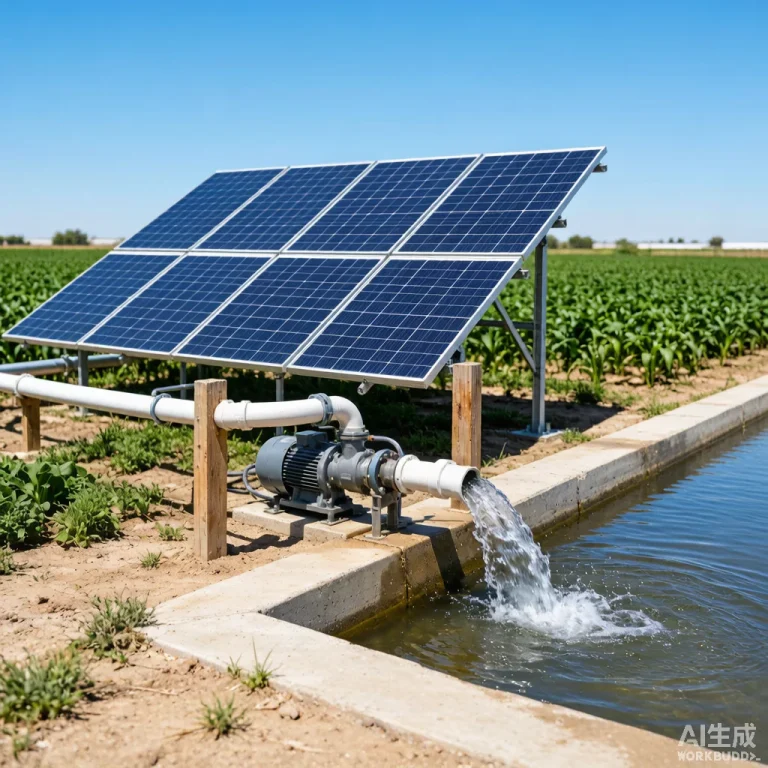
Solar Pump Systems for Gold Mining in Cameroon: Forest-Zone Alluvial Pumping
Introduction
Cameroon’s gold sector is emerging and largely artisanal, concentrated in the eastern forest zone around Batouri, Lomié and the Congo-border corridor, in a country whose grid stops well short of the mining hinterland. Operators pump from rivers and shallow pits with diesel that must be trucked deep into the forest, so solar offers a clean, fuel-free alternative. This article examines solar pump systems for gold mining in Cameroon, written by specialists at KINBO.
Table of Contents
Gold Mining in Cameroon
- Eastern forest zone—alluvial and reef gold around Batouri, Lomié and the Congo-border corridor draws a large informal workforce.
- Artisanal dominance—the sector is mostly manual and small-scale, with pits that move along forest rivers with the seasons.
- Power reality—the grid serves the west and cities; eastern mines depend on diesel delivered over long forest roads.
- Climate—a humid equatorial pattern with a long dry season of good sun and a wet season that demands robust sizing.
Typical Water Duties
Cameroon gold sites share the universal duties our dewatering guide, process-water guide and community-water guide cover: riverbank and pit dewatering, sluice and washing water, camp and community supply, and rehabilitation. Community water matters in forested rural areas with little infrastructure.
A Cameroon-Suited Solar System
- Portable ASM kits—skid-mounted solar pumps that move with the pit and need no fuel or grid, ideal for shifting forest-river sites.
- Dry-season array sizing—size to the long, sunny dry season for maximum output, with a modest battery for the wet season.
- Humid, rugged build—systems made for damp, dusty, unsupervised sites with minimal spare parts.
- Remote monitoring—our remote-operations guide lets a supervisor track scattered interior sites from the coast or cities.
Solar vs Diesel in Cameroon
| Factor | Diesel in Cameroon | Solar in Cameroon |
|---|---|---|
| Fuel logistics | Trucked into forest | Self-powered on site |
| Running cost | High, volatile | Near-zero OPEX |
| Site mobility | Fixed tanks/cans | Portable skids |
| Best fit | Western grid plants | Eastern / forest / ASM |
For the economics, our solar-vs-diesel analysis shows inland Cameroon sites, with hard-to-deliver fuel, typically pay back in 1–3 years.
Frequently Asked Questions
Can solar work where fuel is hard to deliver?
That is exactly where solar wins—eastern Cameroon mines sit far from fuel supply lines, so a self-powered array removes the delivery problem.
Is the system movable for shifting rivers?
Yes—skid-mounted solar pumps relocate with the pit, letting operators follow the ore without fixed diesel lines.
Will solar meet a larger site’s process load?
For continuous process duties, a hybrid solar-diesel system carries the bulk on sun and uses a small generator only as backup, cutting fuel 60–90%.
How do I start in Cameroon?
Define each duty (flow, head, water quality, hours), then we size the array, pump and buffer—our sizing methodology applies directly.
Related Articles
- Community Water Supply for Gold Mines with Solar Pumps
- Solar Pumps for Gold Mine Dewatering in Africa
- Hybrid Solar-Diesel Pump Systems for Gold Mines
- Explore KINBO Solar Pump Products
Get a Cameroon Gold-Mine Solar Pump System
Tell KINBO your Cameroon site’s duties—eastern forest pit, ASM camp, or community borehole—and we will specify a fully off-grid, portable solar pump system built for remote, fuel-scarce interior operations. Contact our team for a tailored quote.
Published by KINBO · September 29, 2026 · Category: Application Cases