
Solar-Powered Emergency Water Supply Systems for Humanitarian Relief and Disaster Response in Africa
Introduction
When crisis hits, water becomes the first lifeline. Displaced communities, drought survivors, and disaster-affected towns need safe water within hours, but fuel for diesel pumps is often unavailable precisely when it is needed most. Solar-powered emergency water supply systems for humanitarian relief and disaster response in Africa remove that bottleneck with portable, fuel-free pumping. KINBO ruggedized units are designed for rapid deployment and easy handling by field teams. This article reviews how responders deploy them, treat the water, and manage logistics in the field.
Table of Contents
Why Relief Operations Need Solar Pumping
Emergency water points must run every day, yet conflict or disaster routinely cuts fuel supply lines and damages grids. A solar pump needs only sunlight, which is abundant across most of Africa even in drought. That independence keeps a clinic, school, or camp supplied when everything else has failed.
Solar also avoids the theft and cost risks of stockpiled diesel, and removes exhaust fumes from crowded camps where air quality matters.
Rapid Deployment in the Field
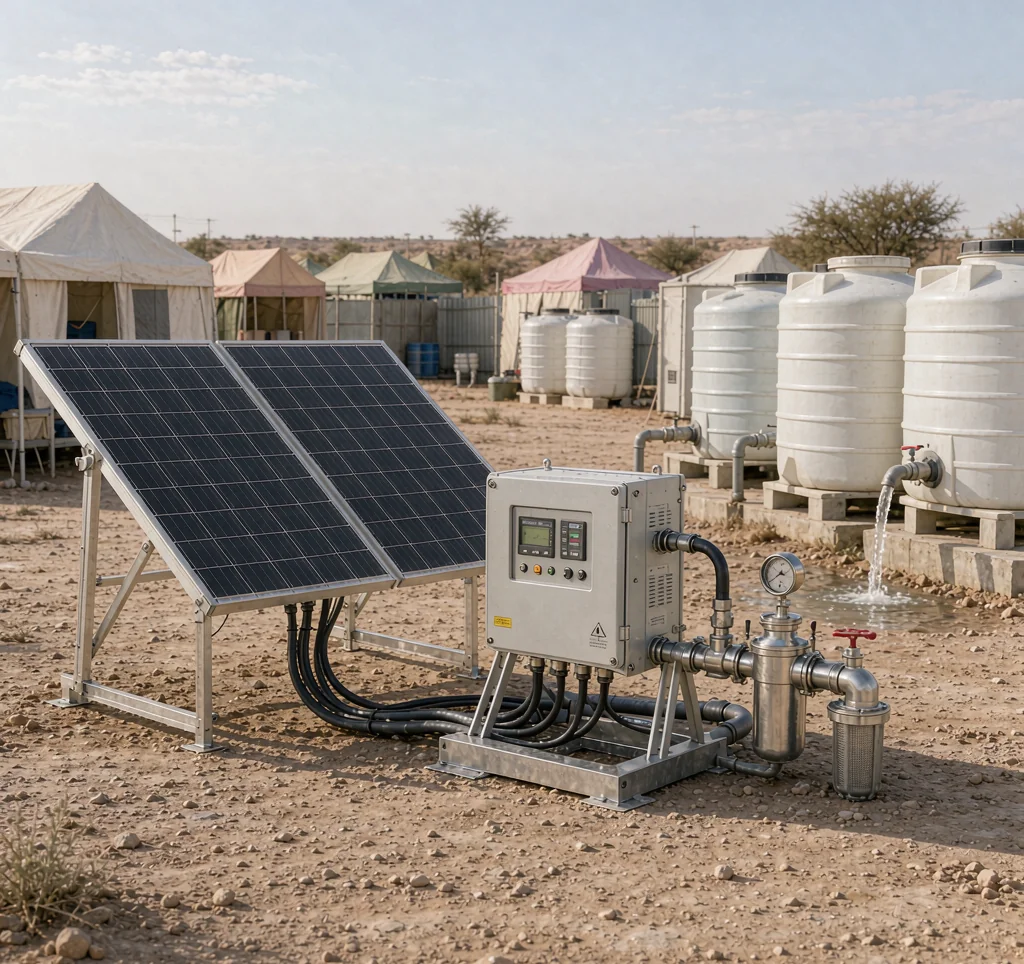
Relief kits are built for speed: a foldable panel, a compact surface or submersible pump, and quick-connect hoses that a small team assembles in minutes. The unit draws from a nearby well, river, or bladder and fills a distribution tank.
| Stage | Solar pump | Diesel alternative |
|---|---|---|
| Setup time | Under 30 min | Longer, needs fuel |
| Daily running cost | Zero | High |
| Fuel dependency | None | Critical |
Pairing Pumps with Water Treatment
Pumping is only half the task; the water must be safe. Relief systems pair the pump with filtration and chlorination or UV treatment before distribution. A water treatment solution integrated at the point of use prevents cholera and other waterborne outbreaks that follow displacement.
KINBO field kits document the treatment chain so responders do not overlook disinfection while focused on volume.
Logistics and Training for Responders
Successful missions standardize equipment so one spare-parts pool serves many units. Training local partners to operate and clean panels extends coverage after international teams leave.
- Pre-position kits at regional hubs for fast dispatch.
- Standardize on one pump family to simplify spares.
- Train host-community operators during the response.
- Monitor tank levels to catch pump or pipe faults early.
Outcomes and Scalability
In practice, solar relief pumps have kept camps supplied through extended crises where diesel rationing would have forced rationing of water itself. After the emergency, the same units often transition into community or school systems, extending their value. That dual-use path is why many agencies now specify solar as the default for water response.
The approach scales from a single camp to a coordinated multi-site response without changing the underlying technology.
Frequently Asked Questions
How fast can a solar relief pump be set up?
A portable kit with quick-connect hoses is typically assembled by a small team in under 30 minutes, drawing from a nearby well or surface source.
Is solar pumping reliable when there is no fuel?
Yes. The pump runs on sunlight alone with no fuel supply chain, which is exactly why agencies choose it when diesel logistics fail during crises.
Does the water need treatment after pumping?
Always. Pumping moves water but does not make it safe; relief systems pair the pump with filtration and disinfection before distribution.
Can relief pumps be reused after the emergency?
Often yes. The same units frequently transition into community or school water systems, extending their useful life well beyond the initial response.
For B2B buyers emergency water supply for relief and disaster response missions, contact KINBO for competitive FOB pricing and technical specifications.
Related Articles
- Solar-Powered Water Supply for African Schools Case Study
- Solar Water Pumps for African Pastoralists
- Explore KINBO Solar Surface Pumps