Borehole Drilling for Solar Pump Installation: Casing, Depth, and Completion Guide
Introduction
KINBO provides technical guidance for borehole drilling specifications that match solar pump installation requirements, ensuring proper fit between well construction and pump deployment.
Table of Contents
Borehole Casing Specifications
The minimum borehole diameter for solar submersible pumps is 100mm (4 inches) for pumps up to 3 kW, and 150mm (6 inches) for larger units up to 11 kW. The casing must extend from the surface to at least 6 meters into competent bedrock. PVC-U casing is standard for depths up to 200m; steel casing is required beyond 200m or in unstable ground.
The annular space between casing and borehole wall must be gravel-packed with clean, rounded silica sand (2-4mm grain size) from the bottom of the casing to at least 3 meters above the pump intake. A bentonite seal above the gravel pack prevents surface water contamination.
Well Development and Aquifer Testing
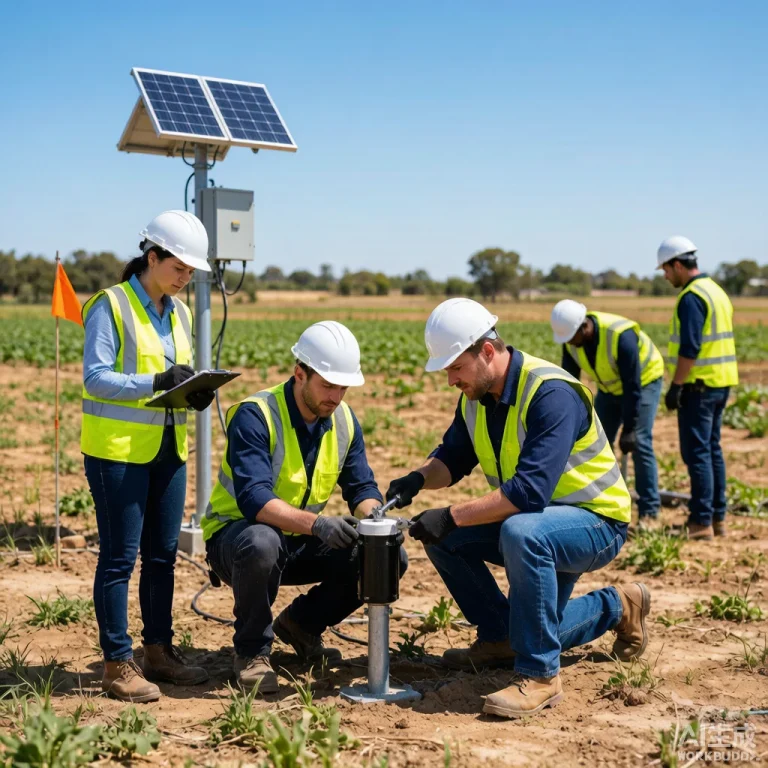
After drilling, the well must be developed to remove drilling fluids and fine sediments. Air-lift development typically requires 4-8 hours of continuous operation until discharge water runs clear with sand content below 50 ppm at the design pumping rate.
A step-drawdown test should be performed: operate at 3-4 progressively higher flow rates for 30-60 minutes each, measuring water level. The data confirms the aquifer can sustain the design pumping rate without excessive drawdown.
Drilling Depth Planning
The borehole depth must accommodate three zones: pump submergence (min 5m below pumping level), sediment settling (min 3m), and sump (min 2m). If the pumping level is at 60m, minimum borehole depth is 70m. In fractured rock aquifers, drilling an additional 10-15m beyond the water-bearing fracture maximizes available drawdown.
| t | a | b | l | e | ||||||||||||||||||
|---|---|---|---|---|---|---|---|---|---|---|---|---|---|---|---|---|---|---|---|---|---|---|
| P | u | m | p | P | o | w | e | r | ||||||||||||||
| M | i | n | i | m | u | m | C | a | s | i | n | g | I | D | ||||||||
| M | i | n | i | m | u | m | B | o | r | e | h | o | l | e | D | e | p | t | h | |||
| T | y | p | i | c | a | l | D | r | i | l | l | i | n | g | C | o | s | t | / | m |
[[‘0.75-1.5 kW’, ‘100mm (4″)’, ’50-80m’, ‘$15-25’], [‘2.2-3.0 kW’, ‘100mm (4″)’, ’60-120m’, ‘$18-30’], [‘5.5-7.5 kW’, ‘150mm (6″)’, ’80-180m’, ‘$25-40′], [’11-15 kW’, ‘150mm (6″)’, ‘100-250m’, ‘$35-60’]]
Frequently Asked Questions
Q: What casing material is best for solar pump boreholes?
A: PVC-U casing is preferred for depths up to 200m due to corrosion resistance and lower cost. Steel casing is necessary for depths beyond 200m or in unstable ground conditions where PVC may collapse under formation pressure.
Q: How long should a borehole be developed before pump installation?
A: Minimum 4-8 hours of continuous air-lift development, or until discharge water runs visibly clear with sand content below 50 ppm. Insufficient development is the leading cause of premature pump wear in new boreholes.
Q: What is the typical borehole lifespan?
A: A properly constructed and developed borehole should last 20-30 years before significant rehabilitation is required. The pump will be replaced 2-3 times during the borehole’s service life. Investing in quality drilling and completion pays back many times over through reduced pump wear and maintenance.
For B2B project planners, contact KINBO for borehole specifications and pump compatibility guidance.
Related Articles