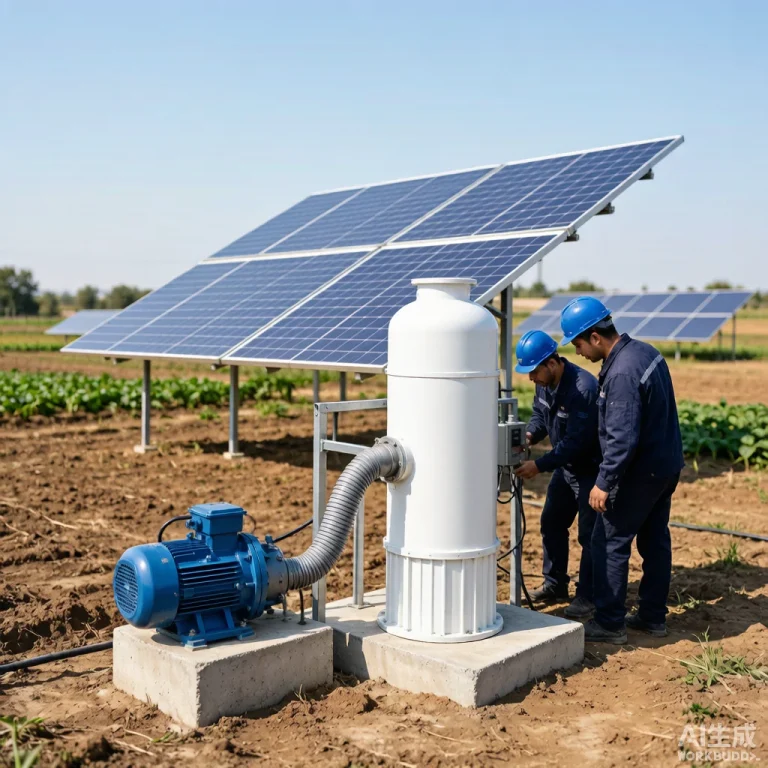
Header Tanks and Booster Pumps for Gold-Mine Solar Pumps in Mali
Introduction
Solar flow is strongest at noon and weakest at dawn, but a gold mine needs steady process water around the clock—so a header tank and booster step in. This article covers header tanks and booster pumps for gold-mine solar pumps, using Mali’s goldfields—the Sadiola and Morila corridors—as the worked example, written by the solar-pumping specialists at KINBO. The tank banks midday solar so the pump and a small booster deliver constant pressure after dark, the hydraulic partner to our pipe-and-fittings guide.
Table of Contents
Why a Header Tank and Booster Matter
- Buffer the sun—the tank stores noon surplus so the duty runs when solar is gone, smoothing the sizing.
- Steady pressure—a small booster on the tank gives constant head to leaching or dewatering, independent of sun.
- Protect the pump—the controller sees a stable load, helped by our pipe-and-fittings guide.
- Cut battery need—a tank is cheaper than cells for overnight buffering, per our TCO guide.
Mali Goldfield Conditions
Mali’s hot, grid-poor gold corridors around Sadiola and Morila need water long after sunset, and diesel is expensive—so a solar-plus-tank buffer is the economical answer. Our dust-and-heat guide and sizing guide frame the duties; here the prize is round-the-clock water from a daytime-only source.
Sizing and Installing, Step-by-Step
- Compute the buffer—from the sizing, size the tank to cover non-solar hours at the duty flow.
- Pick the booster—a small AC or DC pump on the tank delivers constant pressure overnight.
- Route the hydraulics—our pipe-and-fittings guide sizes mains and prevents water-hammer at the booster start.
- Tune the controller—the controller fills by day and the booster tops up by level, not by sun.
- Maintain it—our maintenance guide covers tank cleaning and booster service.
- Verify yield—check overnight delivery against the duty to confirm the buffer holds.
With vs Without a Header Tank
| Aspect | With header tank | Without |
|---|---|---|
| Overnight flow | Yes, steady | Stops at dusk |
| Pressure | Constant via booster | Sun-dependent |
| Cost | Tank beats batteries | Needs storage |
For the cost view, our TCO guide compares tank buffering against battery backup.
Frequently Asked Questions
How big should the tank be?
Big enough to cover the non-solar hours at duty flow from the sizing—usually a few hours of storage, not days.
Do I still need a booster?
For constant pressure after dark, yes—a small pump on the tank does what gravity alone cannot.
Does the tank replace batteries?
For overnight water buffering, largely yes—cheaper than cells, per our TCO guide; keep batteries only for controls.
How do I start a Mali header-tank project?
Share your Sadiola or Morila duty and sun hours, and we size the tank, booster and hydraulics for your pump.
Related Articles
- Pipe Fittings and Hydraulics for Gold-Mine Solar Pumps
- DC/AC Controllers for Gold-Mine Solar Pumps
- Total Cost of Ownership for Gold-Mine Solar Pumps
- Explore KINBO Solar Pump Products
Keep Your Mali Gold-Mine Solar Pump Flowing After Dark
Tell KINBO your Sadiola or Morila duty and sun hours, and we will size the header tank, booster and hydraulics so your pump delivers steady water around the clock. Contact our team for a tailored quote.
Published by KINBO · October 9, 2026 · Category: Application Cases