Solar Pump Stations for District Applications: Designing Community Water Supply Systems at Scale
Introduction
When a single village becomes a district or a group of communities shares supply, a solar pump station – multiple arrays, large tanks and distribution – becomes the right model. KINBO designs station-scale systems for rural districts and peri-urban areas. This article reviews design, capacities, treatment and operation for reliable district water supply.
Table of Contents
What a District Station Is
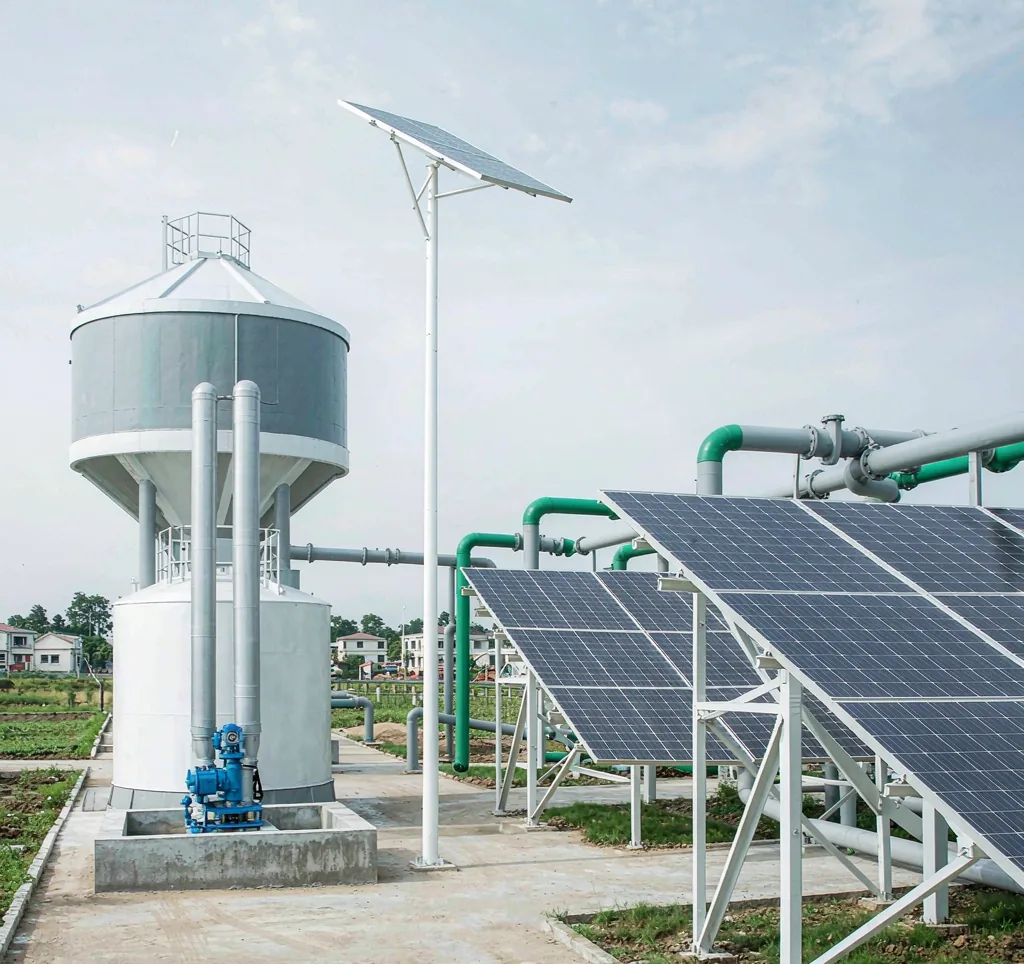
A district station aggregates supply for thousands of people across several settlements, using multiple pump lines, a buffer tank farm and a distribution network. It sits between a single kiosk and a full municipal plant.
This scale unlocks economies: shared O&M, bulk spare parts and centralized treatment.
It also shifts the conversation from a single pump to a resilient water utility.
Unlike a municipal plant, a district station is usually built modularly, so capacity can grow settlement by settlement without redesigning the whole system – a key advantage for funding that arrives in phases rather than all at once.
Station Design Principles
Design for redundancy: parallel pumps and arrays so one fault does not stop supply. Standardize equipment to share spares across the district.
- Modular arrays scaled to demand.
- Redundant pumps in parallel.
- Shared tank farm for buffering.
- Metered zones for fair distribution.
Redundancy costs more upfront but prevents district-wide outages.
Place arrays and tanks to minimize trenching between them, and keep the control room centralized so a single operator can supervise the whole district from one point. Good layout saves more over the project than shaving a few panels.
Capacity and Storage
Size to peak daily demand with margin; oversize storage before panels. The table sketches district tiers.
| Tier | Population | Storage |
|---|---|---|
| Small district | 2,000 | 50 m3 |
| Medium | 10,000 | 200 m3 |
| Large | 50,000 | 1,000 m3 |
Storage is cheaper than panels, so buffer generously before adding array.
Where land allows, building elevated tanks above the highest settlement reduces the pumping head needed to pressurize the network, lowering both energy and panel requirements across the district.
Water Quality and Treatment
District supply must meet drinking standards, so pair pumping with filtration and disinfection. A proven drinking water solution framework keeps quality consistent across zones.
Centralized treatment at the station is far easier to monitor than point-of-use fixes at every tap.
In fluoride- or arsenic-affected regions, pair the station with specific removal units sized to flow, and sample regularly so treatment keeps pace with seasonal source changes rather than being set once and forgotten.
Operation and Maintenance
Train a district operator, fund maintenance from tariffs, and monitor arrays remotely. KINBO documents standardized parts so a region keeps one spare pool.
Remote monitoring turns failures from days-long surprises into same-day fixes.
A simple tariff – even a flat monthly fee – funds a spare-parts fund and a trained operator, turning a donated project into a self-sustaining utility that survives long after external support ends.
Frequently Asked Questions
What is a solar pump station for districts?
It aggregates supply for multiple settlements using parallel pumps, a buffer tank farm and a distribution network beyond a single kiosk.
How much storage does a district need?
Storage scales with population: roughly 50 m3 for 2,000 people up to 1,000 m3 for 50,000, with margin for peaks.
Does district supply need treatment?
Yes. Pair pumping with filtration and disinfection to meet drinking standards across all zones.
How is a district station maintained?
Train a district operator, fund maintenance from tariffs, and standardize equipment so the region shares one spare-parts pool.
For B2B buyers district solar pump station design, contact KINBO for competitive FOB pricing and technical specifications.
Related Articles
- Solar Water Pumps for African Water Kiosks and Pay-As-You-Go Community Water Supply Systems
- Solar Water Supply Systems for Rural Villages in Africa
- Explore KINBO Solar Submersible Pumps