
Solar Water Pumps for African Water Kiosks and Pay-As-You-Go Community Water Supply Systems
Introduction
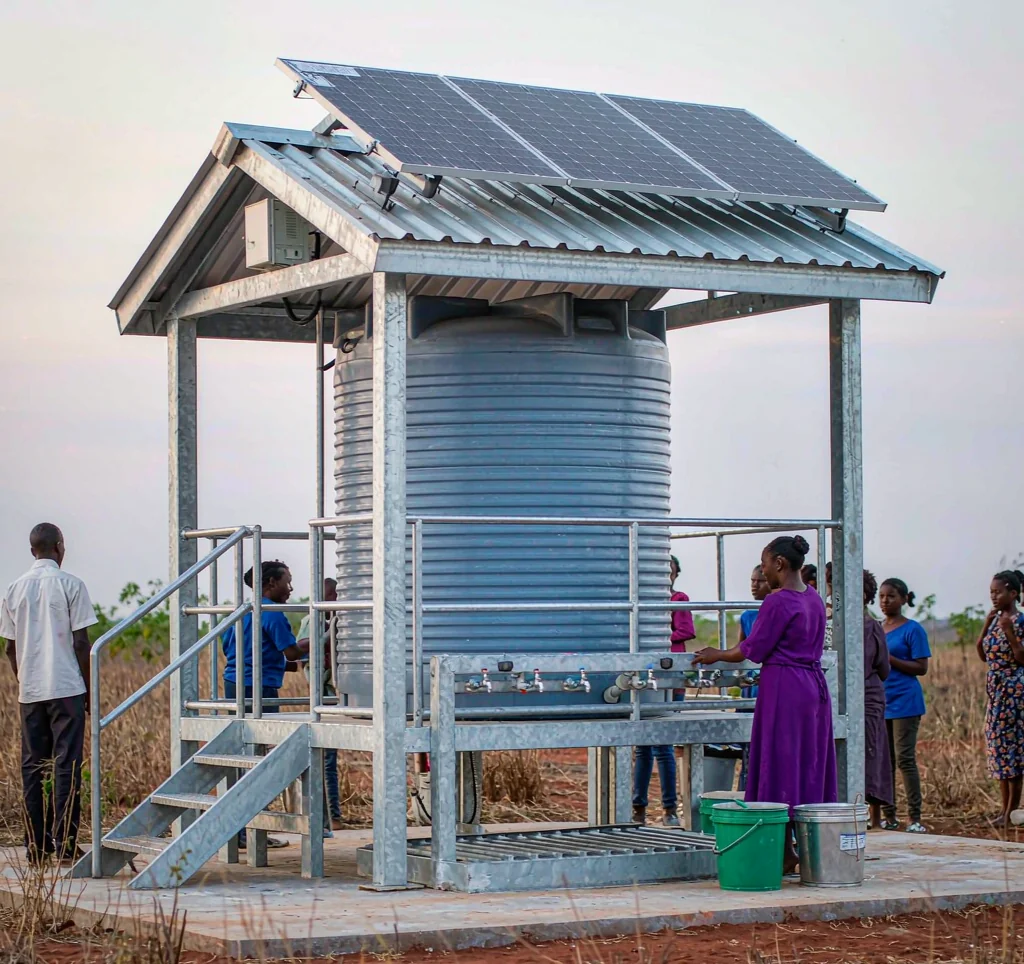
In African towns and peri-urban settlements, the water kiosk has become a trusted point where households buy safe water by the jerrycan. Running that kiosk on grid power is unreliable and on diesel is costly, so solar water pumps for African water kiosks are now the default for new installations. KINBO systems pair a borehole or piped source with a panel array and tank to dispense water through a pay-as-you-go meter. This case study reviews design, the revenue model, and lessons for operators.
Table of Contents
Why Kiosks Need Solar Pumping
A kiosk’s demand is concentrated in daylight hours when households collect water, which maps perfectly onto solar generation. Grid outages leave queues stranded, and diesel erodes the thin margin on low tariffs. Solar removes both risks.
For operators, the appeal is predictable cost: once installed, the sun meters the water for free. That stability is what makes kiosks bankable in underserved areas.
System Design for a Solar Kiosk
A typical kiosk draws from a borehole via a submersible pump into an elevated or pressurized tank, then dispenses through a metered tap. The array is sized so the tank refills within sun hours even on a busy day.
| Parameter | Small kiosk | Medium kiosk |
|---|---|---|
| Daily volume | 5 m3 | 15 m3 |
| Tank | 3 m3 | 10 m3 |
| PV array | 1 kW | 2.5 kW |
Pay-As-You-Go and Revenue Model
Modern kiosks use prepaid meters linked to mobile money, so users pay per litre and operators track revenue remotely. This removes cash-handling risk and funds maintenance from the tariff itself.
- Prepaid meter on the dispensing line.
- Controller logging volume and faults.
- Elevated or pressurized tank for steady pressure.
- Public tap with overflow protection.
Operation and Community Trust
A kiosk only works if the community trusts the water and the price. Regular panel cleaning, transparent tariffs, and visible maintenance build that trust. Operators should anchor standards on a proven drinking water solution framework so quality never slips.
KINBO documentation emphasizes simple operator training so a single local attendant can keep the site running.
Lessons for Scalable Deployment
Across deployments, three lessons recur. First, oversize the tank before the pump: storage is cheaper than extra panels. Second, standardize one meter and pump family so a district shares spares. Third, involve the water committee in pricing to protect trust.
Together these turn a single kiosk into a repeatable, fundable model that scales across towns.
Frequently Asked Questions
How much solar capacity does a water kiosk need?
A small kiosk dispensing 5 m3 per day typically needs about 1 kW of PV with a 3 m3 tank; a medium 15 m3 kiosk approaches 2.5 kW.
Can a kiosk run on pay-as-you-go metering?
Yes. Prepaid meters linked to mobile money let users pay per litre and give operators remote revenue and fault visibility.
Is solar cheaper than diesel for water kiosks?
Over a few years solar wins decisively: there is no fuel cost and far less servicing, so the tariff stays low and stable.
Who maintains a community water kiosk?
Best practice is a trained local attendant plus a small tariff-funded maintenance fund, rather than relying on infrequent external visits.
For B2B buyers community water kiosk deployments, contact KINBO for competitive FOB pricing and technical specifications.
Related Articles
- Solar Water Supply Systems for Rural Villages in Africa
- Solar-Powered Emergency Water Supply Systems for Humanitarian Relief and Disaster Response in Africa
- Explore KINBO Solar Submersible Pumps