
Solar Water Pumps for African Construction Sites: Dust Suppression and Worker Water Supply Applications
Introduction
African cities are building upward and outward at speed, yet construction sites need large, steady volumes for dust suppression, concrete mixing and worker hygiene, often where grid or water mains are absent. Diesel bowsers are costly and unreliable. Solar water pumps for African construction sites now back up these duties with a quiet, fuel-free source. KINBO compact pumps keep water moving with minimal upkeep. This article covers suppression and supply uses, design, and lessons from site deployments.
Table of Contents
Why Construction Sites Need Water
Water on site is time-critical: dust control protects workers’ lungs and neighboring complaints, mixing needs exact volumes, and basic hygiene prevents illness. An outage slows the whole program, so backup must be dependable.
Solar pumping gives a passive safeguard: even if mains or grid drop, the sun keeps the tank filled through the hottest, dustiest part of the day.
Dust Suppression and Mixing Uses
Two duties dominate. Sprinklers and misting cannons need steady pressure for suppression, while batching needs a measured flow into the mixer. Both can share one solar source with zoning.
| Use | Solar Pump | Diesel Pump |
|---|---|---|
| Uptime | High | Fuel-limited |
| Running cost | Low | High |
| Noise on site | Low | High |
System Design for Sites
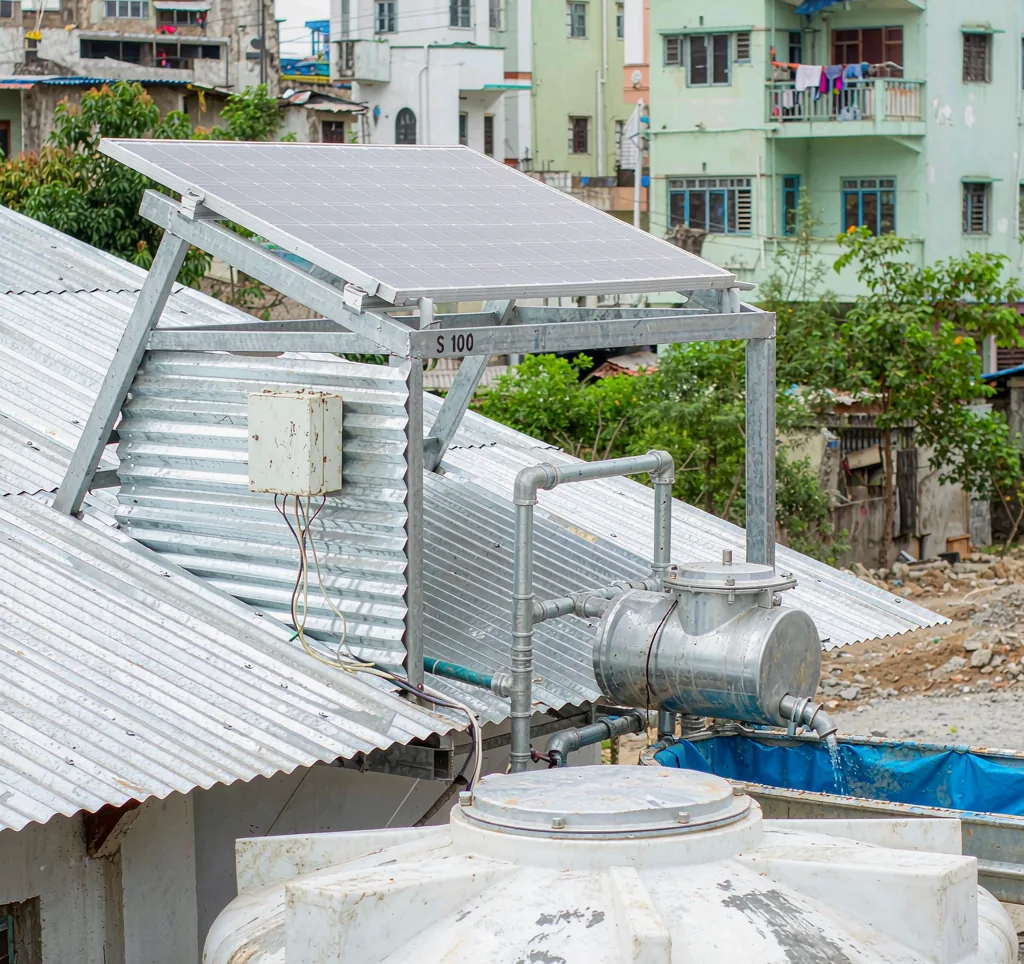
A compact surface pump draws from a tanker-fed tank or borehole into a buffer tank, then pressure lines feed misting and the mixer. Filtration keeps sprinkler nozzles from clogging with site dust.
- Source tank or borehole with float control.
- Surface pump with controller for steady pressure.
- Buffer tank sized to a shift.
- Filtration before suppression nozzles.
Many sites adapt a proven drinking water solution for worker hygiene points too.
Sizing and Mobility
Estimate crew, suppression area and batching volume, then size the pump and array with margin. Because sites move, a skid-mounted kit that reloads onto a truck saves redeployment cost.
- Total daily litres by use.
- Peak suppression flow.
- Total dynamic head.
- Pump and PV with margin.
- Buffer tank for a full shift.
Operation Lessons
Field deployments teach three things. Redundancy matters: a small backup pump prevents a total stoppage. Filtration must be maintained or suppression nozzles clog fast in dust. And training one site hand on panel cleaning and fault checks keeps work flowing.
KINBO‘s simple controller design supports this low-skill maintenance model well on busy sites.
Frequently Asked Questions
How much water does a construction site use per day?
A small site may use a few cubic metres for suppression and hygiene, while a large project with batching can exceed 20 m3 per day depending on scale.
Can solar pumps run dust suppression systems?
Yes. A solar surface pump can feed both misting cannons for dust and the mixer, peaking with the midday heat that raises dust.
Which KINBO pump suits a small site?
A compact surface pump with a built-in controller is usually ideal for a small site, drawing from a tank into suppression and hygiene lines.
Do construction systems need battery backup?
Not always. The buffer tank covers a shift and solar peaks with daytime demand, but batteries help if batching must continue after sunset.
For B2B buyers construction site water and dust systems, contact KINBO for competitive FOB pricing and technical specifications.
Related Articles
- Solar Water Pumps for African Water Kiosks and Pay-As-You-Go Community Water Supply Systems
- Solar Water Pumps for African Health Clinics and Rural Medical Facilities
- Explore KINBO Solar Surface Pumps