Solar Water Pump Trends in 2026: Efficiency, Hybrid Systems and What Buyers Should Prioritize
Introduction
The solar water pump category is maturing fast. What was once a niche for remote off-grid sites is now a mainstream choice for farms, villages, and industry, and the technology is sharpening each year. This brief maps the solar water pump trends in 2026 that buyers should watch. KINBO tracks these shifts closely because they shape what we build and recommend.
Table of Contents
Efficiency Gains
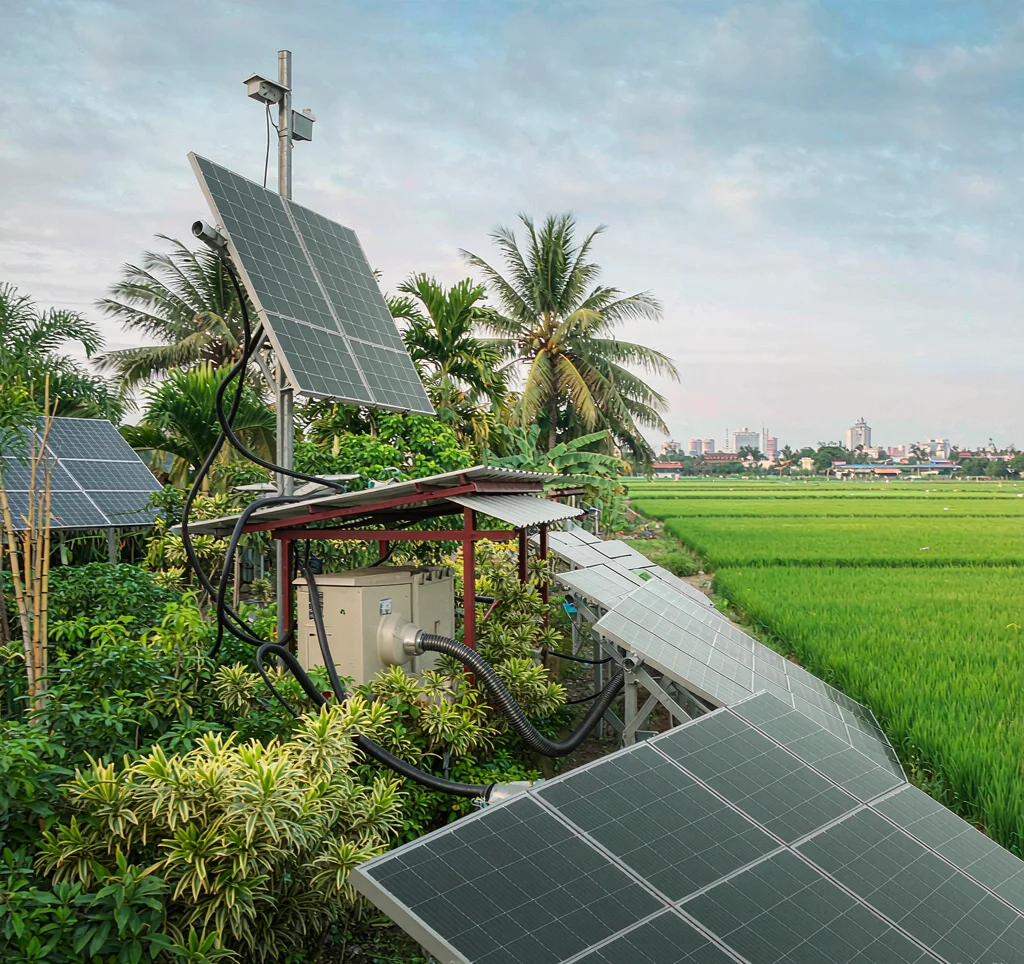
Panels keep getting cheaper per watt and controllers keep squeezing more water per watt-hour. Better MPPT tracking, lower standby losses, and brushless motor designs mean a given array now delivers more liters than it did a few years ago. For the buyer, that translates into smaller arrays for the same duty, or more output from the same roof, which shortens payback. Over a typical system life, those gains compound into meaningful fuel and labor savings compared with older equipment, and lower cost per watt also means hybrid and battery options that were premium a few years ago are now reachable for ordinary farms, widening who can adopt resilient water supply.
The Rise of Hybrid Systems
Pure daytime direct solar is still the leanest option, but hybrid controllers that accept solar plus battery and even grid or generator input are gaining ground. They answer the one weakness of solar: it stops at night. Commercial farms and community supplies increasingly want uninterrupted pumping, and hybrid hardware now does it without bespoke engineering. For the trade-off discussion, see our piece on solar pump battery backup vs direct solar.
| Trend | Buyer impact |
|---|---|
| Higher efficiency | Smaller array, faster payback |
| Hybrid ready | Night and cloudy resilience |
| Connected controls | Remote status, fewer site visits |
| Local service networks | Long-term reliability |
Smarter Controls
Controllers increasingly log faults, report via simple interfaces, and protect the motor with finer parameters. For remote sites, even basic status visibility cuts downtime because a fault is diagnosed before a technician travels. Even modest logging turns a mystery outage into a timestamped event, so the operator knows whether a fault is electrical, hydraulic, or simply a dry source. Expect connectivity to become a default expectation rather than a premium option over the next couple of years.
What Buyers Should Prioritize
- Match the system to the real duty, not a headline wattage.
- Favor proven, serviceable hardware with local support over the cheapest import.
- Decide early whether you need hybrid input; it changes the controller choice.
- Price a season of fuel and downtime when comparing against diesel.
Most of all, treat the purchase as a system, not a pump: array, pipe, tank, and training together decide the outcome far more than any single component’s brand. Buyers who skip training often underuse protective features and blame the hardware when a simple setting would have prevented the fault. The 2026 buyer has more capable options than ever, but the winning choice is still the one sized and supported for the specific site, not the one with the loudest spec sheet.
Frequently Asked Questions
What is the biggest 2026 efficiency change?
Better controllers and motors delivering more water per watt-hour, shrinking the array needed for a given duty.
Are hybrid systems now mainstream?
Rapidly. Hybrid-ready controllers are increasingly standard where night or cloudy resilience matters.
Should I wait for newer tech?
No. Current systems are mature; waiting rarely beats deploying and saving fuel now.
What matters more than specs?
Sizing to duty and local service support, which determine real-world reliability.
For B2B buyers evaluating solar pumping technology and procurement in 2026, contact KINBO for competitive FOB pricing and technical specifications.
Related Articles
- Solar Pump Battery Backup vs Direct Solar
- Solar Water Pump Market in Africa 2026
- Explore KINBO Solar Surface Pumps