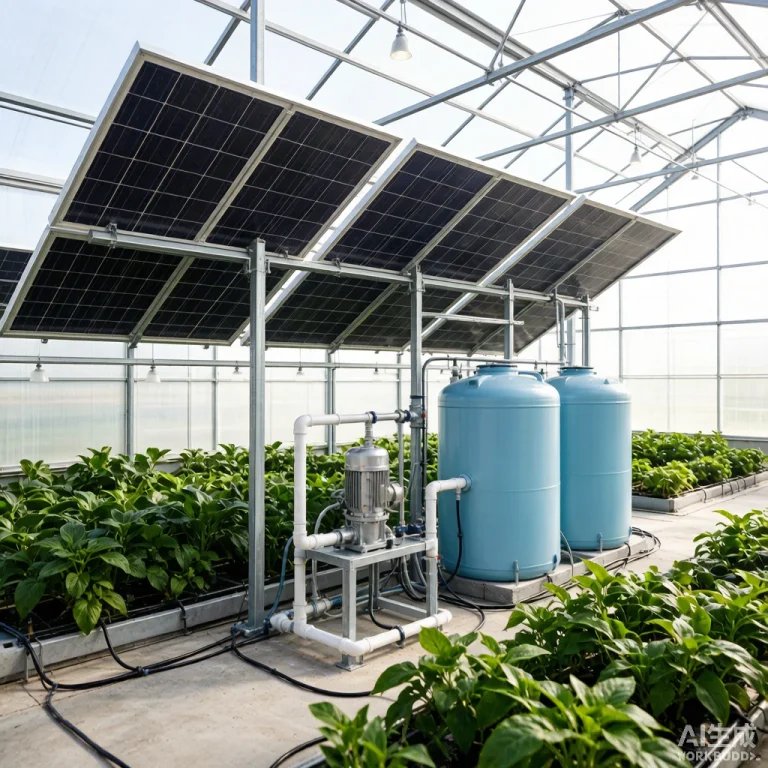
Solar Pump Systems for Gold Mine Vehicle and Equipment Wash Bays
Introduction
Gold-mine trucks and machinery leave the pit or plant coated in ore, clay and dust. If that material is carried off site on wheels and tracks it becomes a fugitive-dust and environmental-control problem—and in many jurisdictions a wheel-wash before the gate is a licence condition. Running a wash bay on diesel is noisy, fuel-hungry and prone to failure at the worst moment. A solar pump delivers the pressure and volume a wash bay needs off-grid, quietly. This article covers solar pump systems for gold-mine vehicle and equipment wash bays, from specialists at KINBO.
Table of Contents
The Wash-Bay Duty
- Wheel and chassis wash—high-pressure rinse to remove ore carry-back before vehicles leave the site boundary.
- Equipment washdown—periodic cleaning of excavators, loaders and screens to control dust and inspect for wear.
- Pressure and volume—wash bays need higher pressure than a garden hose; multiple lanes or guns raise total flow.
- Run pattern—bursty and daytime, ideal for solar; a tank buffer covers gaps between vehicles.
This is distinct from ore washing (our ore-washing guide) and camp sanitation (our sanitation guide)—it is about vehicles, not process or people.
Selecting the Wash-Bay Pump
- High-pressure centrifugal or multi-stage—delivers the bar pressure spray bars and lances need; multistage where the source is a deep bore (our deep-borehole guide).
- Solids handling—wash water is dirty; use semi-open impellers and a settling or recycle loop (our abrasive-water guide).
- Recycle pump—a transfer pump returns settled wash water to the bay, cutting draw on the source.
- Control—a VFD-style solar controller holds pressure as vehicles come and go.
Solar Drive and Recycle
- Array sizing—size to peak wash demand with ~20% headroom; the bursty, daytime pattern suits solar well.
- Buffer tank—an elevated tank smooths pressure between vehicles so the lance never drops off mid-wash.
- Recycle loop—settle and reuse wash water where consent allows, reducing source draw and the load on your bore or river.
Solar vs Diesel Wash Bay
| Factor | Diesel Wash Bay | Solar Wash Bay |
|---|---|---|
| Energy cost | Per run-hour, perpetual | Zero after install |
| Noise / emissions | At the gate, all shift | Silent, clean |
| Downtime | Fuel-out stops the gate | Buffer keeps washing |
| Best fit | Grid-connected sites | Off-grid / remote gates |
A wash bay that stops is a compliance gap at the gate; solar with buffer keeps it running, which matters more than the fuel saving alone.
Frequently Asked Questions
Can solar hold wash-bay pressure?
Yes—an array sized to peak demand plus a buffer tank and VFD control keeps lance pressure steady as vehicles move through; the buffer covers gaps between washes.
What about dirty recycle water?
Use semi-open impellers, a settling pit and abrasion-resistant wet-ends; recycle the clarified fraction to cut source draw, as our abrasive-water guide describes.
Does this satisfy a wheel-wash licence condition?
Solar provides the water and pressure; meeting the condition is about flow, pressure and capture, which the system is sized to. We design to your licence’s stated rates.
Can it share the mine’s other solar?
It shares the array philosophy with dewatering, wash and process duties; our complete system guide shows how to combine them.
Related Articles
- Solar Pump Selection for Gold Mine Ore Washing
- Solar Pump Systems for Gold Mine Camp Sanitation
- Solar Pump Selection for Abrasive and Sediment-Laden Water
- Explore KINBO Solar Pump Products
Get a Solar Wash-Bay Pump
Share KINBO your wash-bay lanes, required pressure and flow, water source and any recycle intent, and we will specify a solar wash-bay pump with the right buffer and control to keep your gate clean and compliant off-grid. Contact our team for a tailored quote.
Published by KINBO · September 23, 2026 · Category: Application Cases