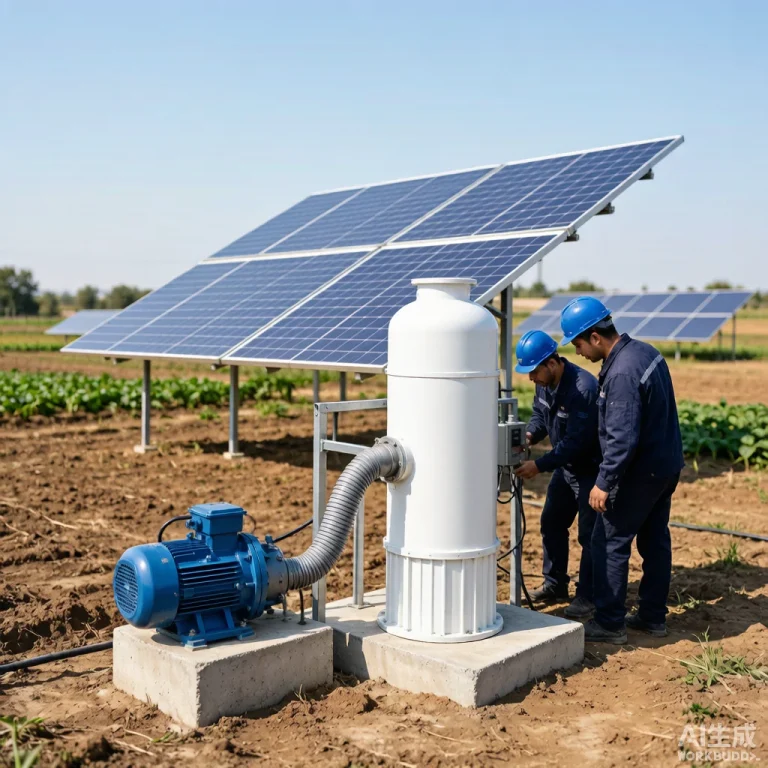
Solar Tracking and Single-Axis Trackers for Gold-Mine Pump Arrays in Egypt
Introduction
A fixed array points at the sun only at noon, but a tracker follows it all day—and for a pump that means more litres before the sun leaves. This article covers solar tracking and single-axis trackers for gold-mine pump arrays, using Egypt’s goldfields—the Eastern Desert and Sukari belt—as the worked example, written by the solar-pumping specialists at KINBO. A tracker lifts yield into the structure and feeds the controller, the geometry partner to our sizing guide.
Table of Contents
Why Tracking Matters
- More sun hours—a tracker holds modules near normal to the sun, lifting daily yield that the pump can use.
- Flatter output—yield stays high across the day, easing the controller and buffer load.
- More water—our efficiency-audit guide counts the extra litres as real recovery.
- Plan the moving parts—our maintenance guide covers the actuator and bearings.
Egypt Goldfield Conditions
Egypt’s Eastern Desert is high-sun and dust-prone, so every extra degree of capture and a clean tracking surface pays back fast. Our dust-and-heat guide and PV-structure guide frame the duties; here the prize is an array that chases the sun instead of waiting for noon.
Adding a Tracker, Step-by-Step
- Re-size the duty—from the sizing, model the higher tracker yield before committing.
- Pick single-axis—it tracks the sun’s east-west path, the cost-effective choice for pump duty.
- Strengthen the mount—the structure carries moving load and wind torque, so it is built heavier than a fixed rack.
- Drive it—a small actuator runs off the same DC bus feeding the controller.
- Monitor yield—monitoring compares tracker vs expected, per our efficiency-audit guide.
- Service it—our maintenance guide stocks actuator and bearing spares.
Tracker vs Fixed Array
| Aspect | Tracker | Fixed |
|---|---|---|
| Daily yield | Higher | Lower |
| Complexity | Moving parts | Static |
| Water | More litres | Fewer |
For the cost maths, our TCO guide weighs tracker cost against extra water and saved array area.
Frequently Asked Questions
Is single-axis enough?
For pump duty, yes—it captures the sun’s daily east-west sweep, which is most of the gain, per our PV-structure guide.
Does it need more maintenance?
A little—actuator and bearings, covered in our maintenance guide; the extra water usually pays for it.
How do I confirm the gain?
Yield logging in monitoring shows the tracker beating the fixed baseline, per our efficiency-audit guide.
How do I start an Egypt tracker array?
Share your Eastern Desert or Sukari duty and we size a single-axis tracker that lifts yield into your controller.
Related Articles
- PV Mounting Structures and Wind Resistance for Solar Pumps
- Gold-Mine Solar Pump Sizing Guide
- Energy Efficiency Audits for Gold-Mine Solar Pumps
- Explore KINBO Solar Pump Products
Chase the Sun on Your Egypt Gold-Mine Solar Pump Array
Tell KINBO your Eastern Desert or Sukari duty, and we will size a single-axis tracker that lifts yield into your controller. Contact our team for a tailored quote.
Published by KINBO · October 19, 2026 · Category: Application Cases