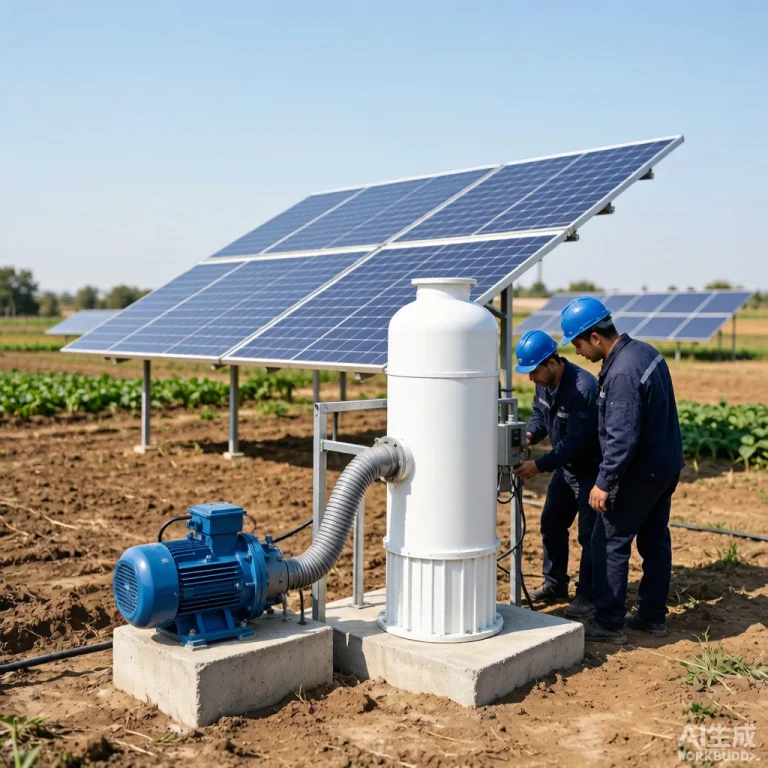
Solar Pump Telemetry and Remote Monitoring Systems: Design Guide for Off-Grid Water Assets
Introduction
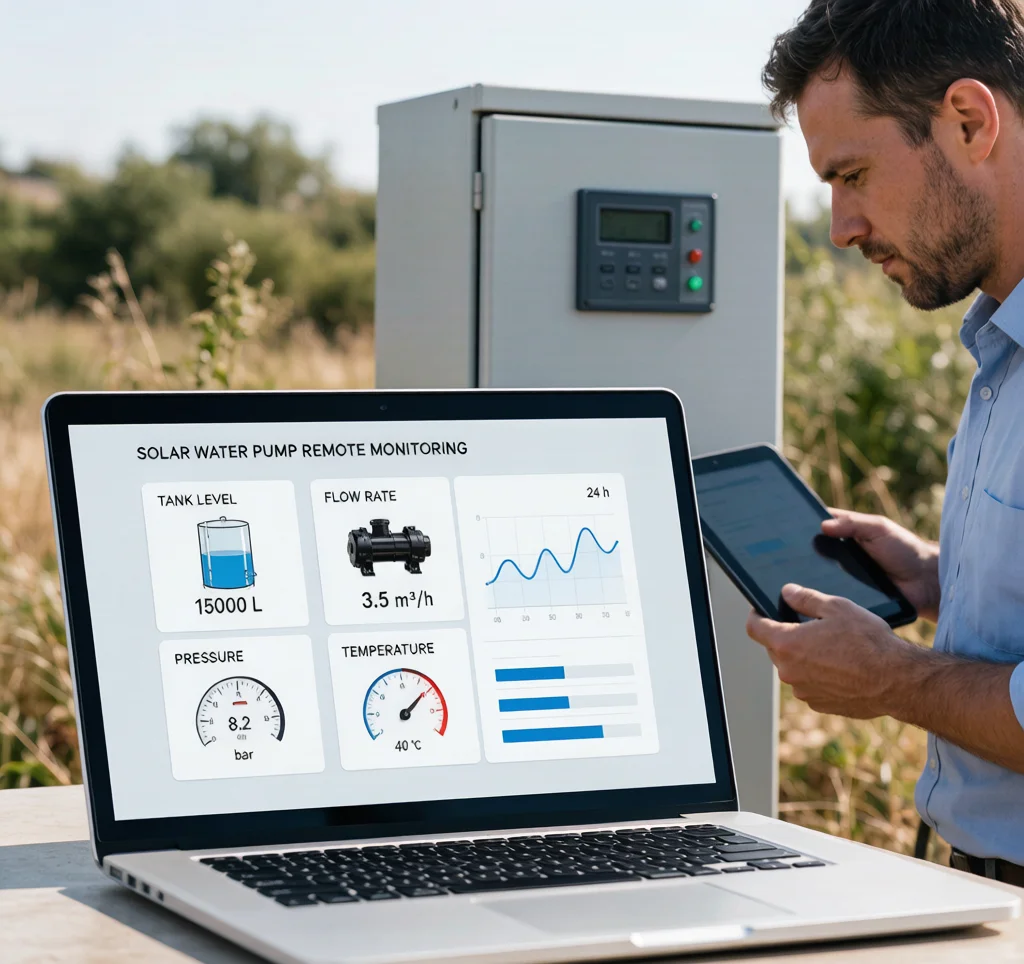
A solar water pump in a remote field runs unattended most of the day. When it stops—dry well, cable fault, clogged strainer—nobody notices until the tank runs dry or the crops wilt. Telemetry closes that gap. Remote monitoring turns a silent pump into a system that reports flow, head, power and tank level to a dashboard, so operators can act before water stops. For B2B buyers running a fleet, telemetry also converts scattered assets into manageable data. This article covers what solar pump monitoring measures, which communication options fit off-grid sites, and how to design a system that survives weak networks. Manufacturers such as KINBO integrate telemetry-ready controllers and sensor ports so monitoring is designed in, not bolted on.
Table of Contents
What Telemetry Should Measure
Monitoring is only useful if the data answers a real question: is water flowing, and if not, why? A practical sensor set covers hydraulic, electrical and environmental signals.
- Flow rate and total volume—the primary output; confirms the pump is doing its job.
- Motor current and voltage—detects dry-run, overload and voltage-drop problems.
- Pump speed / frequency—shows whether the controller is tracking available sun.
- Tank / reservoir level—prevents overflow and reveals demand patterns.
- DC array voltage and power—flags shading, dirty panels or a failing string.
- Fault and alarm status—dry-run, over-temperature, over-voltage events with timestamps.
For controllers to report these values they need matching sensor ports; our guide on solar pump dry-running protection sensors explains how the protection signals are wired and interpreted.
Communication Options for Off-Grid Sites
The network is usually the weakest link. Choose the option that matches local coverage, data volume and cost.
| Option | Best For | Data Load | Constraint |
|---|---|---|---|
| GSM / SMS | Alarms only, 2G/4G coverage | Very low | No rich data |
| NB-IoT / LTE-M | Periodic telemetry | Low | Coverage varies |
| LoRaWAN (local gateway) | Site clusters, no SIM cost | Medium | Needs gateway + power |
| Satellite | True remote, no cellular | Low–medium | Higher hardware cost |
System Architecture and Power
A monitoring node is itself a small off-grid device, so its power budget matters. Three design rules keep it alive:
- Tiny duty cycle—log and transmit in bursts, then sleep; a 5-minute interval is usually enough.
- Independent or shared supply—tap a small DC-DC from the pump’s array, or use a dedicated mini panel and battery.
- Buffer locally—store readings on the device and forward when the network returns, so gaps do not lose data.
KINBO supplies telemetry-ready controllers with standard sensor ports and a documented Modbus-style interface, which lets integrators connect third-party gateways without custom firmware.
Turning Data into Uptime and Savings
Telemetry pays for itself through avoided downtime, not through the dashboard. The table shows typical benefit areas for a fleet.
| Signal | Action Enabled | Benefit |
|---|---|---|
| Flow drop vs. baseline | Clean strainer / check valve | Restore output fast |
| Rising motor current | Inspect for wear / sand | Prevent burnout |
| Frequent dry-run alarms | Adjust level probe depth | Protect motor, staff time |
| Low array power | Clean / re-angle panels | More daily volume |
Note: benefits depend on baseline maintenance practice; fleets with no monitoring usually see the largest gain.
Frequently Asked Questions
Do I need internet for solar pump telemetry?
No. SMS alarms work with basic cellular coverage, and local LoRaWAN logging works with no internet at all, uploading when a gateway is reachable.
Can I add telemetry to an existing pump?
Often yes, if the controller exposes sensor ports or a data interface; otherwise add external flow and current sensors with a separate gateway.
How much power does a monitoring node use?
A well-designed node with burst transmission draws only a few watts; a small dedicated panel and battery is usually enough.
Is telemetry worth it for a single pump?
For one critical pump feeding a community or clinic, yes; the value is protecting a water supply, not just saving on site visits.
For B2B buyers planning monitored solar pumping fleets, contact KINBO for telemetry-ready controllers, sensor options and integration support.