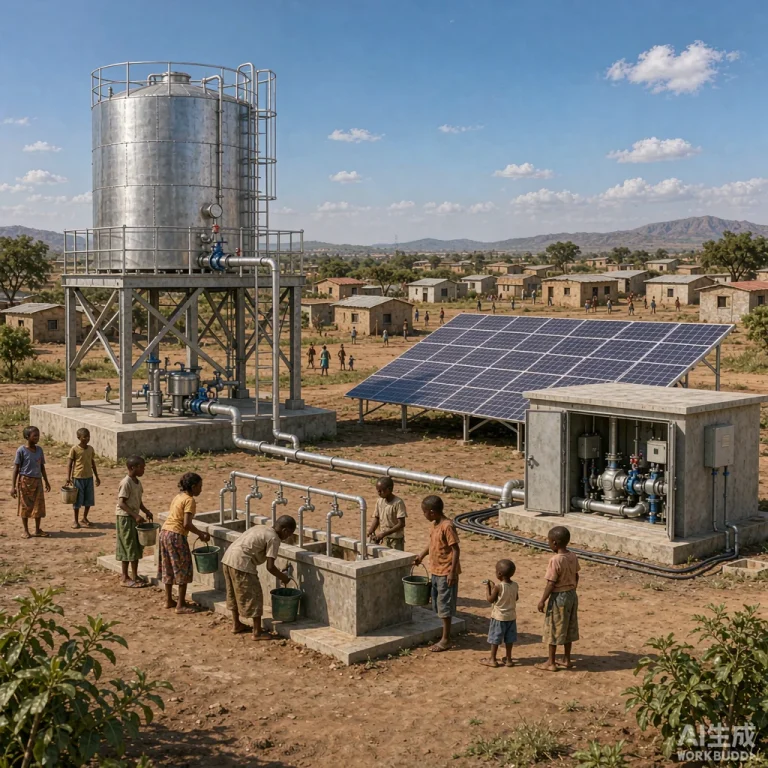
Solar Water Pumps for Community Kiosks and Public Taps: Shared Water Points That Pay for Themselves
Introduction
A shared water point – a kiosk or public tap – turns a solar pump into a community service people can afford and trust. KINBO supports kiosk systems where a single pump serves many households through metered taps. This article covers why shared points work, system design, pay-as-you-go models, governance and long-term sustainability.
Table of Contents
Why Shared Water Points Work
Many households cannot afford a private pump, yet together they can fund a shared one. A kiosk concentrates demand, simplifying operation and maintenance versus hundreds of scattered units.
Solar makes the kiosk viable off-grid, and a tank ensures water is available even when the sun dips. The result is nearer, cheaper, safer water than distant unprotected sources.
A drinking water solution paired with the kiosk protects public health directly.
Kiosk System Design
A pump fills an elevated tank; multiple metered taps draw from it. Submersible from a borehole is common, with treatment upstream of the tank.
| Component | Function |
|---|---|
| Pump + borehole | Source supply |
| Elevated tank | Pressure + buffer |
| Metered taps | Fair distribution |
A water kiosk model details the metered, paid approach that scales across a region.
Pay-As-You-Go Models
Metered, prepaid water lets households pay per litre, removing the upfront barrier and building a revenue stream that funds maintenance.
Mobile money or coin tokens keep collection transparent and low-cost. The key is a price low enough for the poorest yet sufficient to cover spares and an operator.
KINBO sees pay-as-you-go as the difference between a donated white elephant and a self-sustaining utility.
Governance and Trust
A kiosk lives or dies on trust. A clear operator role, published tariffs and a complaint channel prevent the suspicion that kills usage.
Community committees that own the asset and share reports build the legitimacy needed for long life. Transparency around revenue and repairs is non-negotiable.
A district station approach extends this governance to larger shared systems.
Long-Term Sustainability
Sustainability comes from the revenue funded tariff, a trained operator and a spare-parts habit. Without all three, even a perfect install declines.
A maintenance checklist and a small reserve fund turn breakdowns into minor, planned events.
Measure uptime, not just installation – a kiosk that runs 95 percent of the time changes a community; one that fails does not.
Frequently Asked Questions
Why use shared water points or kiosks?
Many households cannot afford a private pump, but together can fund a shared one; a kiosk simplifies operation and maintenance versus scattered units and brings safer nearer water.
How is a kiosk system designed?
A pump fills an elevated tank that metered taps draw from, usually submersible from a borehole with upstream treatment, distributing water fairly and under pressure.
What is pay-as-you-go water?
Metered prepaid water lets households pay per litre via mobile money or tokens, removing upfront cost and building revenue that funds maintenance.
What makes a community kiosk sustainable?
A revenue-funded tariff, a trained operator, a spare-parts habit, transparent governance and a maintenance reserve keep uptime high for years.
For B2B buyers solar pumps for community kiosks, contact KINBO for competitive FOB pricing and technical specifications.
Related Articles
- Solar Water Pumps for African Water Kiosks and Pay-As-You-Go Community Water Supply Systems
- Solar Pump Stations for District Applications: Designing Community Water Supply Systems at Scale
- Explore KINBO Solar Submersible Pumps