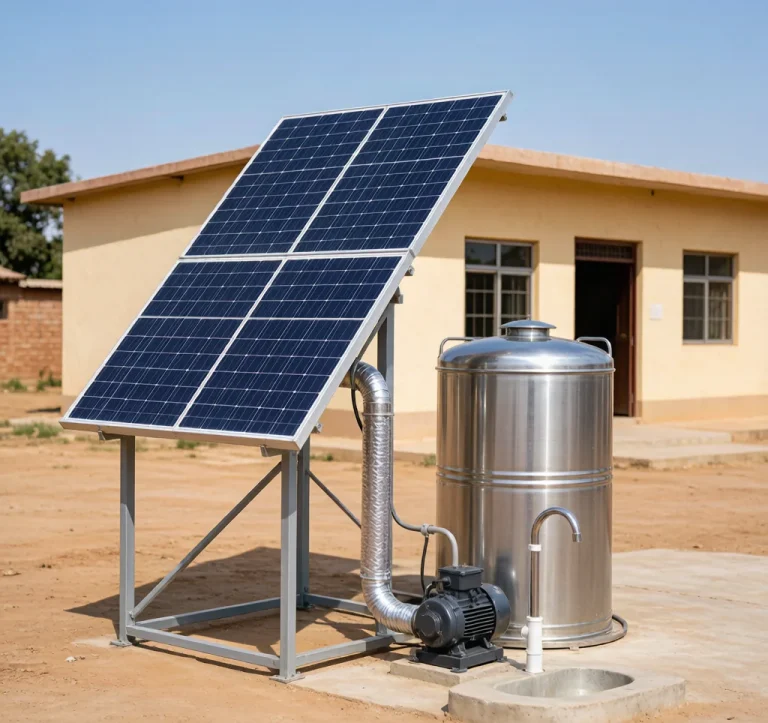
Solar Pump Systems for Gold Mine Dust Suppression
Introduction
Dust is the constant enemy of an open-pit gold mine—haul roads, crusher dumps, ROM pads and stockpiles all throw fines into the air that threaten air-quality licence limits, equipment wear and worker lungs. Suppressing that dust means water, applied continuously along roads and at transfer points, usually by diesel pumps that must run all shift. A solar pump delivers dust-suppression water off-grid, quietly, cutting both the fuel bill and the noise. This article covers solar pump systems for gold-mine dust suppression, from specialists at KINBO.
Table of Contents
The Dust-Suppression Duty
- Haul-road spraying—water carts or fixed spray bars along roads keep fines down; a continuous, daytime duty.
- Crusher and conveyor transfer points—spray at transfer and dump points where dust peaks.
- ROM pad and stockpile—periodic wetting of exposed material.
- Compliance link—dust suppression is tied to air-quality licence conditions; failure is a visible, reportable event.
This is distinct from ore washing (our ore-washing guide) and vehicle wash (our wash-bay guide)—it is about the air, not the product or the fleet.
Selecting the Dust-Suppression Pump
- Centrifugal pump—delivers the volume and pressure spray bars and carts need across the site.
- Mobile and fixed options—a central solar pump feeds a water cart, or fixed pumps serve static spray lines at crushers and belts.
- Solids handling—source water is often turbid; use semi-open impellers and a screen (our abrasive-water guide).
- Control—a VFD-style solar controller holds pressure as the array output varies through the day.
Solar Drive and Recycle
- Array sizing—size to peak suppression demand with ~20% headroom; the daytime, bursty pattern suits solar well.
- Buffer tank—an elevated tank keeps spray pressure steady between cart fills and cloud spells.
- Recycle where possible—some sites recover and reuse suppression water; a transfer pump returns it, cutting source draw.
Solar vs Diesel Dust Suppression
| Factor | Diesel Dust Suppression | Solar Dust Suppression |
|---|---|---|
| Energy cost | Per run-hour, perpetual | Zero after install |
| Noise | Diesel at the pad | Silent, solar |
| Compliance risk | Fuel-out stops spraying | Buffer keeps spraying |
| Best fit | Grid-connected sites | Off-grid / remote pits |
A stopped spray program is an air-quality breach, not just a cost line—so a reliably watered suppression system protects the licence. Our cost analysis quantifies the saving.
Frequently Asked Questions
Can solar hold spray pressure?
Yes—an array sized to peak demand plus a buffer tank and VFD control keeps spray pressure steady as carts fill and clouds pass; the buffer covers gaps.
What about dirty source water?
Use semi-open impellers, a screen and abrasion-resistant wet-ends; recycle clarified water where the site allows to cut source draw.
Does this need to run at night?
Haul-road dust is mostly a daytime duty; a buffer tank carries it through cloud and a daytime-only mine needs no battery. Night operations add a battery or hybrid.
Is this the same as washing ore?
No—ore washing cleans the product; dust suppression protects air quality on roads and at transfer points. Different duties, both solar-served.
Related Articles
- Solar Pump Selection for Gold Mine Ore Washing
- Solar Pump Systems for Gold Mine Vehicle Wash Bays
- Solar Pump Selection for Abrasive and Sediment-Laden Water
- Explore KINBO Solar Pump Products
Get a Solar Dust-Suppression Pump
Share KINBO your road length, spray points, cart fills and source water quality, and we will specify a solar dust-suppression pump with the right buffer and control to keep your gold-mine air-quality compliance off-grid. Contact our team for a tailored quote.
Published by KINBO · September 23, 2026 · Category: Application Cases